
DOI: 10.18441/ibam.26.2026.91.111-130
Brenda Rupar
Freie Universität Berlin, Germany
brendarupar@gmail.com
ORCID ID: https://orcid.org/0000-0001-7630-4068
“– Are you Maoists? If I were Argentine, I would be a Peronist.” This phrase, supposedly uttered by Mao Zedong in response to an Argentine party representative who introduced himself as a member of that current, circulated in national political activism from the late 1960s and has been repeated by sectors of Peronism to this day. While the veracity of this exchange matters little, its reiteration and circulation speak of the significant impact it would have had if it were true.
This statement enables us to examine several critical questions: What connections existed between these two contemporaneous political experiences? What positions did Perón adopt in regards to the Chinese Revolution? Were these positions consistent throughout the period, or do we find turning points during their relationship?
In October 1945, Argentine history witnessed the birth of a political, cultural, social, and economic phenomenon that would permeate its political life to the present day: the Peronist movement. Juan Domingo Perón emerged as leader of a coalition composed mainly of workers, initially structured around his leadership and characterized by members who exchanged autonomy for significant economic and symbolic achievements (James 1990; Torre 2012; Murmis and Portantiero 2011; Doyon 2006). Perón served as Argentine president between 1946 and 1952, was reelected in 1952 until the coup d’état of 1955, and again held the presidency briefly from October 1973 until his death in July 1974. The guiding principles of his policies, particularly during the first governments, were economic independence, political sovereignty, and social justice. The transformations implemented during his initial administrations –by means of import substitution industrialization and the expansion of social and labor rights– left a profound impression on contemporary interpretations. The literature addressing this phenomenon, its debates, and their implications ranks among the most extensive in Argentina, making any enumeration necessarily selective. The economic crisis of 1951-1952 revealed the limitations of this development model. Faced with this scenario, Peronism began to retreat and such instability was exploited by opposition sectors linked to the military forces. In September 1955, these forces overthrew the president, inaugurating a prolonged period of crisis in Argentina.
The overthrowing of Perón in 1955 initiated a period of profound political instability within Argentina, characterized by recurring economic crises, loss of state legitimacy, and escalating social conflicts. This era, which culminated tragically with the civic-military coup of 1976, has generated extensive scholarly attention from diverse disciplinary perspectives. A vast production addresses various and diverse aspects of this complex problem, which remains unresolved due to its close connection with the present. Within this context of institutional crisis, a broad trend toward social and political radicalization emerged amongst significant sectors of the population. However, this transformation proceeded unevenly, manifesting in considerable diversity in scope and intensity across different regions and social groups. It was precisely during this period of radicalization that Maoist organizations were formed in Argentina, and when the influences of the Chinese Revolution and Mao Zedong’s thought began to resonate among numerous intellectuals and political figures –including members of Argentina’s largest political movement: Peronism.
Although Argentina’s diplomatic relations with China dated from 1945, countless interruptions and postponements occurred due to the international and national context. While a Treaty of Friendship was formalized in 1947, its implementation was curtailed by subsequent political instability.2 The triumph of the Chinese Revolution in October 1949 occurred during the first mandate of Juan Domingo Perón’s government, a period commonly characterized as one of the greatest economic and social transformations in Argentine history. In a context where two seats claimed official representation of China, Argentina did not recognize the People’s Republic of China (PRC). Years later, the dictatorship of the self-named ‘Liberating Revolution’, would establish the embassy in Taipei. Meanwhile, commercial ties with Beijing began in 1950 and followed a course that attended to the priorities of the various Argentine governments thereafter.
Following its victory in October 1949, the Chinese government launched an international campaign to build solidarity around its revolutionary project –recognized only by socialist countries–. As part of this, numerous delegations were invited to learn about the Chinese experience (Lovell 2021; Rupar 2020; Hubert 2017; Locane and Montt 2020; Ortega 2020; Johnson 1970; Xu 2006; Ratliff 1972). These delegation visits and training programs became crucial mechanisms through which foreign personalities and organizations encountered –and often embraced– the Chinese revolutionary model. In Argentina, this cultural diplomacy contributed to the ideological framework that was developing among radicalized sectors, providing new concepts and categories derived from the Chinese experience. In this way, cultural diplomacy was constituted as a first moment of approximation and, at the same time, had some impact on the Maoist organizations that would be conformed later. As the Sino-Soviet split deepened, Chinese invitations were increasingly extended to influential political figures from non-communist parties. Throughout the 1960s, leaders from various Argentine political movements, including Peronism, traveled to the PRC, where they were profoundly influenced by the revolutionary experience which they encountered.
The post-1955 period witnessed severe challenges to democratic governance in Argentina. The proscription of Peronism –the country’s most representative political party– combined with recurring military coups, created a sense of exclusion and alienation among an entire generation. Electoral processes appeared increasingly illegitimate, leading many to conclude that preserving established rights whilst advancing new ones demanded autonomous organization and direct action. This domestic crisis coincided with the growing discrediting of Argentina’s traditional left, represented by socialist and communist parties. These organizations had supported or maintained faith in various governments throughout this period, continuing to pursue parliamentary paths to transformation even as their effectiveness diminished. The radicalization process was further catalyzed by international developments that suggested alternative paths to social change. The wave of Asian and African decolonization, combined with the Cuban Revolution’s success, indicated that revolutionary transformation remained possible, providing inspiration for Argentine activists seeking alternatives to failed institutional politics.
Although the Chinese revolution succeeded in 1949, Maoism only emerged as a distinct political trend during the 1960s. This differentiation developed through two parallel processes: the construction of socialism within China after 1949, and the escalating ideological confrontation with the Soviet Union beginning in 1956.3 The Chinese experience was understood and interpreted as a model for certain countries in Asia, Africa, and Latin America.4 Increasingly, the PRC was also assuming a leadership role among the countries of the so-called Third World, positioning itself as better qualified to understand and serve as a guide to revolutionary processes within peripheral societies due to its own recent experience with imperialism and underdevelopment.
Within this context, as debates within the International Communist Movement (ICM) were beginning to transcend national boundaries, various Argentine groups began expressing their dissidence from the organizations of which they were part, whether communist or socialist. The defense of the armed path as the only certain way to achieve social changes became one of the elements that facilitated various sectors’ connection with Maoism. This assertion appeared as definitive and distinctive in a context where access to power via elections was strongly encouraged by USSR think tanks. Such questioning and criticism were formulated from the perspective of a triumphant revolutionary and socialist experience, which endowed the increasingly popular Chinese giant with considerable strength. Within this framework, many characteristics of the Chinese revolutionary process gained even wider dissemination, including protracted people’s war, the theory of New Democracy as a revolutionary program in oppressed countries, the analysis of social classes, and philosophical theses encompassing notions about practice and contradictions that served as guides for revolutionary analysis and influence. The process of the Proletarian Cultural Revolution promoted in the PRC and the direct confrontation with a sector of the party and government appeared as an unprecedented experience in the left. In addition to being a great unifying and propaganda element around the world (Lowy 2002), in Argentina this was a moment of great dissemination of other characteristics of the Chinese revolution.
In this context of growing social and political radicalization in Argentina and increasing global influence of Maoism it was perhaps inevitable that a link would be established (sometimes as dialogue, sometimes as dispute) between Argentina’s majority political movement, Peronism, and Maoism.
For different tendencies within Peronism and for Perón himself, the Chinese experience became a reference that increasingly gained ground, although not in a linear or univocal manner. Despite the recognized ties and mentions of Mao from different sectors of Peronism, we lack a systematization that analyzes these connections. By virtue of this scholarly gap, this work proposes a first approach to the subject. The temporal arc we have established, 1949-1975, spans from the beginning of the Chinese Revolution to the dawn of 1976, the year of Mao Zedong’s death. This framework encompasses the three governments of Juan Domingo Perón and all the years the leader spent in exile following the coup d’état. The course of events and formulations were in close dialogue with both national and international developments, acquiring different meanings and uses that allow us to establish different analytical periods. Firstly, we examine developments between the triumph of the Chinese revolution and the coup d’état against the second Peronist government in 1955. Secondly, we focus on Perón’s years in exile, a period that concludes shortly after Argentina reestablished diplomatic relations with the People’s Republic of China. Here we also observe the emergence of sectors of Peronism that linked with China and the Chinese Revolution outside the direct mediations of the leader. Finally, and more narrowly, we analyze developments after Perón’s return, his third government, and the debates between the Peronist left and more orthodox positions.
The second postwar period and the Cold War constituted the fundamental framework within which both experiences developed their respective projects. Both Perón’s Argentina and Mao’s China emerged as significant political national forces during the early Cold War period, when peripheral countries faced intense pressure to align with either the Soviet or American blocs. As dependent nations, both countries shared characteristics that would later facilitate dialogue and comparative analysis5. The perceived ideological affinity between Perón and Mao largely represents a retrospective construction that gained prominence during the 1960s. This interpretation was fostered both by Peronist intellectuals and by later theoretical work that emphasized the convergent aspects of their respective projects. The intellectual Alcira Argumedo (2017, 38) has argued that Perón’s rise should be understood within a broader pattern of Third World liberation movements. According to her analysis:
October 17 in Argentina in 1945 coincided with Indian independence in 1947, Indonesian independence in 1948 –the same year as Gaitán’s assassination in Colombia and French withdrawal from Vietnam– Mao’s victory in 1949, and in subsequent decades, Nasser’s rise in Egypt, followed by the Cuban and Algerian revolutions. Within this framework, the convergence between Perón and Mao relates to questions of national sovereignty and the concept of ‘people’, which proves more complex and appropriate to peripheral countries than the rigid notion of ‘proletariat’ characteristic of European Marxist tradition.
This interpretation suggests that both leaders drew upon concepts of national liberation that transcended traditional Marxist class analysis, adapting instead to the specific conditions of peripheral societies seeking independence from imperial domination. For Argumedo, national sovereignty and the notion of “people” would function as articulators and approximators of the experiences. Correspondingly, the concept of Third Position, as formulated by Perón and related to the Third World (as conceptualized by Mao Zedong), served as a fundamental connecting mechanism in this construction.
The concept of the Third Position, central to understanding Perón’s later affinity for Mao, requires careful examination of its original formulation and evolution. According to Cecilia Miguez’s recent analysis (forthcoming), Perón first articulated this concept during a 1946 address at the Colón Theater, initially conceiving it as Argentina’s pursuit of international autonomy, particularly in resistance to U.S. influence. Through this formulation, Perón distanced himself from the contending blocs in the Cold War in terms of international relations. However, the promoted ‘justicialism’ entailed the pursuit of humanized capitalism based on class conciliation, which culturally placed it in the Western cultural tradition. Perón himself characterized ‘Justicialist third-worldism’ as an “arithmetic rather than geometric” position, signifying that it was not neutral –possessing foundational principles– and was termed ‘third’ because it followed the first (capitalist) and second (communist) positions rather than positioning itself between them.
As previously noted, the triumph of Mao Zedong’s revolution occurred during Juan Domingo Perón’s first presidential term in Argentina (1946-1951). The diplomatic negotiations, initiated several years earlier, were disrupted by this new scenario, and the Argentine government withheld recognition of the People’s Republic of China.6 Within the Third Position that had been systematized in those years as a bulwark of Argentine foreign policy, supporting such an event which was aligned with the Soviet-led bloc was inconceivable.7 Moreover, Peronism maintained explicitly anti-communist positions and, to consolidate its power base, implemented persecutory and repressive measures aimed at dismantling the Argentine Communist Party, which had achieved significant worker support through sustained organizing efforts since the 1920s (Camarero 2007; Bohoslavsky and Franco 2024). Perón successfully mobilized the majority of the Argentine working class through material and labor improvements and inclusion within a symbolic framework that conferred positive identity –a community that not only embraced them but also discursively positioned them at its center (James 1990). As Ernesto Bohoslavsky and Marina Franco point out, Peronism in government transformed the preceding anti-communism, more strongly linked to the traditional ruling-class conservatism, turning it into a “popular anti-communism, where nationalism was a fundamental value in clear competition with the foreignness associated with communism” (2024, 70).
Despite this positioning against the eastern bloc in general, the Argentine government did not transfer the embassy to Guangdong when requested by the Kuomintang regime, nor did it send an ambassador to Taipei. Following a logic that characterized its relationships with most countries, the PRC government sought to maintain relations through alternative channels whilst facilitating commercial ties beneficial to both parties. The Peronist Third Position also proved to be a propitious tactic for diversifying buyer and seller markets.8 Although Perón maintained fluid exchanges with Chiang Kai-shek, Argentina became among the first countries to establish commercial relations with Beijing in 1950, seeking to circumvent U.S.-imposed economic isolation (Taiana 2022; Oviedo 2010). This period witnessed the initial Argentine exports to the PRC.
These postwar years also saw the systematization of the Third World concept, which emerged as a defining voice of the era. Its formulation by Alfred Sauvy in 1952 for the French magazine L’Observateur provided coherence and international projection.9 Subsequently, it became a structuring axis within the intellectual universe of diverse intellectuals and political forces. Its premises addressed the Cold War context, positioning the Third World as what remained outside the primary contest of latent military geopolitics. However, its political and identity implications were shaped through its intersection with contemporary debates, particularly those concerning peripheral zone development, which at times became synonymous with Third World status. Over time, the PRC developed its own interpretation of this concept, linked to its interests in a new geopolitical configuration.
The 1955 coup d’état fundamentally altered Argentina’s relationship with China. The following period in Argentina was characterized by rapid political changes, with alternating weak civilian governments and military coups. During the self-proclaimed ‘Liberating Revolution’ (1955-1958), bilateral trade with Beijing decreased considerably, and previously established diplomatic negotiations were suspended. Cultural exchanges were also affected– the military government unsuccessfully attempted to block a Chinese artistic mission that performed at the Colón Theater in 1956, citing fears of communist infiltration. In 1957, the military government established relations with the Nationalist Chinese, settling the embassy in Taipei. Regarding connections with the PRC, constitutional president Arturo Frondizi pursued greater international autonomy, which included renewed engagement with China through artistic exchanges and the reactivation of bilateral trade. These negotiations gained significant impulse and consolidation under the government of Arturo Illia (Oviedo 2010).
A novel element of 1955 was the military sectors’ conviction that Peronism and communism represented two interconnected components that needed to be dismantled in order to “heal” Argentine society. This represented a break from earlier interpretations that had seen Peronism as a potential barrier against communist influence. Both the emergence of Peronist Resistance and the triumph of the Cuban Revolution appeared as new evidence for explanations that increasingly linked these movements (Pontoriero 2022).
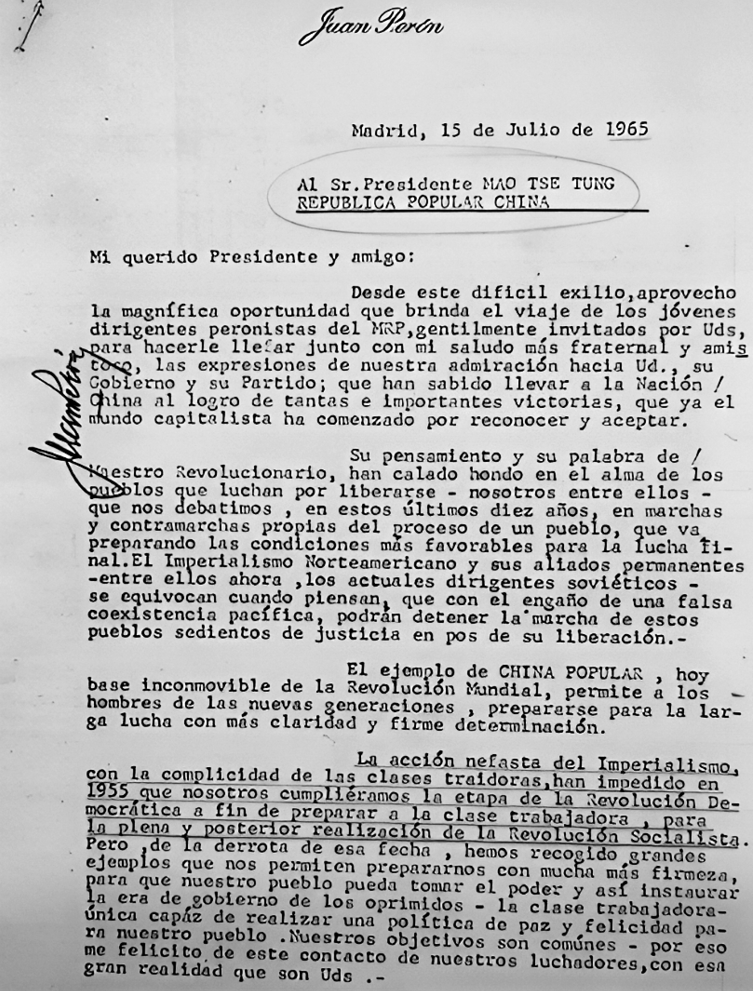
It was within this context of domestic repression and international realignment that Perón’s own positions toward China and Mao began to evolve significantly. From his Madrid exile, Perón’s discourse began incorporating new elements that reflected both his changed circumstances and the evolving international landscape. His first direct reference to the Chinese Revolution, according to Roberto Baschetti (2017), appeared in a March 14, 1965 letter where he offered a stark critique of Western civilization while praising Eastern alternatives. In a particularly striking formulation, he declared that “either we liberate ourselves or the Chinese liberate us […] (Perón in Baschetti 2017, s.p.).
However, it was Perón’s well-known letter to Mao, dated July 15, 1965 in Madrid [image 1], that marked a significant shift in his position. In this letter, Perón explicitly told the Chinese leader that he was taking advantage of “the magnificent opportunity provided by the trip of the young Peronist leaders of the MRP [Revolutionary Peronist Movement]... to convey to you... our admiration for you, your Government and your Party.”10 He immediately acknowledged their shared struggle against “North American Imperialism and its permanent allies –including now the current Soviet leaders [author’s emphasis]”– and dismissed “peaceful coexistence” as deception. Notably diverging from his previous declarations and policies11, he analyzed that “the nefarious action of Imperialism, with the complicity of the traitor classes, prevented us in 1955 from completing the stage of the Democratic Revolution in order to prepare the working class for the full and subsequent realization of the Socialist Revolution.”
The referenced trip involved a delegation of seven Argentines who traveled to the PRC for instruction.12 Carlos Gaitán, a Peronist leader and trade unionist with close ties to Héctor Villalón (one of Perón’s delegates during his exile), led this group.13 The delegation included members from the recently formed Revolutionary Peronist Movement14 and the Revolutionary Nationalist Tacuara Movement, and they remained whitin Chinese territory for five to six months.
One persistent version of this trip suggests that this delegation carried letters from Perón to Chairman Mao. However, when interviewed, both Gaitán and Jorge Rulli (also a Peronist leader) denied being the messengers15 and speculated that the letters arrived through other delegation or diplomatic channels via Switzerland. Roberto Baschetti (2017) revealed that Bernabé Castellano delivered the letter to Zhou Enlai and provided copies to Marcel Niedergang of Le Monde and other European media.
The clandestine nature of the journey reflected the political constraints facing Latin American revolutionaries during the 1960s. Beginning with an undocumented departure from Montevideo, the delegation obtained proper documentation in Geneva before proceeding through Pakistan to Shanghai, where they spent only one day before reaching Beijing. Based at Beijing’s International Hotel, the delegates began an intensive program16. Jorge Rulli explains that the trip’s objective was to receive military training at a school for foreign cadets of the People’s Liberation Army. Their goal was to:
organize a military device that would enable Perón’s return, within the framework of our revolutionary aspirations [...] traveling to China was a way of assuming new responsibilities: that of organizing a military organization in the suburbs that we called FAP [Peronist Armed Forces].17
The training involved long days alternating between physical exercises, military instruction, and theoretical education.18 Both Rulli’s testimony and accounts from other delegations reveal that Chinese leaders emphasized developing their own revolutionary approach rather than exporting a rigid Chinese model. Delegates were instructed to study the Chinese revolutionary experience and then develop strategies appropriate to Argentine conditions. While this guidance might seem to contradict the famous phrase attributed to Mao about Peronism, it could also be considered within the context of informal exchanges. However, verifying the authenticity of such statements is not our primary concern here.
The trip and its theoretical contributions also influenced Gaitán’s understanding of the concept of “people.” He recalls that the Chinese had a dynamic conception of this term. They explained that during the War with Japan, all Chinese, including the Kuomintang, were considered “people.” However, after the triumph of the Chinese Revolution, the “people” no longer included the Kuomintang.19 Similarly, Armando Jaime remembers that the Chinese demonstrated a sophisticated understanding of national issues by connecting them to theories of imperialism20. He points out that these considerations enabled the CCP to develop policies toward both the working-class movement and the national bourgeoisie in anti-imperialist struggles21. Such analysis explained Chinese interest in Peronism as a nationalist movement that had successfully mobilized popular support while maintaining complex relationships with domestic capitalist sectors. “Not only us, but people from various tendencies went. Many Peronists traveled to China!”22 As an interesting anecdote, Gaitán recalls that during the May Day celebration of 1965 in Tiananmen Square, they began singing the Peronist March among the crowd. “There was a CGT delegation there (which we didn’t know about), and when the comrades returned, they informed their colleagues. Everyone was surprised that they had heard the march being sung.”23
These testimonies collectively demonstrate how the Chinese experience provided Argentine radicals with both practical training and theoretical frameworks that would significantly influence their subsequent political development. Although Gaitán later acknowledged that his youthful idealism may have coloured his perception of China, the testimonies reveal that radicalized Peronist sectors drew selectively from multiple revolutionary experiences –Chinese, Cuban, Vietnamese– to construct theoretical frameworks suited to Argentine conditions.
Perón’s evolving position toward China reflects the intersection of multiple factors that fundamentally altered the geopolitical landscape after 1955. His search for both domestic and international alliances coincided with the emergence of the Non-Aligned Movement, where China assumed increasing prominence as a leader of Third World nations seeking alternatives to Cold War bipolarity. Several elements contributed to Perón’s rhetorical transformation. First, increased knowledge of Chinese revolutionary strategy, particularly its approach to the national bourgeoisie in anti-imperialist struggles, offered insights relevant to Peronist politics. Secondly, China’s assertion of independence within the ICM resonated with Perón’s quest for autonomy. This shift also coincided with the growing conflict and eventual split between the CCP and the CPSU (Rupar 2018 and 2023). It’s important to remember that Perón was highly critical of the USSR. Finally, domestic radicalization processes within Argentina, including growing Maoist influence among Peronists, created pressure for Perón to adapt his discourse to maintain relevance among increasingly revolutionary constituencies.
In a 1973 interview with Le Monde newspaper, Perón stated:
[...] last December, Perón affirmed that he would be capable of throwing bombs “if I were fifty years younger.”
Was this a humorous gesture?
– [...] It is true that every revolution, to be realized, must choose between two paths: blood or time [...] I am a pacifist general. An herbivorous lion. But what I wanted to say with the bomb story [...] is that I understand and share the rebellion of youth. This violent rebellion, these guerrilla actions, are a response to the violence of the authorities.24
This formulation demonstrates Perón’s attempt to maintain leadership over increasingly radicalized sectors while positioning himself as a moderating influence. In the same 1973 Le Monde interview, alongside his criticism of peaceful coexistence for not being conducted “in favor of the peoples,” Perón claimed to be a precursor because “the Third Position we have defended is now the slogan of the Third World, which rejects two imperialisms [author’s emphasis].”25 He viewed Chinese national liberation as representing “what Argentina was seeking” –suggesting he saw parallels between Chinese and Argentine experiences of anti-imperialist struggle. He reaffirmed this position in August of that year when, after visiting a Chinese exhibition in Argentina, he declared, “this is Mao’s hour.”26
The 1960s transformation of Peronist ideology reflects broader patterns of political adaptation during the Cold War’s turbulent decade. In Argentina, this coincided with an extended organic crisis that affected Peronism in a distinctive way, since its leader remained exiled and its symbols were banned. Both Perón and various Peronist sectors incorporated elements of Chinese revolutionary thought, although their motivations and interpretations differed significantly. For Perón, Chinese concepts offered tools for maintaining relevance and building international alliances. For some radicalized Peronist youths, Maoism provided theoretical frameworks to understand Argentine conditions and strategies for revolutionary transformation. Whilst these interpretations were not identical and did not share the same strategic direction, such differences did not become prominent until 1973. Until then, we can assert that the Third Position had been reconfigured through its connection to the Third World category, in which both Perón and Peronists placed Argentina. This represented one of the “entry points” for convergence with broad sectors of the contemporary political and social landscape.
The exile period thus represents a crucial phase in Peronist-Maoist relations, characterized by increasing ideological convergence facilitated by shared Third World identity. The combination of delegation visits, correspondence, and evolving discourse created networks of connection that would significantly influence Argentine politics upon Perón’s return.
The early 1970s witnessed a fundamental realignment in international relations that would profoundly affect Peronist-Chinese connections. China’s admission to the United Nations in 1971, followed by President Nixon’s historic visit in 1972, marked the PRC’s emergence from diplomatic isolation and its integration into the global diplomatic community. For the PRC, these events represented the moment when they achieved recognition and (re)established diplomatic relations with most Western countries. Argentina did so on February 19, 1972 (Delpino 2024). From that date forward, formal state diplomatic visits were added to the existing informal connections.
The years 1973 and 1974 were marked by the call for elections and the concrete possibility that Perón would return to the country after many years of exile. In April 1973, the first official contact occurred between the Chinese government and the General, following an invitation extended by the official responsible for Asian commercial affairs at the PRC Embassy in Paris. A month later, on the eve of Héctor Cámpora’s assumption, a delegation from the ‘National Justicialist Movement’ led by Isabel Martínez de Perón visited the People’s Republic of China and the Democratic People’s Republic of Korea to strengthen ties between governments.27
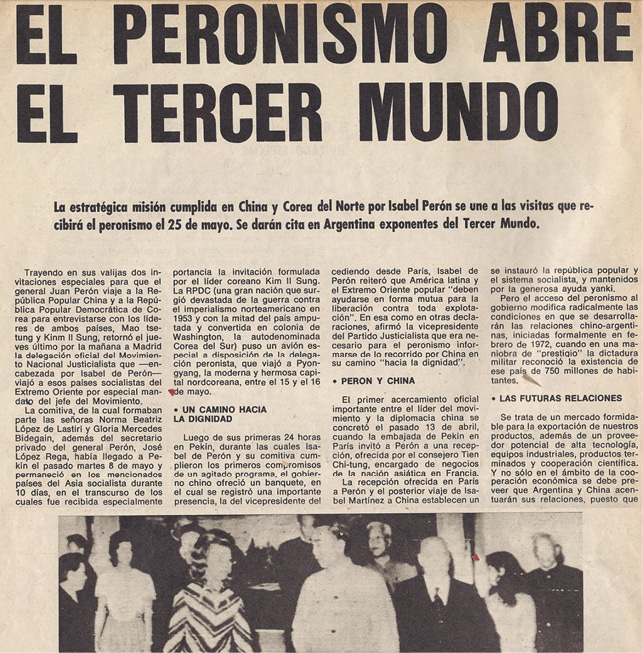
The tour lasted ten days and included José López Rega, Norma López Rega de Lastiri, and Gloria Bidegain. In an interview with El Descamisado, Bidegain emphasized the similarities she found between China’s socialist construction and the revolutionary project proposed by the ‘Juventud Peronista’ (Peronist Youth), of which she was a member: “Their socialism is also a national socialism, since it is not copied from any model and has its own characteristics.”28 It is worth examining the identification she makes based on the idea of socialist construction. By 1973, Peronism encompassed increasingly incompatible tendencies. The radicalization process that gained momentum after 1969 resulted in a major and significant leftist faction within Peronism, led predominantly by youth organizations that combined Marxist thought with the goal of presenting Peronism as Argentina’s true socialist alternative. These groups proliferated during the early 1970s, developing considerable influence within the movement. One of the organizations which held the greatest presence and influence during those years was ‘Montoneros’. They made their public debut by kidnapping and executing General Pedro Eugenio Aramburu in 197029 and managed to gain relevance in various strategic spaces within the Peronist movement and, subsequently, in Cámpora’s government. The delegation’s composition perfectly illustrated these branches: while Bidegain represented the revolutionary Peronist Youth, the other members belonged to Perón’s inner circle, including José López Rega, who would later establish the Argentine Anticommunist Alliance, a paramilitary organization dedicated to eliminating leftist influence. Despite these internal divisions, both Peronist sectors found common ground in Third World identity when approaching China. As Bidegain explained, “we all fight for a homeland where social justice, economic independence, and political sovereignty reign [...] and we all belong to the Third World.” 30
The Third World framework also gained institutional expression in educational spaces that proliferated during this period. The Chair of National and Popular History at the National and Popular University of Buenos Aires exemplified this trend by including both Perón and Mao in its 1973 booklet The Method of Leadership. Both leaders were understood to “establish a broad field for common problems by recognizing as the center of theoretical reflection in Third World countries the construction of a political leadership framework in which the working popular masses of both countries see themselves reflected, referred to, and identified.” 31
The shared framework temporarily obscured deeper ideological incompatibilities. Perón’s 1973 response in the Le Monde interview captures many of the tensions developing during those years. The question certainly sought to position him regarding revolutionary violence. Perón elegantly attributed the attacks to the rebellious nature of youth responding to violence “from the authorities.” For himself, he reserved the characterization of being a “pacifist [military] general” who chooses time over bloodshed (issues that had been present since the dawn of the 1955 coup, when he was offered the opportunity to organize resistance against it), marking a distance and seeking to (re)position himself in the leadership of the movement. However, the differences with the so-called ‘Peronist left’ were not exhausted in these declarations.
The convergences masked deepening tensions that would soon explode into open conflict. Upon Perón’s return and assumption of the presidency in October 1973, conservative sectors began systematically challenging and then repressing these leftist wings.
The expulsion of the ‘Montoneros’ column from the Plaza de Mayo demonstration in 1974 represents a key moment in reinforcing Perón’s leadership within the movement. Shortly afterwards, the ‘Montoneros’ decided to go underground and transform themselves from a Politico-military organization (PMO) into a political party. These decisions also allow us to focus on the debates within these organizations and the competing interpretations of Peronism and national history.
In the Curso de formación de cuadros del Partido Montonero, which began to be elaborated in 1975 and was completed in April 1976 after revisions which were prompted by the transformation into a Party, they analyzed the “exhaustion of Peronism in its traditional format” and the need to account for the new political moment. Their conversion from PMO to Party was developed with numerous implicit references to Mao (and also to Clausewitz). According to Guillermo Caviasca’s analysis (2018), the Manual’s training sessions also revealed the extent of this strategic transformation: “the instructor elaborates on the organization’s history, the exhaustion of Peronism (at least traditional Peronism […]), civil war, how annihilation is being avoided and the offensive is being prepared […]”. For the author, it is clear that an such approach signaled Montoneros’ adoption of protracted people’s war strategy, abandoning their earlier insurrectional approach in favour of Maoist concepts of gradual territorial conquest.
These allusions did not go unnoticed and were even criticized by the renowned journalist and intellectual who had joined ‘Montoneros’, Rodolfo Walsh. In his ‘Papers’,32 Walsh’s critique targeted both the timing and fundamental logic of this strategic shift. He pointed out that it had been a premature error to propose the “exhaustion of Peronism” and that the problem was fundamentally understanding the issue in military rather than political terms,33 since “although we criticize militarism, the entire document seems like a recipe for one Army to break another’s siege and then defeat it,” outside the mass movement.34 According to him, they were making a mechanical copy of Vietnamese and Chinese experiences without understanding that “in our country it is the Movement that generates the Vanguard, and not the reverse...” and that by ignoring the Peronist movement that had engendered them, they would have to undertake the task of building a ‘Montoneros’ movement.35
In summary, he argues that:
The party line and the documents that express it over the last 18 months reveal [referring to June 1975], in my judgment, a strong influence of Maoist thought in the political aspect and Clausewitz’s doctrine in the military aspect. Obviously, this is not about questioning the utility of instruments that rest on fundamental experiences, but rather seeing them as historical products. From this vision emerges the necessity of our own historical product.
Once this necessity is established, the main deficiency of “Montoneros thought” becomes clear: a deficit of historicity.36
This criticism went beyond tactical disagreements to challenge the organization’s theoretical foundations, arguing that their mechanical adoption of foreign models reflected an inability to understand Argentine historical specificity.
It is important to note that Perón’s disagreements with ‘Montoneros’, as well as criticisms arising within the Peronist left itself, revolved around conceptions of violence –especially after the country’s democratic restoration– and also around assessments of the USSR. While one sector of the Peronist left regarded that socialist experiment favorably, another criticized it as an “importation of foreign ideas,” stressing the need to pursue genuinely national paths (namely, Peronism), and yet another reaffirmed its most intransigent anticommunism. These three trends, as noted, became more pronounced after Perón’s death in July 1974, largely characterizing the period that culminated in the final civil-military dictatorship of March 1976.
Mao Zedong and Juan Domingo Perón came to power at roughly the same time in two peripheral countries during the Cold War era. In this article, which represents a first approach to a complex set of issues, we have examined different moments in the evolving relationship between Juan Domingo Perón and Mao Zedong and Maoism. The focus was to observe the positions of Perón and Peronism towards the Eastern experience.
The initial phase (1949-1955) illuminated the limitations of ideological frameworks in determining practical policy. Perón was governing Argentina when the Chinese Revolution triumphed. His government, like most Western countries, did not recognize the newly established People’s Republic of China. Furthermore, his political identity had been strongly built on anticommunist rhetoric. Despite this reluctance, mutual necessity led to the beginning of commercial exchanges with China in 1950. This contradiction may suggest that peripheral nations’ foreign policy choices were driven primarily by material necessities rather than ideological consistency.
The exile period (1955-1973) witnessed a transformation, driven by multiple intersecting factors. After his overthrow and nearly two decades of exile, Perón’s statements about Mao began to change. This shift happened as new connections formed through trips and training courses that various Peronist leaders took in China, alongside the growing influence of Chinese experiences and Mao Zedong’s writings in Argentina. These changes took place in a country already experiencing intense political and social upheaval that challenged the established order –a nation grappling with economic crises, political instability, and limited democratic freedoms. Large sectors of Peronism found themselves drawn to the Chinese experience and influenced by its theoretical and practical approaches. Perón did not oppose these sectors and sometimes even encouraged them. The shared interpretation of both countries as part of the Third World struggling for independence and autonomy seemed to provide a unifying framework that accommodated different tendencies for several years. However, deep differences crystallized during Perón’s third term in office and even more so after his death.
Perón’s Third Position in international relations was initially developed as a strategy to maintain equidistance from the ideological competition between the USSR and the United States, while preserving autonomy for bilateral trade with any country. Over time, both Perón himself and various theorists and intellectuals began to connect this concept with the Third World framework that Mao Zedong was developing.
To conclude, what do Perón’s affirmations and recognition of Mao from 1965 onward actually mean? Which Mao and which China was Perón envisioning? It seems that despite the presence of sectors –particularly among the youth– who emphasized the connections between Marxism and Peronism and characterized the latter as Argentina’s unique form of socialism, Perón’s statements were primarily focused on drawing from the Chinese experience its international positioning, its defense of national sovereignty, its opposition to both the United States and the USSR, and its collaborative approach in forums bringing together countries from Asia, Africa, and Latin America.
Argumedo, Alcira. 2017. “El Tercer Mundo.” Dangdai. Primera revista de intercambio cultural Argentina-China 20: 38.
Baschetti, Roberto. 2017. “Mao y Perón. Paradigmas de una Tercera Posición.” Revista DangDai, Primera revista de intercambio cultural Argentina-China, December 12. https://dangdai.com.ar/2017/12/12/mao-y-peron-paradigmas-de-una-tercera-posicion/.
Bergel, Martín. 2019. “Futuro, pasado, y ocaso del ‘Tercer Mundo’.” In El futuro: miradas desde las Humanidades, edited by A. Kozel, M. Bergel, and V. Llobet, 108-125. Buenos Aires: Universidad Nacional de San Martín.
Bohoslavsky, Ernesto, and Marina Franco. 2024. Fantasmas rojos. El anticomunismo en la Argentina del siglo xx. Buenos Aires: Universidad Nacional de San Martín.
Camarero, Hernán. 2007. A la conquista de la clase obrera. Los comunistas y el mundo del trabajo en Argentina, 1920-1935. Buenos Aires: Siglo XXI.
Caviasca, Guillermo. 2018. “Rodolfo Walsh, Rosas y Mao.” Rebelión. https://rebelion.org/rodolfo-walsh-rosas-y-mao/.
Dandan, Alejandra, and Silvina Heguy. 2006. Joe Baxter: Del Nazismo a la Extrema Izquierda: La Historia Secreta de un Guerrillero. Buenos Aires: Norma.
Delpino, María Florencia. 2024. El establecimiento de las relaciones diplomáticas con la República Popular China. Buenos Aires: Imago Mundi.
Doyon, Louise. 2006. Perón y los trabajadores. Los orígenes del sindicalismo peronista, 1943-1955. Buenos Aires: Siglo XXI.
Goebel, Michael. 2015. Anti-Imperial Metropolis: Interwar Paris and the Seeds of Third World Nationalism. Cambridge: Cambridge University Press.
Hubert, Rosario. 2017. “Intellectual Cartographies of the Cold War. Latin American Visitors to the People’s Republic of China, 1952-1958.” In The Routledge Handbook of Literature and Space, edited by Robert Tally, 337-348. New York: Routledge.
Infobae. 2017. “Carta de Perón a Mao”. Diario Infobae, July 8.
James, Daniel. 1990. Resistencia e integración: el peronismo y la clase trabajadora argentina, 1946-1976. Buenos Aires: Sudamericana.
Johnson, Cecil. 1970. Communist China and Latin America, 1959-1967. New York: Columbia University Press.
Locane, Jorge, and María Montt. 2020. “El viaje América Latina-China. Una interacción sur-sur sui generis.” Transmodernity 9: 1-5.
Lovell, Julia. 2021. Maoismo. Una historia global. Barcelona: Debate.
Lowy, Michael. 2002. “The Revolutionary Romanticism of May 1968.” Thesis Eleven 68.
Míguez, María Cecilia. forthcoming. “La Tercera Posición y sus matices.” In Ministros con historia: vida y política de los cancilleres de la Argentina, 1852-2023, edited by Beatriz Figallo and María Cecilia Míguez. Buenos Aires: Imago Mundi.
Murmis, Miguel, and Juan Carlos Portantiero. 2011. Estudios sobre los orígenes del peronismo. Buenos Aires: Siglo XXI.
Nassif, Silvia, and Brenda Rupar. 2016. “Aproximación al estudio de las luchas de la clase obrera a fines de los ‘60 y principios de los ‘70.” In Movimiento obrero argentino. Aspectos y momentos históricos de la lucha política y sindical, edited by Cristina Mateu and Claudio Spiguel, 89-112. Buenos Aires: La Marea.
Ortega, Jaime. 2020. “Los Dragones y los ríos: los viajeros latinoamericanos en la China ‘roja’.” Ciencia Nueva, Revista de Historia y Política 6, no. 1: 142-160.
Oviedo, Eduardo. 2008. “Reconstruyendo el inicio de las relaciones diplomáticas entre Argentina y China.” Revista Iberoamericana de Estudios de Asia Oriental 1: 23-52.
— 2010. Historia de las Relaciones Internacionales entre Argentina y China 1945-2010. Buenos Aires: Dunken.
— 2015. “Argentina, China y el ‘caso Acuario’. Entrevista al embajador Vicente Ernesto Berasategui.” Revista Temas y Debates 19, no. 30.
Potoriero, Esteban. 2022. La represión militar en Argentina (1955-1976). Buenos Aires: UNGS/UNLP/UNaM.
Rapoport, Mario. 1988. “La posición internacional de la Argentina y las relaciones argentino-soviéticas.” In Argentina en el mundo 1973-1987, edited by Rubén Perina and Roberto Russell, 171-207. Buenos Aires: Grupo Editor Latinoamericano.
Ratliff, William. 1972. “Communist China and Latin America, 1949-1972.” Asian Survey 12, no. 10: 846-863.
Rupar, Brenda. 2018. “El debate chino-soviético y la emergencia del maoísmo como corriente política diferenciada en el Movimiento Comunista Internacional.” Historia Contemporánea 57: 559-586.
— 2020. “Viajeros argentinos a China en el marco de la ‘Diplomacia entre pueblos (1950-1965)’.” Cahiers des Ameriques Latines 94: 203-227.
— 2023. Los ‘chinos’. La conformación del maoísmo en Argentina (1965-1974). Buenos Aires: Imago Mundi.
Stavale, Mariela. 2012. “Las Fuerzas Armadas Peronistas y su experiencia alternativa (1964-1979).” BA thesis, Universidad Nacional de La Plata. http://www.memoria.fahce.unlp.edu.ar/tesis/te.705/te.705.pdf.
Taiana, Francisco. 2022. Argentina, China y el mundo (1945-2022). Buenos Aires: UNQ.
Torre, Juan Carlos. 2012. Ensayos sobre movimiento obrero y peronismo. Buenos Aires: Siglo XXI.
Walsh, Rodolfo. 1979. “Los papeles de Walsh.” Cuaderno del Peronismo Montonero Auténtico. https://upcndigital.org/~ciper/Material/otras/FolletoPapelesWalsh.pdf.
Xu, Shicheng. 2006. “Las diferentes etapas de las relaciones sino-latinoamericanas.” Nueva Sociedad 203: 102-113.
Manuscript received: 14.04.2025
Revised manuscript: 02.10.2025
Manuscript accepted: 04.11.2025
1* This article is based in part on research conducted during a postdoctoral fellowship at the Lateinamerika-Institut, Freie Universität Berlin. I gratefully acknowledge the Alexander von Humboldt Stiftung for its generous funding support.
2 Eduardo Daniel Oviedo (2008) reconstructs the temporalities and addresses what he calls errors in the periodization of the ties. We also recommend a deeper engagement with Taiana (2022).
3 During this period, the debate between the CPSU and the Communist Party of China (CCP) gained momentum, with the latter rejecting the Soviet approach of peaceful coexistence and a peaceful transition to socialism. As these controversies unfolded, the distinct contributions of the Chinese current gradually came to the fore. While initial emphasis was placed on the strategy through which power had been secured –namely, a protracted people’s war based on the peasantry and the encirclement of cities from the countryside– over time, and without negating this experience, greater weight was given to Mao Zedong’s theoretical interventions. These were regarded as marking a new stage in the evolution of Marxist theory, particularly his insistence on the persistence of class struggle under socialism and, later, his characterization of the USSR as ‘social-imperialist’ (Rupar 2018).
4 Nor was it limited to these regions: Maoist currents also took shape in parts of Europe and, more modestly, in North America.
5 This aspect was not restricted to Peronism. In another study, we have explored the similarities between both countries as established by traveling delegations and documented in their travel diaries (Rupar 2020).
6 According to researcher Eduardo Oviedo, “[...] the success of the communist revolution in mainland China forced Juan Domingo Perón to decide which government the Argentine State would recognize. Perón withdrew the diplomatic officials accredited in Shanghai and continued developing diplomatic relations with the government of the Republic of China, which by then was already confined to Taiwan and other nearby islands. This situation continued until 1972, when the Lanusse government recognized the Beijing government as the representative of the Chinese State and severed diplomatic ties with Taiwan” (Oviedo 2015, 180).
7 Oviedo (2010, 133-135) mentions that there were secret negotiations to establish ties between Argentina and the PRC.
8 In view of the challenges confronting the Argentine economy and the strategy endorsed by the Peronist administration at the time (Nassif and Rupar 2016), the nation forged commercial ties with the majority of socialist bloc countries as part of its Second Five-Year Plan. An example of this was the establishment of diplomatic relations with the USSR just two days after Perón took office – ties that remained throughout the period. Although immediate changes did not occur, by 1952 these developed into economic negotiations between the two countries, as evidenced by a meeting between Argentine Ambassador to Moscow Leopoldo Bravo and Joseph Stalin, followed by the signing of the first Argentine-Soviet trade agreement (Rapoport 1988).
9 Although it recognizes precedents in the early post-war period (Goebel 2015; Bergel 2019).
10 “Carta de Perón a Mao”, included in Infobae Newspaper, July 8, 2017.
11 Based on social class reconciliation, subordination, and the laying down of arms.
12 Interview with “Pancho” Gaitán conducted by Xia Tingting in Buenos Aires, August 30, 2017. Unpublished.
13 “Gaitán, Carlos”. Diccionario del Peronismo 1955-1969. Cedinpe-UNSAM. URL: https://diccionarioperonismo55-69.ar/gaitan-carlos/ (March 11, 2025).
14 El Compañero N° 59, August 11, 1964. Upon their return, a split occurred and part of the group distanced itself from Villalón.
15 It is noteworthy that the aforementioned letter is dated July 15, 1965, and explicitly states that it “takes advantage of the magnificent opportunity provided by the trip of the young Peronist leaders of the MRP…”. Gaitán suggests that there were subsequent trips by Peronists.
16 Interview with “Pancho” Gaitán conducted by Xia Tingting in Buenos Aires, August 30, 2017. Unpublished. According to Alejandra Dandan and Silvina Heguy (2006) in their biography of Joe Baxter, the hotel was called ‘Hotel de las Nacionalidades’.
17 Account included in “Los malditos caminos” (2002), documentary by Luis Barone.
18 Interview with Jorge Rulli, conducted by Xia Tingting and Guillermo Salvador Marinaro, Buenos Aires, July 13, 2017.Unpublished.
19 Interview with “Pancho” Gaitán conducted by Xia Tingting in Buenos Aires, August 30, 2017. Unpublished.
20 Interview with Armando Jaime, conducted by Rodolfo Laufer in Salta, October 3, 2016. Unpublished.
21 Jaime points out that in China the Communist Party led the labor movement, and that mechanically applying this model to Argentina would ultimately mean supporting the controversial president Isabel Martínez de Perón. Interview with Armando Jaime, conducted by Rodolfo Laufer in Salta, October 3, 2016. Unpublished
22 Interview with Armando Jaime, conducted by Rodolfo Laufer in Salta, October 3, 2016. Unpublished.
23 Interview with “Pancho” Gaitán conducted by Xia Tingting in Buenos Aires, August 30, 2017. Unpublished.
24 “L’Amérique latine de l’an 2000 sera unie ou dominée nous déclare le général Peron”, Le Monde, February 27, 1973. As we have previously discussed, Perón himself had been pursuing a specific policy toward the radicalized youth of his movement since the 1960s. These positions would shift upon his return and, particularly, during his third administration.
25 Le Monde, February 27, 1973.
26 El Cronista Comercial, 16-08-73, included in Baschetti (2017, s.p.).
27 “El peronismo abre el Tercer mundo”, in El Descamisado 1, no. 1, May 22, 1973, p. 10. According to Gloria Bidegain’s account, the visit was semi-official in China, as they were guests of the Chinese Institute for Relations with Latin America, and official in Korea. “Una Compañera peronista en la tierra de Mao”, El Descamisado 1, no. 7, July 3, 1973, p. 20.
28 “Una Compañera peronista en la tierra de Mao”, El Descamisado 1, no. 7, July 3, 1973, p. 20.
29 Aramburu had been president of the military government following Perón’s overthrow in 1955.
30 “Una Compañera peronista en la tierra de Mao”, El Descamisado 1, no. 7, July 3, 1973, p. 20.
31 “El pensamiento político del Tercer Mundo. Temas de conducción. Perón Mao”, Universidad Nacional y Popular de Buenos Aires, FCE, Cátedra de historia nacional y popular, cuadernillo N° 9, 1973.
32 The ‘Papers’ are a series of critical writings that Walsh composed between August 27, 1976, and January 5, 1977. They primarily concern his analysis of the civic-military dictatorship that had been established in March 1976 (Walsh, 1979). However, we will focus on those references to decisions made by ‘Montoneros’.
33 “Aporte a la discusión del informe del Consejo 13 de diciembre de 1976” (Walsh, 1979, 12).
34 “Observaciones sobre el documento del Consejo del 11/11/76”, November 23, 1976 (Walsh, 1979, 5).
35 “Observaciones sobre el documento del Consejo del 11/11/76”, November 23, 1976 (Walsh, 1979, 6).
36 “Reflexiones sobre la situación partidaria” s/f (Walsh 1979, 23).