
DOI: 10.18441/ibam.26.2026.91.203-226
Henry Large
University of Oxford, UK
henry.large@lac.ox.ac.uk
ORCID ID: https://orcid.org/0009-0003-3195-6590
While the People’s Republic of China (PRC) is one of Panama’s most important political and economic partners today, the two countries did not have formal diplomatic relations until 2017. Behind this delay is the One China Principle, by which the PRC maintains that Taiwan is an inalienable part of its territory and refuses to hold diplomatic relations with any country recognizing Taiwan as a country. Until President Juan Carlos Varela established official relations with China in 2017, Panama maintained diplomatic relations with Taiwan, despite the vast majority of global countries switching diplomatic recognition to China during the late 20th century. The United States –having helped found Panama as a country in 1903 by militarily supporting its separation from Colombia and exerting hegemonic influence on the country while operating the canal through its territory until 1999– also explains the delay, as U.S. influence and interests motivated Panamanian presidents to maintain relations with Taiwan.
Panama’s delayed recognition of the PRC and maintained relations with Taiwan via U.S. influence raise several questions deserving academic inquiry. Why did Panama maintain relations with Taiwan when most other Latin American countries switched official recognition to China? Why was it Varela, and none of his predecessors, who switched recognition? To what extent has Washington influenced how Panama City has engaged with Taipei and Beijing?
Utilizing historical documents and the author’s interviews with major Panamanian foreign policymakers –including two Panamanian presidents and two Panamanian foreign ministers– gathered from seven weeks of fieldwork in Panama, this article explains why and how Panama established relations with China in 2017, and why it did so decades after many countries across Latin America and the Caribbean. This article also serves to elucidate the foreign policymaking process behind Panama switching diplomatic recognition from Taiwan to China, arguing that the 2017 switch was not a sudden or unprecedented decision. Rather, Varela recognizing the PRC was the culmination of nearly four-decades of Panamanian presidents increasing informal relations and attempting to establish formal relations with the PRC.
Many factors influenced Panama’s recognition switch process. These factors include Chinese and Taiwanese political history, Panamanian efforts to gain sovereignty over the Canal and its surrounding Canal Zone territory, Taiwanese efforts to preserve ties with Panama, U.S. geopolitical concerns, and, most importantly, the initiative of individual Panamanian presidents directing their country’s foreign policy. This article analyzes these variables, explaining how they influenced how Panama’s recognition switch between 1980 and 2017. First, the article places Panama in the context of China and Taiwan’s global struggle for diplomatic recognition. The article then explains Panama’s four efforts to switch diplomatic recognition from Taiwan to China, first in 1980 under Torrijos’ military dictatorship, then during Ernesto Pérez Balladares’s 1994-1999 and Martín Torrijos’s 2004-2009 presidencies, and finally Varela’s successful switch from 2016-2017.
The process of Panama switching recognition from Taiwan to China was, as in other countries, a matter of geopolitics and economics. Since the Republic of China’s (ROC) exile from mainland China to Taiwan in December 1949 at the conclusion of the Chinese Civil War, the PRC has insisted that Taiwan is an inseparable part of its territory. Under the One China Principle, the Chinese Communist Party (CCP) has refused to hold diplomatic relations with any country recognizing Taiwan. As such, countries worldwide have severed relations with Taiwan in order to establish relations with the PRC (Erikson and Chen 2007, 70-71). Dozens of European, African, and Asian countries did so between December 1949 and October 1971, when the United Nations (UN) admitted the PRC and expelled Taiwan from the institution under UN Resolution 2758 (Méndez 2021, 208-209).
Until this resolution, only two Latin American countries had switched recognition: Cuba and Chile. Cuba switched in 1960 as part of the Castro regime’s efforts to deepen ties with Global South countries (Cheng 2007, 93). Chile’s switch occurred in 1970 under President Salvador Allende who, like Castro, was a declared leftist and pursued closer ties with socialist regimes (Harmer 2011, 116-117). Against Taipei’s wishes, most countries switched recognition after 1971. The U.S. did so under Jimmy Carter in 1979, making it hypocritical for the U.S. to pressure countries to maintain relations with Taiwan since (Cohen 1996, 215-225). By 1988, Mexico and all of South America –except Paraguay which still recognizes Taiwan– had severed relations with Taiwan and established relations with China (Méndez 2021, 212-213). But not all Latin American countries switched recognition at this time, with Guatemala, El Salvador, Honduras, Costa Rica, Panama, the Dominican Republic, Haiti, and Paraguay maintaining relations with Taiwan well past the 1970s, as Table 1 shows.
Country | Leader | China’s Leader | Date |
Cuba | Fidel Castro | Mao Zedong | September 28, 1960 |
Chile | Salvador Allende | Mao Zedong | December 15, 1970 |
The United Nations | U Thant (Secretary General, Burmese) | Mao Zedong | October 25, 1971 |
Peru | Juan Velasco | Mao Zedong | November 2, 1971 |
Mexico | Luis Echevarría | Mao Zedong | February 14, 1972 |
Argentina | Alejandro Agustín-Lanusse | Mao Zedong | February 19, 1972 |
Venezuela | Carlos Andrés Pérez | Mao Zedong | June 28, 1974 |
Brazil | Ernesto Geisel | Mao Zedong | August 15, 1974 |
Ecuador | Jaime Roldós Aguilera | Deng Xiaoping | January 2, 1980 |
Colombia | Julio César Turbay Ayala | Deng Xiaoping | February 7, 1980 |
Bolivia | Hernán Siles Zuazo | Deng Xiaoping | July 9, 1985 |
Nicaragua | Daniel Ortega | Deng Xiaoping | November 17, 1985 |
Uruguay | Julio María Sanguinetti | Deng Xiaoping | February 3, 1988 |
Costa Rica | Óscar Arias Sánchez | Hu Jintao | June 1, 2007 |
Panama | Juan Carlos Varela | Xi Jinping | June 12, 2017 |
Dominican Republic | Danilo Medina | Xi Jinping | May 1, 2018 |
El Salvador | Salvador Sánchez Cerén | Xi Jinping | August 21, 2018 |
Nicaragua | Daniel Ortega | Xi Jinping | December 9, 2021 |
Honduras | Xiomara Castro | Xi Jinping | March 25, 2023 |
Taiwan’s continued relations in Latin America had less to do with Taipei and Beijing and more to do with Washington and Moscow. Historically, small Latin American countries have heavily depended on U.S. commerce, developmental assistance, and military aid. The 1970s and 1980s were some of the Cold War’s most tense years in Latin America, and many political leaders there did not want to risk destabilizing relations with the economic and strategic hegemon by acting against Washington’s geopolitical interests. Guatemala and El Salvador, for example, had brutal civil wars during this time, and their governments’ military campaigns against insurgent guerrillas depended on U.S. and Taiwanese support. The exception was Nicaragua, which recognized the PRC in 1985 under Daniel Ortega’s socialist Sandinista government, but then notably re-established relations with Taiwan in 1990 after Violeta Chamorro’s election re-aligned Nicaraguan foreign policy with Washington (Erikson and Chen 2007, 69).
Another factor behind Latin American countries maintaining ties with Taiwan is public diplomacy. As the world increasingly switched recognition, Taiwan’s foreign ministry proactively engaged with its remaining allies, sponsoring diplomatic and business trips to Taiwan, educational scholarships in Taiwan, hosting art shows and other cultural events, and building schools, parks, and other public works in those countries (Siu 2007, 21-22, 178-189, 192-193). This activity in Central America dates to 1973, when El Salvador’s Ambassador to Taiwan led a delegation of Salvadoran, Guatemalan, Costa Rica, and Panamanian businessmen to Taipei to “get to know Taiwan” and see Taiwan’s flourishing economic development (Méndez 2021, 210). Taiwan’s foreign aid organization, the International Co-operation and Development Fund (ICDF), has sponsored many economic development initiatives in countries that still recognize Taiwan (Cheng and Cordoba 2009, 355-356). Taiwan has also contributed to Central American multilateral institutions as a non-regional observer, including the Central American Integration System (SICA), the Central American Bank for Economic Integration, and Central American Parliament (PARLACEN). However, this participation depends on Central American countries’ support. In 2023, Nicaragua led an effort that ousted Taiwan from PARLACEN, while Taiwan’s remaining Central American allies, Guatemala and Belize, defend its continued participation in SICA (Tzu-hsuan 2024).
However, Beijing’s efforts have often outmatched Taiwan’s. Academics and Taiwanese politicians have referred to this competition as “checkbook diplomacy.” Shattuck explains:
Beijing targets diplomatic allies through a variety of carrots. The main mechanism that Beijing uses is the promise of money through loans, contracts, and aid. As the countries that still have formal ties with Taiwan are part of the developing world, the promise of economic gains entices them to switch. This is the hallmark of checkbook diplomacy, and whoever writes the biggest check wins (Shattuck 2020, 345).
Checkbook diplomacy has created many visual manifestations of PRC-ROC competition in Latin America and the Caribbean. As a gift for switching recognition in 2005, the PRC rebuilt Grenada’s national cricket stadium (Erikson and Chen 2007, 84-85). Similarly, in exchange for switching recognition, the PRC promised Costa Rica a $100-million sports stadium, an upgraded oil refinery, $20 million in humanitarian relief, and a $300-million bond buy from Beijing (Alden and Mendez 2022, 149-150). Beijing’s massive checkbook has been a critical factor in recognition switches.
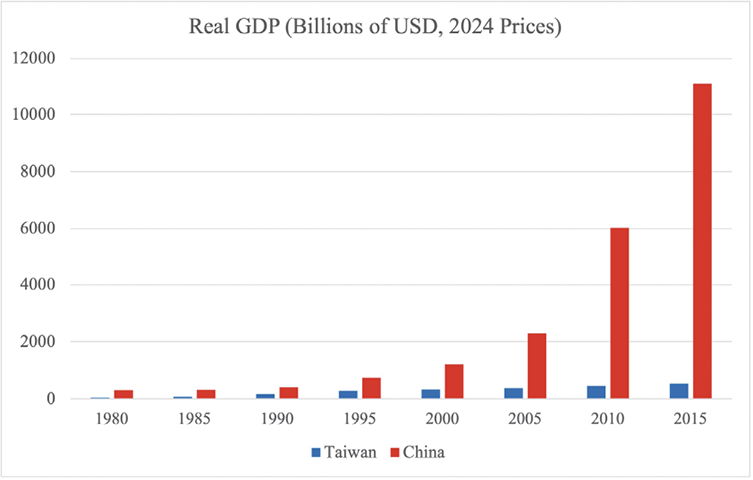
The PRC has other economic offerings that Taiwan cannot match. As Figure 1 shows, China’s economy has achieved extraordinary economic growth since the 1990s. This growth, paired with China’s collossal demand for commodities, has made China a major market for Latin American exports, driving much of South America’s 2003-13 “commodity boom” (Wise and Chonn Ching 2018, 553-554). China’s market potential has motivated Latin American presidents to switch recognition. Within years of switing recognition, Costa Rica, Honduras, Panama, Nicaragua, and El Salvador have begun or completed free trade agreement (FTA) negotiations with China (Alden and Méndez 2022, 150-156; Reuters 2023; García 2024; Gobierno de la República de Honduras 2024; Alvarado 2024). Taiwan has attempted to compete commercially –signing FTAs with Panama, Guatemala, Nicaragua, El Salvador, and Honduras before these countries switched– but China’s 1.4 billion consumers offer an export market that Taiwan’s population of 23 million cannot match (Alden and Méndez 2022, 146). However, the benefits of increasing commerce with China are debatable for Central American economies that, like Mexico, have large manufacturing sectors reliant on U.S. market access, which cheap Chinese imports put at risk (Gallagher and Pozecanski 2010, 83-97).
1980 | 1985 | 1990 | 1995 | 2000 | 2005 | 2010 | 2015 | |
Panama | 4.2 | 6.0 | 5.9 | 8.8 | 13.0 | 17.2 | 30.5 | 56.1 |
Taiwan | 42.3 | 63.6 | 166.6 | 279.1 | 330.7 | 374.1 | 444.3 | 534.5 |
China | 303.0 | 310.1 | 396.6 | 730.1 | 1,205.5 | 2,290.0 | 6,033.8 | 11,113.5 |
To this day, Taiwan’s Latin American relations remain a major foreign policy concern for the U.S., China, and Taiwan. U.S. officials regularly cite recognition switches as reasons for concern about increasing Chinese political and economic influence in Latin America (Richardson 2024; Harrison 2025). The CCP continues seeking to isolate Taiwan diplomatically and has pressured countries that have not switched (Reuters 2024a; AP News 2024). Taiwan’s remaining allies have provided the country with international support, lobbying for its admission to major multilateral organizations such as the UN and World Health Organization (Fan 2021, 232). Moreover, Central American countries recognizing Taiwan enable Taiwanese presidents to meet with major U.S. political figures and bolster U.S. support for the island through “stopover” visits on the way to visit those countries (Pfeiffer and Feng 2023). And as the CCP has intensified rhetoric about Taiwan unification and not ruled out the use of force, Taiwan’s formal allies represent international voices that could speak out against Beijing’s aggression in the event of a military attack against the island (Reuters 2024b).
U.S. and Taiwanese efforts and concerns, however, have not stopped countries from switching recognition. As Table 1 shows, Costa Rica, Panama, the Dominican Republic, El Salvador, Nicaragua, and Honduras have all switched recognition since 2007. The rest of this article explains why and how Panama’s switch occurred in 2017.
Although most Latin American countries switched recognition in the 1970s and 1980s, Panama did not establish relations with China then because of U.S. pressure. After seizing power in 1968, General Omar Torrijos ruled Panama in a military dictatorship under his left-of-center party, the Partido Revolucionario Democrático (PRD), until his 1981 death. Torrijos’s government engaged with the PRC politically, albeit in limited ways due to U.S. opposition.
Torrijos’s fundamental goal was to finish a decades-long struggle to acquire sovereignty over the Panama Canal Zone and control of the Canal from the U.S. Panamanian officials had repeatedly negotiated with Washington to improve terms of the 1903 treaty that granted the U.S. control of the Canal and its Zone. Bilateral treaties in 1936, 1955, and 1967 increased U.S. annuity payments to Panama, limited U.S. land acquisition rights, and promised equal treatment of U.S. and Panamanian canal employees, but Torrijos wanted a complete transfer of ownership to Panama (Conniff 2012, 90-91, 106-108, 120-124). His strategy included both bilateral negotiations with Washington and multilateral pressure to end U.S. control of the Canal Zone, the Canal, and military bases in Panama.
Torrijos’s contact with the CCP began as part of this strategy. After negotiations with the Nixon administration broke down, Panama obtained a temporary seat on the UN Security Council in 1972, and lobbied the Council to host a meeting in Panama in March of the following year. In doing so, Torrijos’s government hoped to pass a resolution that demanded the U.S. transfer the Canal and Canal Zone to Panama (Long 2014, 439-443). As a UN Security Council permanent member, the PRC was an important vote for Panama’s effort. In December 1972, Torrijos sent an advisor, Julio Yao, to meet with PRC officials in the Hague and obtain PRC support for the resolution. Yao traveled secretly because many in Panama’s foreign ministry had close contacts with the U.S. Embassy in Panama, and Torrijos did not want the U.S. government to know of their negotiations with the PRC. In the Hague, Yao met with Huang Hua, China’s UN representative, and asked him to support Panama’s efforts. Huang wrote to Beijing, and later presented Yao with a telegram from Mao Zedong, reading, “The People’s Republic of China will support any resolution that Panama proposes in the Security Council, including the immediate dismantling of U.S. bases” (Yao 2017).
Courting PRC officials proved effective, and Torrijos was grateful for their support. The final vote of the March 1973 Security Council resolution was 13-1-1, with the U.S. opposing the resolution and Britain abstaining. China voted in support of Panama (Long 2014, 445). In the coming years, Torrijos deepened engagement with China, hosting a PRC commercial fair in Panama City in April 1975.1 Upon Mao’s death in September 1976, Torrijos published an effusive eulogy of Mao in a Panamanian newspaper. In the eulogy, Torrijos expressed desire to have been able to meet Mao, whom he called, “the architect of the new China who knew how to bring dignity to his people and take away hunger from them”.2
While the PRC increasingly engaged with the Torrijos administration, Taiwan proactively strengthened ties with Panama. Chiang Kai Shek himself hosted Panamanian diplomats for tea at his country home in 1958 and his presidential palace in 1964, and in 1970, his government arranged an 8-day visit for Panama’s Ambassador to the UN, who declared during the visit that Panama would support Taiwan’s efforts to retain its UN seat.3 Starting in 1964, one of Taiwan’s most distinguished public servants, J.L. Huang, served as ambassador to Panama. After Torrijos’s 1968 coup, Huang sprung to build rapport with the new government, and Taiwan became the 4th country globally to recognize Torrijos’s regime. Huang also strove to improve Taiwan’s public image in Panama, hosting events with the Chinese-Panamanian community, fundraising to renovate a school, opening a Taiwanese bank office in Panama City, and dining with Panamanian presidents. Huang also responded when he saw Torrijos’s government approach the PRC. After hearing of a Panamanian minister traveling to Beijing for meetings with PRC officials in 1972, Huang arranged for him to visit Taiwan after, and was relieved to find out that the minister preferred his time in Taiwan. Huang even arranged for Torrijos’s mother to see a renowned Taiwanese acupuncturist, who relieved her of chronic pain to Torrijos’s delight (Huang 1984, 212-240). To the Taiwanese government, any chance to curry favor with Panama’s people and government was an opportunity to preserve Taiwan’s relations with Panama.
In 1977, Torrijos made Panama’s most historic foreign policy achievement: persuading the U.S. government to relinquish the Canal Zone territory and transfer Canal operations to Panama. Signed in the Organization of American States (OAS) headquarters on September 7, 1977, the Torrijos-Carter Treaties finally abrogated the 1903 Hay-Bunau-Varilla Treaty, returning the Canal Zone to Panamanian territory on October 1, 1979, and gradually transferring control of the Panama Canal to Panamanians by December 31, 1999. However, the bill pended approval in U.S. Congress, where conservatives bitterly opposed ratifying the Treaties with jingoistic rhetoric. A leader of U.S. opposition to the Canal Treaties, Ronald Reagan declared in 1978 that “the world would see [the 1977 Treaties] as, once again, Uncle Sam put his tail between his legs and crept away rather than face trouble” (Washington Post 1978). Both congressional chambers did not ratify the Treaties until September 1979, five days before their scheduled implementation (Conniff 2012, 131-139).
U.S. opposition to the Treaties directly influenced Panama’s relations with China. In 1980, Torrijos planned to establish diplomatic relations with both China and the Soviet Union on October 11th, the anniversary of his regime. On September 28th, two of his advisors, Romulo Escobar Betancourt and former Ambassador to the U.S. Gabriel Lewis, met with the aforementioned Chinese diplomat Huang Hua in New York City, then the following day met with U.S. President Jimmy Carter in the White House. The Panamanians explained Torrijos’s plans and asked for Carter’s thoughts. Carter explained that it would be “very beneficial” if Torrijos could wait until after the election (U.S. Department of State, Office of the Historian 1980). Carter proceeded to call Royo, and told him, as Royo recalled to the author in an interview:
With all respect, I ask that you postpone the establishment of relations with China, and I’ll explain why. Because we have had a very difficult time, as you well know, in the Senate, where they have approved the Treaties by just one vote. And between the things that the senators tell us, there is a suspicion that Torrijos is a communist, that everyone in Torrijos’s government is leftist.
So there is a suspicion. They say that if you open relations with China, I will receive a very strong attack from some of the senators, and a great part of the American electorate will say, “Well look, you gave them the Canal, the delivery was to be December 31, 1999, but the treaties already began in 1979. You decided to give the Panamanians the Canal in a period of years, and already look at the Panamanians’ reaction, running to establish relations with China.” And this, President Royo, can make things difficult for me.4
Out of respect and appreciation for Carter, Royo granted his request, ending his efforts to establish relations with China during his 1978-82 presidency (Murgas Torrazza 2018). Royo explained to the author, “I couldn’t say no to President Carter... What Carter asked us, we were willing to give to him because we knew that he had been a man for Panama”.5 Thus, Panama’s government intended to recognize the PRC in 1980, then reneged after the U.S. pressure asked its president not to.
Washington again frustrated a Panamanian desire to recognize the PRC in the 1990s. There was no Panamanian attempt to switch recognition during General Manuel Noriega’s 1983-1989 dictatorship. After a chaotic 5-year presidency under Guillermo Endara of the Panameñista Party, Ernesto “El Toro” Pérez Balladares won the 1994 election and returned Panama’s presidency to the PRD. Pérez Balladares met with PRC officials during a trip to China as president-elect. The trip was a family vacation, but as was protocol, he had a dinner with Li Peng, the PRC’s premier and second in command to president Jiang Zemin. Over dinner, the two political leaders spoke informally, not discussing political relations.6
Soon into his presidency, however, Pérez Balladares began a process to establish official relations with the PRC. In 1996, his government reached an agreement with the PRC to inaugurate a Chinese commercial office in Panama City and a Panamanian commercial office in Beijing (Méndez and Alden 2024, 9). A Panamanian diplomat associated with the negotiations interviewed in October 1996 explained that the commercial office was the beginning of a process to formalize commercial relations between the two countries.7 According to Pérez Balladares, establishing these offices “evidently” intended to eventually change Panama’s relations, such that the PRC commercial office would convert to a formal embassy, and Taiwan’s embassy would become a commercial office. He explained:
It was Panama’s interest to establish a greater relation [with China], more than anything for our commercial interests… Obviously, the economic possibilities for the country are much greater with China than with Taiwan. Also, one must remember that China is effectively the second greatest user of the Panama Canal… With my decision it was evident that I had to recognize that the primary Panamanian interest was in relations more with China than maintaining the diplomatic relations with Taiwan.8
Pérez Balladares remarked that he notified Taiwanese officials and that they were “very respectful” of the decision, understanding that Pérez Balladares would make decisions for Panama’s best interest.9
The process did not materialize under Pérez Balladares, however, due to U.S. geopolitical concerns. These concerns stemmed from a contract that Hutchison Whampoa, a Hong Kong-based construction company, won in March 1997 to build and operate ports on both the Atlantic and Pacific coasts of Panama, a few miles from both Canal entrances (Conniff and Bigler 2021, 103-104). The Panamanian government awarded this contract to Hutchison Whampoa over the U.S. firm Bechtel, despite pleas from the U.S. ambassador at the time (Siu 2007, 218-225). In response, conservative U.S. officials theatrically associated Hutchison Whampoa with China’s military. In October 1999, Senator Bob Smith testified on the Senate floor:
Hutchison Whampoa, a Hong Kong company controlled by Chinese operatives, will lease the U.S.-built port facilities at Balboa, which handle ocean commerce on the Pacific side, and Cristobal, which handle commerce on the Atlantic side. A Hong Kong company will control–remember, Hong Kong is now part of the PRC. Its chairman is Li Ka-shing, who has close ties to the Chinese Communist leaders and a de facto working relationship with the People’s Liberation Army… That is the Hong Kong company that will control this canal in 88 days…
Does anybody care? One of the favorite expressions among preachers is: “Hello. Does anybody care? Is anybody listening?”
This is Communist China in the Panama Canal that we built, that we maintained, for $32 billion. Not a whimper. Nobody is talking about it, let alone doing anything about it. Nobody cares. Where is the administration? (Smith 1999, n.p.).
Many other congressional speeches in the months leading to the December 1999 Canal turnover reflected Smith’s concerns and used similar rhetoric (Conniff 2012, 119-130).
Recognizing these concerns, Panamanian and Chinese officials wanted to avoid the possibility of U.S. officials using a Taiwan-China recognition switch as, in Pérez Balladares’s words, an “excuse to stop or evade the process of turning over the Panama Canal”.10 Consequently, he decided that it was not the right time to make the switch (Murgas Torraza 2018). He explained:
It was an absurd situation, but you don’t know in that moment if [recognizing the PRC] may generate an effect of saying, ‘Well, wait, [the Panamanians] are effectively going against the interests of the United States and consequently it is better to prolong, postpone, or not do what we had promised to do.11
Completing the Canal transition was Pérez Balladares’s administration’s utmost priority. His foreign minister from 1998 to 1999, Jorge Ritter, was entirely focused on managing and executing the Canal turnover.12 Thus, because of U.S. geopolitical concerns and the importance of completing the Canal turnover, Pérez Balladares postponed recognizing the PRC.
Notably, the Panamanian public was well aware of Washington’s diminishing influence, Beijing’s rising presence, and Taipei’s competition with China in Panama. As Figures 2, 3, and 4 show, Panama City’s La Prensa newspaper published a three-part article in October 1997 titled, “From Uncle Sam to Uncle Chang,” that explained U.S.-China-Taiwan geopolitical dynamics.
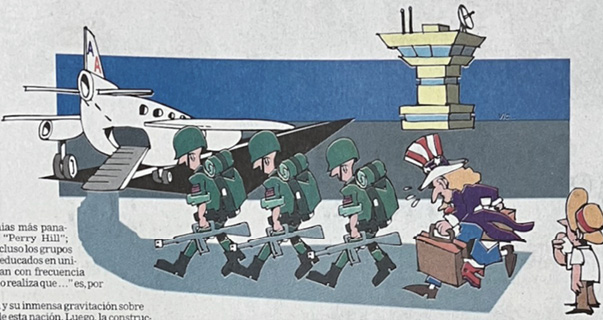
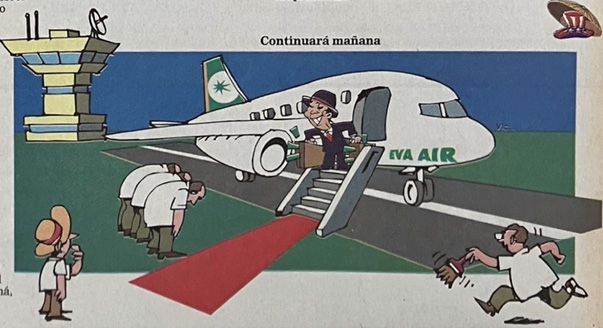
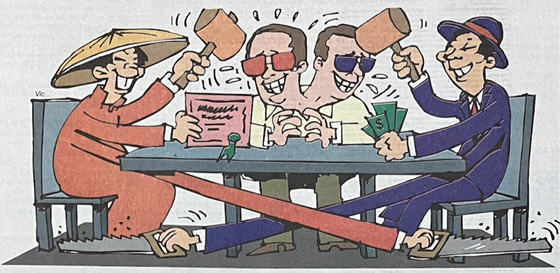
La Prensa published this article at a pivotal moment in Panama’s relations with China, the U.S., and Taiwan. Four months earlier, Hutchison Whampoa had just greatly increased China’s economic presence in Panama, over a bid from a U.S. company. In just two years, the U.S. was to transfer ownership of the Canal and close military bases in Panama. Meanwhile, Chinese and Taiwanese officials competed for influence in Panama through economic offerings. As the cartoons illustrate, Panama was economically and geopolitically caught between the U.S., China, and Taiwan.
Unlike Pérez Balladares, his successor, Mireya Moscoso, made no steps toward switching relations during her 1999-2004 presidency. Shortly after her inauguration, Moscoso’s foreign minister asserted that Panama’s relations with Taiwan would continue (Sung 1999). Within a year of taking office, Moscoso traveled to Taiwan and reiterated Panama’s commitment to recognizing Taiwan (Chieh-yu 2000). Moscoso also deepened economic relations with Taiwan by signing a bilateral FTA in 2003. Within three years of the FTA’s enactment, Panama-Taiwan trade nearly doubled from $130 million to $250 million. While the trade balance continued favoring Taiwan, Panama’s exports to Taiwan quadrupled from $6 million in 2003 to $24 million in 2005 (Erikson and Chen 2007, 76). The U.S. Ambassador to Panama from 2002 to 2005, Linda Watt, recalled that Moscoso was “so obviously in the hands of Taiwan” that Washington never questioned her allegiance to Taipei.13
Not all engagements between Moscoso’s administration and Taiwan, however, benefited the bilateral relationship. Her government faced criticism for an alleged $1-million payment transfer from Taiwan without full accounting. This story emerged as similar scandals emerged involving payments from the Taiwanese government to two Costa Rican presidents and Guatemala’s president at the time (Erikson and Chen 2007, 79). Opaque payments to Panama’s president amid corruption scandals in neighboring countries hurt Taiwan’s public image in Central America.
In stark contrast to Moscoso, Martín Torrijos cooled relations with Taiwan and attempted to recognize the PRC during his 2004-2009 presidency. In 2005, Torrijos invited the Chinese government to assist in an expansion of the Panama Canal and turned down a visit request from Taiwan’s president (Erikson and Chen 2007, 81). Torrijos’s turn towards Beijing worried Washington. The U.S. embassy’s political section noted that Torrijos had discussed moving closer to China during his campaign. The embassy also monitored any contact between Panamanian and Chinese officials. In meetings, U.S. Ambassador Watt would periodically ask Torrijos if he planned to switch recognition from Taiwan to China, and Torrijos would respond that he no such plans, but that Panama did value the Chinese as “important business partners”.14
Torrijos did, however, attempt to recognize China. In September 2005, Torrijos’s vice president and foreign minister, Samuel Lewis Navarro, met with China’s foreign minister, Li Zhaoxing, in New York during the UN General Assembly (La Prensa 2005). Li told Lewis Navarro that China was interested in establishing diplomatic relations and that establishing commercial offices instead of embassies in 1996 was a great error.15 The following year, Torrijos sent three representatives to negotiate with Chinese officials. Leading the negotiations was Jorge Ritter, previously foreign minister under Pérez Balladares. Also participating was Leonardo Kam, Panama’s commercial representative in Beijing, and Jaime Arias Calderón, a lawyer who had helped negotiate the Torrijos-Carter Treaties. The negotiators met six times between the fall of 2006 and February 2009 in Madrid, Rome, and lastly, Beijing.16 The meetings were conducted privately, though rumors reached the Panamanian press in 2006 that Torrijos’s government was meeting with Chinese officials in Spain (Panamá América 2006). Also crucially at this time, Costa Rica switched recognition in June 2007 (Cheng and Cordoba 2009, 359). Costa Rica’s switch sent shockwaves in Panama, where public intellectuals and former officials endorsed Panama doing the same (La Prensa 2007).
The Panama-PRC negotiations, however, ended, in 2009 due to a Taiwanese political transition. In March 2008, Ma Ying-jeou won Taiwan’s presidential election, returning Taiwan’s presidency to the KMT party, which held much more friendly relations with the PRC. Ma sought to reconcile cross-strait relations and negotiated a “truce” with Beijing, in which the CCP pledged to not establish relations with any of Taiwan’s remaining diplomatic allies (Alden and Méndez 2022, 148). This pledge meant that PRC negotiations with Panama had to stop. In February 2009, Ritter arrived in Beijing with instructions from Torrijos to sign an agreement and finalize the recognition process. But PRC officials notified Ritter that the negotiations had to stop not because China did not want to worsen relations with Taiwan by taking away its allies.17 And thus, Panama’s third attempt to establish relations with the PRC failed to materialize.
Panama switched recognition on June 12, 2017 under President Juan Carlos Varela. Confidentiality, U.S. pressure, and presidential initiative were critical elements in Varela’s process, as with previous attempts. Also, like previous attempts, Varela’s primary motivations were economic: to open diplomatic relations with the world’s second largest economy and the Canal’s second largest-user.
The process began with Varela’s first visit to China in 2007. At the time, Varela was president of Panama’s right-of-center Panameñista Party, the party of former presidents Guillermo Endara (1989-1994) and Mireya Moscoso (1999-2004). Varela traveled to Shanghai to see his niece with down syndrome compete in the Special Olympics there (Varela 2017). After the games, he had a lunch at the CCP headquarters in Beijing organized by Panama’s commercial office in Beijing. He met with Wang Hua, the CCP’s Director General for Latin America and the Caribbean. The two leaders agreed to deepen partnerships between the CCP and the Panameñista party (TuPolitica 2007).
China’s economic importance to Panama was growing at this time. As Table 4 shows, Panamanian exports to China significantly increased between 1995 and 2017.
As Panamanian political leaders sought to switch recognition between 2007 and 2017, Panama’s exports to China slightly exceeded exports to Taiwan. However, Panama’s exports to either country never surpassed $100 million annually and still dwarfed exports to the U.S., which averaged between $1 and 4 billion from 2008-2017.
In 2009, Varela became Panama’s vice president and foreign minister through an electoral coalition with the Cambio Democrático (CD) party candidate Ricardo Martinelli, who won that year’s presidential election. Varela led Panama’s foreign ministry from that year until 2011 when Martinelli fired him over interpersonal disagreements (Conniff and Bigler 2021, 238). During this time, Varela informed Chinese and U.S. officials of his intention to switch recognition from Taiwan to China. In January 2010, Varela represented Panama at the 4th Forum for East Asia-Latin America Cooperation in Tokyo, where 34 Latin American and Caribbean countries’ foreign ministries attended (Sue-young 2010). At the forum, Varela spoke with China’s foreign minister, Yang Jiechi, and communicated his interest in establishing relations with China. Yang told Varela that they could not do so then because of the truce with Taiwan (Keating 2011).
Year | Taiwan | China | The U.S. |
1995 | 0.6 | 0.03 | 257 |
1996 | 1.0 | 0.02 | 286 |
1997 | 0.7 | 0.72 | 323 |
1998 | 3.4 | 4.8 | 298 |
1999 | 3.1 | 2.82 | 316 |
2000 | 1.6 | 1.6 | 354 |
2001 | 4.4 | 3.22 | 402 |
2002 | 6.2 | 2.0 | 361 |
2003 | 6.4 | 12.12 | 415 |
2004 | 22.9 | 10.8 | 445 |
2005 | 24.6 | 10.22 | 433 |
2006 | 36.3 | 16.0 | 719 |
2007 | 53.8 | 72.02 | 757 |
2008 | 69.0 | 52.1 | 1,074 |
2009 | 23.5 | 22.52 | 2,710 |
2010 | 44.8 | 38.0 | 2,172 |
2011 | 43.9 | 40.52 | 3,831 |
2012 | 35.4 | 36.8 | 4,070 |
2013 | 40.3 | 54.92 | 3,703 |
2014 | 37.2 | 70.8 | 2,772 |
2015 | 29.5 | 41.22 | 2,612 |
2016 | 27.5 | 36.4 | 2,287 |
2017 | 33.5 | 43.72 | 2,252 |
In May 2014, Varela was elected president and still sought to switch recognition if the truce broke. Varela pursued an active foreign policy agenda, hosting the 2014 Summit of the Americas where Barack Obama and Raúl Castro met, the first meeting between a U.S. and Cuban president since the Cuban Revolution in 1959 (Conniff and Bigler 2021, 280). But Varela did not initially pursue establishing diplomatic relations with the PRC, knowing that the truce prevented doing so. Varela’s vice minister of foreign affairs, Luis Miguel Hincapié, recalled, “there was a diplomatic truce, and we were not going to make any move until that truce broke”.18 Still, in January 2015, Hincapié represented Panama at a mulitateral forum for the PRC and the Community of Latin American and Caribbean States (CELAC) and told PRC officials there that Panama intended to switch recognition if the truce broke.19
This dynamic changed in January 2016 with Tsai Ing-wen’s election in Taiwan, which returned the Democratic Progressive Party (DPP) to power in Taipei. The DPP has a much more antagonistic relationship with the CCP, and notably refuses to adhere to a 1992 Consensus agreement that had calmed cross-strait relations for years (Alden and Méndez 2022, 148). Tsai’s election ended the 8-year PRC-ROC truce, and Panama’s delegation to her inauguration noted the DPP’s much more pro-independence stance on cross-strait relations. Hincapié, present at Tsai’s inauguration, recalled that her inaugural address “started everything” and that “at that point we knew it was time to establish relations [with China]”.20
Furthermore, by this time, China’s economic importance to Panama had dramatically increased. Hutchison Whampoa built the aforementioned ports in 1997, and by Varela’s presidency, China had become the number two user of the Panama Canal and the main supplier of Panama’s Free Trade Zone in Colón. Chinese companies were making great investments in Panama, including in October 2015 when Huawei, a major Chinese telecommunications company, relocated its corporate headquarters from Mexico to Panama’s Colón Free Trade Zone (Alden and Méndez 2022, 155). In May of the following year, China’s Landbridge Groups announced the planned construction of a massive container port on the island of Margarita on Panama’s Caribbean coast, an investment worth $900 million that promised to massively increase Panama’s capacity as a logistics and shipping hub (Tasón 2016).
Meanwhile, the U.S. Embassy in Panama communicated opposition to the PRC growing its presence in Panama. In June 2016, Varela held an inaugural ceremony for a massive expansion of the Panama Canal, a 9-year project that accommodated much larger ships and thus greatly increased the Canal’s profitability (Conniff and Bigler 2021, 272-73). The first ship scheduled to cross through the new locks was owned by COSTCO, a Chinese company. In response, the U.S. Ambassador to Panama at the time, John Feeley, placed a U.S. Navy ship near the locks during the ceremony, in view of the Chinese ship passing through (Lee Anderson 2018). After the African country São Tomé and Príncipe severed ties with Taiwan in December that year, the U.S. government grew concerned that the PRC-KMT truce had broken and that Varela might switch Panama’s recognition (Feeley 2019). Feeley asked Varela directly in late 2016 and February 2017 if he would switch, and both times Varela told Feeley that he would not and that Panama’s ties with Taiwan were strong (Lee Anderson 2018). While U.S. officials did not formally pressure Panamanian officials to maintain relations with Taiwan, they made it abundantly clear that Panama’s relations with Taiwan mattered to them and that Panama approaching China concerned them.
Journalists also increasingly questioned Panama’s ties with Taiwan. Fearing a Panamanian approximation with Beijing, Taiwanese journalists repeatedly asked Panamanian officials to affirm support for Taipei after Tsai’s election. In May 2016, multiple Taiwanese reporters asked Varela’s vice president and foreign minister, Isabel Saint Malo de Alvarado, whether or not Panama would continue recognizing Taiwan at a public event in Washington D.C. She carefully answered, “We have diplomatic relations with Taiwan. We have very good diplomatic relations. We have, as I have mentioned, commercial relations with China. We understand the two Chinas have an agreement, currently a truce, which we respect” (Saint Malo de Alvarado 2016, n.p.). Days after São Tomé and Príncipe severed relations with Taiwan in December 2016, Reuters asked Vice Minister Hincapié about Panama’s relationship with Taiwan. Hincapié stated that relations with Taiwan “are good, in excellent condition as always […] . They’ve been a cooperative partner of Panama for many years, and will continue to be so”, but he also noted China’s importance to Panama as an “investor in Panama” and a “very important” canal user (Moreno 2016, n.p.). Tsai’s election and São Tomé and Príncipe’s rupture of relations with Taiwan evidently called Panama’s relations with Taiwan into question.
Panama’s relations with Taiwan and China were fundamentally changing at that time. That month, Varela’s director of foreign policy, Nicole Wong, flew to Madrid, where she met with PRC officials at the Chinese Embassy in Spain. At the confidential meetings, Wong explained that Varela and Saint Malo were interested in establishing formal relations. The Chinese officials were doubtful of Varela’s intention due to earlier Panamanian attempts to establish relations with China that had not been completed. Wong explained that Panama recognized the diplomatic truce between Taiwan and China, but that Varela’s government intended to switch recognition when that truce ended. Over the following months, Wong led more negotiations with PRC officials to negotiate the establishment of relations. The negotiations remained entirely confidential, with no one other than Varela, Saint Malo, Wong, and a presidential advisor from the Chinese-Panamanian community knowing of them (Wong 2022). On June 12, 2017, Varela hosted a press conference in Panama City, announcing the severance of all relations with Taiwan to adhere to the One China Policy and thereby establish relations with the PRC. At the same time in Beijing, Saint Malo signed a bilateral agreement with China’s foreign minister, Wang Yi, that agreed to establish diplomatic relations between the two countries (Cogley 2017).
Varela’s decision paved the way for substantially deepened relations between Beijing and Panama City. In just over two years between establishing relations in June 2017 and leaving office in July 2019, Varela established the first Panamanian embassy in Beijing and the first Chinese embassy in Panama City, initiated bilateral free trade agreement negotiations, visited China three times, hosted Xi Jinping for a state visit to Panama, and made Panama the first Latin American country to join the PRC’s Belt and Road Initiative (Méndez and Alden 2024, 9-10). The rapid pace at which Panama and China increased engagement deeply worried Washington, with the U.S. State Department recalling its ambassador to Washington to discuss this engagement in September 2018 and Trump’s Secretary of State condemning relations with China in a visit to Panama the following month (Wong 2018a; 2018b). Despite U.S. admonitions, China has emerged as a critical economic partner for Panama, providing the country with much of its export markets, foreign direct investment, and infrastructure development in recent years (Ellis 2023).
Panama established diplomatic relations with China 57 years after the first Latin American country to do so, Cuba. In 1960, Fidel Castro had just taken over Cuba’s government through the previous year’s revolution that ousted dictator Fulgencio Batista. A declared leftist who opposed U.S. interventionism in Latin America, Castro pursued foreign policy that approached socialist regimes worldwide and defied U.S. Cold War geopolitical interests. Speaking to a crowd in Havana in August 1960, Fidel declared, “we are friends of the Soviet Union and of the Chinese People’s Republic because they have shown they are our friends” (quoted in Schoulz 2009, 130). Addressing the U.S., he said: “We no longer believe in your philosophy of exploitation and privilege [...]. We no longer are willing to submit to the orders of your ambassadors. We no longer are disposed to follow in tow your reactionary policy, which is the enemy of human progress” (quoted in Schoulz 2009, 130). The following month, he recognized the PRC, and Cuba has maintained relations with Beijing ever since (Cheng 2007, 93).
Panama’s case was different. Since U.S. president Theodore Roosevelt helped create Panama by supporting its 1903 nationalist uprising, Panama has long been under heavy U.S. influence and rarely dared to act against the global interests of the hegemon that built and operated the canal through its territory. Jimmy Carter so ingratiated Panamanian officials for signing the 1977 Treaties that Panama’s then-president granted his wish for Panama to delay establishing relations with China in 1980, despite the fact that many Latin American countries and the U.S. had already done so. In the late 1990s, U.S. concerns regarding ports leased to a Hong Kong-based company paired with the planned 1999 Canal transition motivated Panama’s then-president to abandon his desire to switch diplomatic recognition from Taiwan to China. But after a 2008-2016 diplomatic truce between Taipei and Beijing paused PRC efforts to convince Taiwan’s remaining diplomatic allies to switch recognition, President Juan Carlos Varela was the first Panamanian president with the intention and capacity to establish diplomatic relations with China, which he promptly did in June 2017.
Considering the decades of Taiwan-China competition in Latin America and diminishing U.S. influence in Panamanian foreign policy, Panama’s recognition of the People’s Republic of China carries major implications for understanding contemporary Sino-Latin American relations and U.S.-Latin American relations. First, Taiwan’s remaining allies in Latin America have dissipated in recent years. Since Panama’s switching, El Salvador, the Dominican Republic, Nicaragua, and Honduras have all switched, leaving many wondering if political leaders in Guatemala or Paraguay, which as of this writing still recognize Taiwan, may do what Varela did in 2017. Second, since the 1999 Canal turnover, Panamanian political leaders have been much more willing to defy U.S. geopolitical interests, a clear example being Panamanian presidents abandoning attempts to recognize China over U.S. concerns before the turnover but presidents since 1999 attempting to recognize the PRC despite U.S. concerns. Finally, in Panama and elsewhere in Latin America, China has emerged as a major extra regional actor that has significantly grown its economic and political presence even while the region’s traditional hegemon, the U.S., has opposed such geopolitical expansion. These trends are likely to continue as China continues to seek to diplomatically isolate Taiwan, Latin American countries continue to seek to maximize economic opportunities with China, and the U.S. continues to oppose China’s growing presence in Latin America, going as far as Trump alleging that “China is operating the Panama Canal” and pledging to retake control of the waterway in his second inaugural address (AP News 2024; Heine 2025; Zamorano 2025; Trump 2025).
Alden, Chris, and Álvaro Méndez. 2022. China and Latin America: Development, Agency and Geopolitics. London: Bloomsbury Academic.
Alvarado, Jimmy. 2024. “Los fundadores de Chivo Wallet lideran la negociación del TLC con China.” El Faro, September 11, 2024. https://elfaro.net/es/202409/el_salvador/27549/los-fundadores-de-chivo-wallet-lideran-la-negociacion-del-tlc-con-china.
AP News. 2024. “Paraguay Kicks out a Visiting Chinese Envoy for Urging Its Lawmakers to Turn Their Backs on Taiwan.” December 5, 2024. https://apnews.com/article/paraguay-china-diplomatic-ties-taiwan-trade-784b083353b331bf9274a4666066beb4.
Chang Chien, Amy, and Emiliano Rodríguez Mega. 2023. “In Blow to Taiwan, Honduras Switches Relations to China.” New York Times, March 25, 2023. https://www.nytimes.com/2023/03/25/world/asia/taiwan-honduras-china-relations.html.
Cheng, Yinghong. 2007. “Sino-Cuban Relations during the Early Years of the Castro Regime, 1959-1966.” Journal of Cold War Studies 9, no. 3: 78-114.
Cheng, Joseph Y. S., and Thaís M. Cordoba. 2009. “The Establishment of Diplomatic Relations with China: A Study of Costa Rica’s Rationale.” The Journal of Comparative Asian Development 8, no. 2: 333-364.
Chieh-yu, Lin. 2000. “Panama’s President Says Ties with Taiwan Will Stay Strong.” Taipei Times, July 2, 2000. https://www.taipeitimes.com/News/local/archives/1999/11/29/0000012893.
Cogley, Flor L. 2017. “Panamá reconoce el Principio de Una Sola China y rompe relaciones con Taiwán.” La Prensa, June 12, 2017. https://www.prensa.com/politica/Panama-diplomaticas-Republica-Popular-China_0_4778522162.html.
Cohen, Warren. 1996. America’s Response to China: A History of Sino-American Relations. New York: Columbia University Press.
Conniff, Michael L. 2012. Panama and the United States: The End of the Alliance. Athens: University of Georgia Press.
Conniff, Michael L., and Gene E. Bigler. 2019. Modern Panama: From Occupation to Crossroads of the Americas. Cambridge: Cambridge University Press.
Crítica. 1975. “Lamenta el mundo la muerte de Mao: Torrijos envía mensaje.” September 10, 1975. Hemeroteca, Biblioteca Nacional de Panamá. Panama City, Panama.
Ellis, R. Evan. 2023. “China’s Uneven Military, Political, and Commercial Advance in Panama.” The Diplomat, March 25, 2023. https://thediplomat.com/2023/03/chinas-uneven-military-political-and-commercial-advance-in-panama/.
Erikson, Daniel P, and Janice Chen. 2007. “China, Taiwan, and the Battle for Latin America.” The Fletcher Forum of World Affairs 31, no. 2: 69-89.
Fan, Felipe. 2021. “Taiwan’s Relations with the Northern Triangle.” In Taiwan’s Relations with Latin America: A Strategic Rivalry between the United States, China, and Taiwan, edited by Li He and Antonio C. Hsiang, 225-261. Lanham: Lexington Books.
Feeley, John. 2019. “Hysteria or Reality? China in Panama.” Interview by Pete Romero. American Diplomat (podcast), January 24, 2019. https://americandiplomat.libsyn.com/hysteria-or-reality-china-in-panama.
Gallagher, Kevin, and Roberto Porzecanski. 2010. The Dragon in the Room: China and the Future of Latin American Industrialization. Redwood City: Stanford University Press.
García, Armuelles. 2024. “Mulino: Todavía no hay nada concreto sobre un TLC con China.” La Estrella de Panamá, September 5, 2024. https://www.laestrella.com.pa/economia/mulino-todavia-no-hay-nada-concreto-sobre-un-tlc-con-china-DD8454371.
Gobierno de la República de Honduras. 2024. “Comienza la Sexta Ronda de Negociaciones Del Tratado de Libre Comercio Entre Honduras y La República Popular de China.” Secretaría de Desarrollo Económico. https://sde.gob.hn/2024/07/30/comienza-la-sexta-ronda-de-negociaciones-del-tratado-de-libre-comercio-entre-honduras-y-la-republica-popular-de-china/.
Gorriti, Gustavo, and Miren Gutiérrez. 1997. “De tío Sam a tío Chang, I-III.” La Prensa, August 10-12, 1997. Hermeroteca, Biblioteca Nacional de Panamá. Panama City, Panama.
Harrison, Chase. 2025. “The Rubio Recap: What He Said about Latin America at His Hearing.” AS/COA, January 24, 2025. https://www.as-coa.org/articles/rubio-recap-what-he-said-about-latin-america-his-hearing.
Harmer, Tanya. 2011. Allende’s Chile and the Inter-American Cold War. Chapel Hill: University of North Carolina Press.
Heine, Jorge. 2025. “Not Picking Sides and the ‘New Neutrals’: Active Nonalignment, Great Power Competition, and the Global South.” Journal of World Affairs: Voice of the Global South 1, no. 1: 7-14.
Huang, J. L. 1984. Memoirs of J. L. Huang. Ann Arbor: University of Michigan Press.
International Trade Administration. 2024. “Import +re-Imports, Panama, 1989/1990-2017/2018.” Ministry of Economic Affairs of Taiwan (Republic of China). https://publicinfo.trade.gov.tw/cuswebo/FSCE3000C?table=FSCE3010F&utm
Keating, Joshua. 2011. “Why Does Central America Still Love Taiwan?” Foreign Policy, May 12, 2011. https://foreignpolicy.com/2011/05/12/why-does-central-america-still-love-taiwan/.
Kinzer, Stephen. 1985. “Nicaragua Plan Ties with Peking.” New York Times, November 17, 1985. https://www.nytimes.com/1985/11/17/world/nicaragua-plans-ties-with-peking.html.
La Estrella de Panamá. 1975. “El General Torrijos inauguró exposición de China Popular.” April 5, 1975. Hermeroteca. Biblioteca Nacional de Panamá. Panama City, Panama.
La Prensa. 2005. “Más China, menos Taiwan.” September 21, 2005. https://www.prensa.com/politica/China-Taiwan_0_1567343283.html.
La Prensa. 2007. “Taiwan se queda sin Amigos.” June 8, 2007. https://www.prensa.com/politica/Taiwan-queda-amigos_0_2036046459.html.
Lee Anderson, John. 2018. “The Diplomat Who Quit the Trump Administration.” The New Yorker, May 21, 2018. https://www.newyorker.com/magazine/2018/05/28/the-diplomat-who-quit-the-trump-administration.
Méndez, Álvaro. 2021. “Geopolitics in Central America: China and El Salvador in the 21st Century.” In China-Latin America and the Caribbean, edited by Thierry Kellner and Sophie Wintgens, 207-221. New York: Routledge.
Méndez, Álvaro, and Chris Alden. 2024. “Panama, Ecuador, and China: The Dangers of Short-Term Calculations.” Washington, D.C.: United States Institute of Peace.
Moreno, Elida. 2016. “Panama Sees No Change in Taiwan, China Ties despite Trump.” Reuters, December 31, 2016. https://www.reuters.com/article/world/panama-sees-no-change-in-taiwan-china-ties-despite-trump-idUSKBN14J1Z3/.
Murgas Torrazza, Rubén. 2018. “Un extranjero en China.” La Estrella de Panamá, December 9, 2018. https://www.laestrella.com.pa/vida-y-cultura/cultura/china-extranjero-HOLE27922.
Lee Myers, Steven. 2021. “Taiwan Loses Nicaragua as Ally as Tensions with China Rise.” New York Times, December 9, 2021. https://www.nytimes.com/2021/12/10/world/asia/taiwan-nicaragua-china.html.
Long, Tom. 2014. “Putting the Canal on the Map: Panamanian Agenda-Setting and the 1973 Security Council Meetings.” Diplomatic History 38, no. 2: 431-55. https://doi.org/10.1093/dh/dht096.
Panamá América. 2006. “Embajadas chinas guardan silencio.” February 22, 2006. https://www.panamaamerica.com.pa/nacion/embajadas-chinas-guardan-silencio-222766.
Pfeiffer, Sacha, and Emily Feng. 2023. “Taiwan’s President is Making What’s Being Called a ‘High Stakes’ Stopover in New York.” March 30, 2023. https://www.npr.org/2023/03/30/1166969935/taiwans-president-is-making-whats-being-called-a-high-stakes-stopover-in-new-yor.
Reuters. 2023. “China, Former Taiwan Ally Nicaragua Sign Wide-Ranging Free Trade Deal.” August 31, 2023. https://www.reuters.com/world/asia-pacific/china-former-taiwan-ally-nicaragua-sign-wide-ranging-free-trade-deal-2023-08-31/.
— 2024a. “China’s Rejection of Guatemalan Shipments Could Be Related to Taiwan Ties, Guatemala President Says.” May 25, 2024. https://www.reuters.com/world/chinas-rejection-guatemalan-shipments-could-be-related-taiwan-ties-guatemala-2024-05-25/.
— 2024b. “China’s Xi Says ‘reunification’ with Taiwan Is Inevitable.” January 1, 2024. https://www.reuters.com/world/asia-pacific/china-calls-taiwan-president-frontrunner-destroyer-peace-2023-12-31/.
Richardson, Laura. 2024. “Statement of General Laura J. Richardson, Commander, United States Southern Command, before the 118th Congress.” U.S. Congress, March 12. https://www.southcom.mil/Portals/7/Documents/Posture%20Statements/2024%20SOUTHCOM%20Posture%20Statement%20FINAL.pdf?ver=Iwci9nu-nOJkQjxIWpo9Rg%3D%3D.
Saint Malo de Alvarado, Isabel. 2016. “A Conversation with Isabel de Saint Malo de Alvarado.” Council on Foreign Relations, Washington, D.C., May 5, 2016. https://www.youtube.com/watch?v=4-rTc6XMTvM&t=1s.
Schoulz, Lars. 2009. That Little Infernal Cuban Republic: The United States and the Cuban Revolution. Chapel Hill: University of North Carolina Press.
Shattuck, Thomas J. 2020. “The Race to Zero?: China’s Poaching of Taiwan’s Diplomatic Allies.” Orbis 64, no. 2: 334-352.
Siu, Lok C. D. 2007. Memories of a Future Home: Diasporic Citizenship of Chinese in Panama. Redwood City: Stanford University Press.
Smith, Bob. 1999. “The Panama Canal.” Presented at the United States Senate, Washington D.C., October 4. https://www.congress.gov/congressional-record/volume-145/issue-132/senate-section/article/S11848-1.
Sue-young, Kim. 2010. “Seoul Seeks Summit with Latin America.” Koreatimes, January 17, 2010, sec. National. https://www.koreatimes.co.kr/www/nation/2024/10/113_59168.html.
Sung, Catherine. 1999. “Aleman Confirms Panama to Retain Dual Relations.” November 29, 1999. https://www.taipeitimes.com/News/local/archives/1999/11/30/0000013017.
Tasón, Jessica. 2016. “China Landbridge Group invertirá $900 millones.” La Estrella de Panamá, May 5, 2016. https://www.laestrella.com.pa/economia/900-china-group-invertira-landbridge-GJLE110879.
World Bank. 2024. “Panama Trade Statistics: Exports, Imports, Products, Tariffs, GDP, and Related Development Indicator.” World Integrated Trade Solution. https://wits.worldbank.org/CountryProfile/en/PAN (November 18, 2024).
Tupolitica.Com. 2007. “Presidente del Panameñismo Juan Carlos Varela de gira por China.” November 24, 2007. https://tupolitica.com/partido-panamenista-panama/presidente-del-panamenismo-juan-carlos-varela-de-gira-por-china.html/.
Trump, Donald. 2025. “The Inaugural Address.” Speech, The U.S. Capitol, Washington, D.C., January 20. https://www.whitehouse.gov/remarks/2025/01/the-inaugural-address/.
Tzu-hsuan, Liu. 2024. “Taiwan Launches Projects to Help Guatemala, Belize.” Taipei Times, April 9, 2024. https://www.taipeitimes.com/News/taiwan/archives/2024/
04/09/2003816162.
U.S. Department of State, Office of the Historian. 1980. “270. Memorandum of Conversation.” September 28, 1980. https://history.state.gov/historicaldocuments/frus1977-80v29/d270.
Varela, Juan Carlos. 2017. Interview by Michael Shifter. “A Conversation with Juan Carlos Varela, President of Panama.” The Inter-American Dialogue, September 26, 2017. https://www.youtube.com/watch?v=-2SWJybey4g&t=3028s.
Wise, Carol, and Victoria Chonn Ching. 2018. “Conceptualizing China-Latin America Relations in the Twenty-First Century: The Boom, the Bust, and the Aftermath.” The Pacific Review 31 (5): 553-72.
Wong, Edward. 2018a. “U.S. Recalls Top Diplomats From Latin America as Worries Rise Over China’s Influence.” The New York Times, September 8, 2018. https://www.nytimes.com/2018/09/08/us/politics/us-latin-america-china.html.
— 2018b. “Mike Pompeo Warns Panama Against Doing Business With China.” New York Times, October 19, 2018. https://www.nytimes.com/2018/10/19/world/americas/mike-pompeo-panama-china.html.
Wong, Nicole. 2022. Radio interview. Omega Stereo 107.3, Panama City, August 4, 2022. https://www.youtube.com/watch?v=RpjWH_e3rUg&t=652s.
Yao, Julio. 2017. “Panamá y China Popular: antecedentes.” La Estrella de Panamá, June 16, 2017. https://www.laestrella.com.pa/opinion/columnistas/china-panama-popular-antecedentes-HTLE66810.
Zamorano, Juan. 2025. “Hegseth Says China’s Military Presence in Western Hemisphere Is ‘Too Large.’” AP News, April 9, 2025. https://apnews.com/article/panama-canal-us-hegseth-china-6a4bdea15c3cbb3b28a38c15c7dbac15.
Manuscript received: 15.04.2025
Manuscript accepted: 22.08.2025
1 “El General Torrijos inauguró exposición de China Popular,” La Estrella de Panamá, April 5, 1975. Hermeroteca of the Biblioteca Nacional de Panamá. Panama City, Panama.
2 “Lamenta el mundo la muerte de Mao: Torrijos envía mensaje,” Crítica, September 10, 1975. Hermeroteca of the Biblioteca Nacional de Panamá. Panama City, Panama. Torrijos also wrote, “I express to the government and people of the People’s Republic of China our feeling of solidarity in this time of mourning, not just for the Chinese people but rather for all the peoples who fight for their liberation, given this irreparable loss of this great driver of masses that was the President Mao Tse-Tung.”
3 File titled, “Embajadores de Panamá ante la República de China, 1954-1985.” Box 2, Folder 53, titled “Documentos relacionados con el establecimiento de Relaciones Diplomaticas de Panamá y China.” Acervo Histórico Diplomático, Ministerio de Relaciones Exteriores de la República de Panamá. Panama City, Panama.
4 Personal interview with Aristides Royo, March 24, 2025 (virtual interview).
5 Personal interview with Aristides Royo, March 24, 2025 (virtual interview).
6 Personal interview with Ernesto Pérez Balladares, October 22, 2024 (virtual interview).
7 Michele Labrut, “China Bureau in Panama 1st Step to Commercial Relations,” Bridge News, October 16, 1996. Box 2, Folder 53. Box 2, Folder 53, titled “Documentos relacionados con el establecimiento de Relaciones Diplomaticas de Panamá y China.” Acervo Histórico Diplomático, Ministerio de Relaciones Exteriores de la República de Panamá. Panama City, Panama.
8 Personal interview with Ernesto Pérez Balladares, October 22, 2024 (virtual interview).
9 Personal interview with Ernesto Pérez Balladares, October 22, 2024 (virtual interview).
10 Personal interview with Ernesto Pérez Balladares, October 22, 2024 (virtual interview).
11 Personal interview with Ernesto Pérez Balladares, October 22, 2024 (virtual interview).
12 Personal interview with Jorge Ritter, Panama City, Panama. October 3, 2024.
13 Personal interview with Linda Watt, February 7, 2025 (virtual interview).
14 Personal interview with Linda Watt, February 7, 2025 (virtual interview).
15 Personal interview with Samuel Lewis Navarro, November 26, 2024 (virtual interview).
16 Personal interview with Jorge Ritter, Panama City, Panama. October 3, 2024.
17 Personal interview with Jorge Ritter, Panama City, Panama. October 3, 2024.
18 Personal interview with Luis Miguel Hincápie, Panama City, September 23, 2024.
19 Personal interview with Luis Miguel Hincápie, Panama City, September 23, 2024.
20 Personal interview with Luis Miguel Hincápie, Panama City, September 23, 2024.