
DOI: 10.18441/ibam.26.2026.92.15-36
Fraya Frehse
Universidade de São Paulo, Brazil
fraya@usp.br
ORCID ID: https://orcid.org/0000-0002-9501-5584
How do intersectional inequalities contribute to shape the physical-material and social dimensions of urban public space in contemporary Latin America on a daily basis? Drawing on the outcomes of previous research on this question (Frehse 2022a), this paper aims to tackle the space-productive dimension, so to speak, of the wider dossier issue to which it contributes: the relationship between intersectionality and social inequality in the public spaces of twenty-first century Latin America.
Therefore, my starting point is theoretical. I am interested in the everyday, lived experience of social inequality in its diversely combined categorial dimensions. In contemporary capitalism, these intersections involve a comprehensive variety of socially un-equalizing couplings between the historically crucial marker of difference known as “class” and other social categories, such as gender, race/ethnicity, sexuality, age, disability among others. Hence, intersectional markers of difference turn into what I term intersectional markers of social inequality, whose social-processual outcome is a set of intersectional inequalities – rather than a single “intersectional inequality” (Ragin and Fiss 2017). My specific interest lies in how these intersectional inequalities –or asymmetries among socially different human beings– affect both the physical materiality of streets and squares in Latin American cities, and the social interactions among human beings, their interactions with non-humans such as animals and plants, and their engagements with material objects in these same streets and squares.
These urban places publicly display the manifold asymmetries that have rendered contemporary Latin America the most unequal region in the world (World Inequality Database 2023). We need only recall that, in urban studies, streets and squares are the most common empirical instances –conceptually, places– encompassed within the theoretical, abstract concept of public space. Across the various conceptualizations of public space, a common denominator regarding publicness is “access” – whether physical, legal, or informational (Frehse 2018). In Latin America, public streets and squares uniquely integrate these three dimensions. They are the physically, legally, and informationally the most accessible places within the region’s urban public space. Hence, they are also publicly most accessible to the daily bodily and material staging of the region’s palette of intersectional inequalities. But how do these asymmetries shape urban public space, both physical-materially and socially?
The paper addresses this how from a specific methodological and empirical angle. Methodologically, my focus lies on the literal “here-and-now” of bodily and materially mediated face-to-face interactions. Empirically, I centre on some of the most poignant victims of intersectional inequalities in the public spaces of Latin America’s largest city during the Covid-19 pandemic. I refer to women who, between 2020 and 2022, made more or less regular use of São Paulo’s public places for dwelling purposes: street-dwelling women, whom I will refer to from now as “homeless” women, to heuristically facilitate my dialogue with the international scholarship on homelessness.1
Without disregarding neither the influence of social-structural, socioeconomic and political factors on intersectional inequalities in the public spaces of urban Latin America (see this dossier), nor the social drama surrounding women’s homelessness in Covid-19 São Paulo, this paper focuses on the temporally fleeting moments of everyday life in which street-dwelling women physically move around the city’s public places and socially interact “face to face” – that is, in physical co-presence with other individuals (Goffman 1959; 1963). Once we recall that these interactions are underpinned by socially embedded “rules of conduct”, whether “situational” or not (Goffman 1963, passim, 22, 21), São Paulo’s street-dwelling women help me theoretically argue that face-to-face interactions in the city’s public spaces are also symbolically infused with intersectional markers of inequality. During their face-to-face interactions, the women mobilise categories that not only differentiate them from one another, their peers, and third persons. Class, gender, race/ethnicity, sexuality, age –and, as we will see, family bonding as well– simultaneously un-equalize them. The women re-produce specific regimes of oppression both among themselves and in relation to their peers and third parties.
In applying this methodological framework to ethnographic data about these women’s interactions in Covid-19 São Paulo, the following pages advance a specific theoretical statement about the issue addressed in this paper. Intersectional inequalities contribute situationally to the physical-material and social dimension of urban public space in Latin America. The term “situationally” refers to the ways in which these asymmetries are managed within the transitory, spatial-temporal here-and-now, which makes up the situational boundaries of face-to-face interaction (Frehse 2021a). Situations are “the full spatial environment[s]” encompassed by the bodily and materially mediated, communicative exchanges between two or more human beings in physical co-presence (Goffman 1963, 18, passim).
The paper demonstrates this statement in four steps. First (Section 1), I briefly situate my thesis theoretically within three scholarly debates. They address the interactional dimension of intersectionality, the production of space –particularly public space in urban Latin America– and the spatial dimension of (women’s) homelessness.
Next (Section 2), I outline my methodology for analytically addressing the situational-spatial impact of intersectional inequalities. Ethnography and the daily, social-reproductive practices of homeless women in Covid-19 São Paulo are crucial in this context. Subsequently (Section 3), I put this methodology into action by first (Subsection 3.1) highlighting four patterns of spatialized interaction among the women in focus; and then (Subsection 3.2), showing how these patterns contribute to the interactional production of three specific situational spaces within urban public space.
Building on this analysis, I finally (Section 4) summarize four key contributions of the homeless women examined in pandemic São Paulo to both this paper and the dossier as a whole. As we will see, these contributions hinge on the need for a methodology sensitive to the situational-spatial dimension of social interaction; the interpretive relevance of social values forged in different spaces; the concept of what I term family public space as a social-structurally specific spatial product; and finally, the situational impact of intersectional inequalities in urban public space as a family issue.
Currently, we know that social inequality is underpinned by global, regional, national, and local “orders of stratification”; that is, grounded in “situated intersectionality” (Yuval-Davis 2015, 95). Moreover, there is established scholarship on both the “performative” role of intersectional markers of difference in social interaction (Bettie 2014) and the situational negotiation of intersecting, marked, and unmarked identities in face-to-face interaction (Brekhus 2022, 9). However, much less is known about their spatial dimension and impact within face-to-face interaction (for an exception, see Ganji and Risbeth 2020).
My theoretical interest in this issue is part of a longstanding sociological debate on the production of space. The discussion has been revitalized since 1974, when Henri Lefebvre (2000) pioneered the conceptual and empirical demonstration that space is a product of bodily and materially mediated social and economic relationships between human beings (and primarily their practices), alongside and amidst material and symbolic objects. In short, space is a “set of relations” (Lefebvre 2000, xix). Hence, the socio-economic, cultural and historical processes involved in the physical-material and social bringing about of space –rather than space itself– have become a social-scientific research issue. To summarize: the production of space matters. Since then, various sociological conceptualizations of this social phenomenon have emerged – with the aid of concepts such as the Marxist-dialectical “production”, the phenomenological “construction” (whether social or, more recently, communicative) or the Giddensian “constitution” of space (for overviews, see Frehse 2021a; 2025).
In light of this broader history of sociology, the specificity of my approach here lies in its methodological standpoint. Rather than addressing the production of space by focusing on social positions or on bodily and materially mediated actions, whether communicative or otherwise (Frehse 2021a, 389), I am interested in the space-productive role of intersectionally marked, face-to-face interactions. In short: it is an interactional-spatial approach (Frehse, Reis, and Patitucci 2024, 16).
The originality of this framework also becomes evident against the backdrop of two other longstanding theoretical strands of urban research. Let me address them briefly.
Since the 1970s Latin American urban studies have drawn on concepts such as (auto-)segregation to consistently emphasize the impact of sociostructurally based inequalities in access –to urban infrastructure, public policies and living conditions– on the production of urban space (Frehse 2016a). The empirical outcome of this sociospatial process is a continual increase in (auto-)segregation both among and within neighbourhoods. Regarding public space specifically, the scholarship has generally focused on three topics. First, there has been an overall interest in the (pervasive) physical-material and social presence of street vending and waste-picking in public space (for an overview see Perelman 2017). This trend has only exceptionally tackled interactionally mediated inequalities in these spaces (Frehse 2016b). Alternatively, researchers have addressed the social impact of gentrification projects in downtown areas across Latin America – and, thus, especially in urban streets and squares (for an overview see Leite 2005). Finally, and more recently, studies have also explored the influence of intersectional inequalities on urban (public) space (for example, Jaramillo Cruz 2022; LabCidade 2025).
Developed in dialogue with these social-structural and social-processual approaches, the distinctiveness of my approach lies in its methodological interest in the spatial dimension of face-to-face interaction.
Given that my empirical focus here centres on the public-spatial impact in particular of women’s street-dwelling, a third and last relevant scholarly counterpoint is the urban-studies debate on the spatial dimension of homelessness. While the public-private dichotomy is a conventional conceptual tool for addressing the production of public space in general (Harding and Blokland 2014, 185-189; Low 2021; Kemmer et al. 2022), homeless studies do not frame homelessness as a public-space privatizing condition at all. By contrast, and more recently, they have focused on “homemaking” experiences, or practices of homeless people (see, among others, Lenhard, Coulomb, and Miranda-Nieto 2022; Pleace, O’Sullivan and Johnson 2022; Banerjee 2023; Lancione 2025). Generally, the term is used to conceptualize the creative agency of street-dwellers in establishing a “home” in the streets or shelters as both “a domestic place” and “a constellation of practices, processes, skills, material settings and meanings that evolve in private, public and communal spaces” (Lenhard, Coulomb, and Miranda-Nieto 2022, 183). Particularly in the case of homeless women, whether in shelters or on footpaths (Paul 2022; Banerjee 2023, 18-20), the creative dimension of their dwelling practices regarding “home” is often interpreted as “resistance”. This resistance is seen as a response either to urban “austerity” policies (Paul 2022) or to homelessness understood as the absence of a “family/household” related to “a physical idea of home” (Banerjee 2022, 8; see also Pleace, O’Sullivan, and Johnson 2022, passim).
By emphasizing the routinized essence of spatial practices, these accounts remain open-ended when it comes to the public-spatial impact of the intersectional inequalities implicit in an alternative, temporal dimension implicit in spatial practices. I mean the temporally fleeting nature of the women’s interactions with humans, non-humans, and material goods in public places.
All in all, these research gaps span over a remarkably broad spectrum of inter- and intra-disciplinary subjects, ranging from sociological theory to homelessness studies as well as urban studies (in Latin America). However, these gaps share a common denominator: scholarship often overlooks the spatial-productive role of intersectionally marked, face-to-face interactions.
In what follows, I introduce a specific methodology to address precisely this gap. This implies coping with the inherent limitations of attempting to tackle such a wide-ranging theoretical issue methodologically within the confines of this paper.
Empirically, the interactions in question took place in a city where inequality becomes public-spatial in distinctive ways, particularly for homeless people during the Covid-19 pandemic. With nearly 12,5 million inhabitants, São Paulo was then the fifth largest city in the world in a country whose inequality sharply increased during the four years of the Bolsonaro presidency (2019-2022) (World Inequality Database 2023). The city became the pandemic epicentre in Brazil, where the virus claimed nearly 700,000 lives between March 2020 and April 2022 (Ministério da Saúde 2025). Homelessness, in particular, registered an increase of more than 31% between 2019 and 2021 in São Paulo (SMADS/Qualitest 2021, 28).
Moreover, homelessness included a historic novelty. Family homelessness increased by almost 30%, between 2019 and 2021 (SMADS/Qualitest 2021, 25). Since then, streets and squares have increasingly become dwelling places for regular physical gatherings of cis women with dependent children or of childless cis or transgender couples. This is without mentioning individual men or women physically accompanied, on a daily basis, by animals (mainly dogs or cats) whose verbal face-to-face interactions are symbolically mediated through the use of very specific identification labels: “mother”, “father”, “daughter”, “son”, “wife”, “husband”, and so forth.
These social markers are institutionally linked to the complex set of nuclear and peripheric family relations that underlie everyday life in contemporary Brazil (Frehse 2021c, 54-55). These bonds not only encompass creative combinations of “nonformalizable rules” regarding “biological and nonbiological relations” among humans (Butler 2020, 14) They also include animals (Frehse, Reis and Patitucci 2024, 10, 14) within the framework of “multispecies families”; that is, possibility of “affective ties” as part of “a horizontal and equitable relationship” with non-humans (Truyenque 2023; Baquero and Peçanha 2023).
In pandemic São Paulo, these variegated forms of homeless families were physically and socially present in urban public space. They dwelled in tents, under bridges or beneath marquees when it was impossible to secure a place in one of the relatively scarce state-sponsored women’s and family shelters, whose first initiatives date back to 2014 (Frehse 2020; 2021d).
Social-scientific scholarship has already explored the reasons behind the pervasiveness of family homelessness in Covid-19 São Paulo and Brazil (see among others Natalino 2022), and particularly street-dwelling among women, whether with or without families (see among others Reimberg 2023). Some studies have also employed intersectional categories: especially “race” – which has been crucial in empirically demonstrating that Black people were the most frequent victims of Covid-19 in São Paulo, and Brazil2 – and gender – with domestic violence in the city increasing by 555% from 2020 to 2021 (Damasceno and Pagnan 2021).
Here, differently, the empirical object under scrutiny is a spatialized variation of Goffman’s concept of social interaction. Goffman’s sociological focus on “rules” of conduct is inseparable from a specific analytical object of attention: the temporal repetitions –that is, the regularities or patterns– of empirically observed conduct. When we build upon this approach spatially (Frehse 2021c), we arrive at patterns of spatialized social interaction (Frehse 2021c, 50; Frehse, Reis, and Patitucci 2024). The term refers to the “symbolic regularities (i.e., rules)” implicit in “the temporal immediacy of bodily and materially mediated human (non-)verbal, face-to-face interaction with one another, with other living beings and/or material and symbolic goods in places” (Frehse, Reis, and Patitucci 2024, 8).3 This object has already helped me address, respectively, the historicity of spatial-mobility trends often assumed to be globally pervasive (Frehse 2021c) and the contributions of homeless people to urban sustainability (Frehse, Reis, and Patitucci 2024). Here, however, the empirical focus shifts to the public-spatial impact of the situational dimension of intersectional inequalities.
Given this empirical focus, the choice for ethnographic data is not incidental. Goffman himself explicitly regarded ethnography as a privileged empirical research method for tackling social interaction (Frehse 2021b, 77). My referential dataset was produced both independently and in collaboration with an interdisciplinary team of graduate student researchers under my supervision, within the framework of four studies conducted between November 2020 and April 2022.4 The common research issue underlying the dataset is what I have called everyday spatialities of homelessness in Covid-19 São Paulo (see, among others, Frehse, Reis, and Patitucci 2024). I mean the bodily arrangements that men, women, and children make on a daily basis of the public places where they dwell, while ascribing meanings to their face-to-face interactions with people, institutions, objects, animals and plants therein. Therefore, the data collection encompasses, on the one hand, 114 field reports based on participant observation, which include textual fieldnotes, sketches, photographs and drawings produced by the research team and/or homeless people in the city streets and squares alongside the public halls or courtyards of state- or church-led social-assistance institutions during working hours on random weekdays (and, on one exceptional occasion, at dawn on a Saturday). On the other hand, the corpus includes 29 transcripts of semi-structured go-along interviews which were also conducted with homeless people –11 of which with women, cis and transgender, with or without children– in public places.
If the the ethnographic set addresses a different issue from the one at stake here, why would it be relevant for the focus of this paper? While intersectionality researchers acknowledge ethnography as valuable precisely because of its qualitative nature (Esposito and Evans-Winters 2022, 63), they also critique it for not considering “how race, class, and gender influence the researcher’s perceptions and interpretations and how race, class, gender and other identities converge to shape our participant’s lives in a particular sociocultural context” (Esposito and Evans-Winters 2002, 63).
At this point, however, the epistemological facet of ethnography becomes crucial. What I have termed ethnographic perspective (Frehse 2011, 34) is a specific way of understanding the empirical world that underpins the entire research process. It involves simultaneously “making strange what is familiar and making familiar what is strange” throughout all research phases: from problem construction to the dissemination of results (Frehse, Reis, and Patitucci 2024, 6-7). From this angle, intersectionality as a theoretical-political and methodological approach (see this dossier’s Introduction) indeed enhances ethnography as an epistemological perspective. It sensitizes us ethnographers to the multiple oppressions embedded in markers of difference, which un-equalize us. The ethnographic perspective involves simultaneously making the intersectional inequalities that are familiar to us seem strange, and those that are unfamiliar to us seem familiar.
Following this overarching epistemological guideline, the available ethnographic data may be framed intersectionally. The field diaries and interview transcripts contain references to the socially intersectional roots of our team’s own interactional positionality during our face-to-face contact with our interlocutors. On the other hand, the dataset contains qualitative information on the interlocutors’ gender, age, race/ethnicity phenotype, sexuality as well as any alternative, circumstantially eye-witnessed details about their broader interactional, face-to-face dynamics. These data coexist with information gaps, which stem from the difficult pedagogic and public-health circumstances under which the fieldwork took place.
All that said, what remains open is which ethnographic data should be selected within the set to reveal the situational impact of intersectional inequalities in urban public space. Therefore, let me recall Goffman’s forementioned emphasis on the spatial dimension of situations: “anywhere within which an entering person becomes a member of the gathering that is (or does then become present). Situations begin when mutual monitoring occurs, and lapse when the second-last person has left” (Goffman 1963, 243). While Goffmanian scholarship has extensively explored his spatial concepts to address the interactional dynamic implicit in this spatialization mechanism (for a concise overview see Frehse 2022b), my focus is on the temporal dimension inherent in Goffman’s concept of situation: immediacy. Situations are temporally immediate, interactional-spatial environments of a (non-)verbal nature.
From this spatial-temporal standpoint, patterns of spatialized interactions become analytically operational. At least three or more fieldnote and/or interview records within the ethnographic dataset thematically converge around very specific social-reproductive, face-to-face situations. Arising from the women’s daily pursuit of physical-bodily, economic and social subsistence, these situations pertain, respectively, to struggles for housing; for income and/or economically useful material objects; and for bodily and affective well-being (if not explicitly also mental health). Accordingly, I conceptualise affects as socially and physical-materially –hence also spatially– mediated “states of bodily arousal” that convey sensitive and perceptive emotions (Reckwitz 2012, 244, 249).
Once analytically framed within the situations surrounding the social-reproductive routines of homeless women in pandemic-era São Paulo, spatialized interactions teach us ways in which the women’s interactions become spatial. The analytical outcome is indeed the production of situational spaces.
The communicative dimension of face-to-face interaction is grounded in how human beings verbally and non-verbally manage their “body idiom” within situations of interaction (Goffman 1963, 32). The body idiom encompasses their “bodily appearance” (that is, dress, facial decorations, etc.), their “manners” or “personal acts” (that is, bearing, physical gestures, etc.) and the “setting” (Goffman 1963, 32). This, in turn, includes both the physical layout, or background of interaction, and the combined elements of appearance, manners and the same setting within the so-called social front or social setting (Goffman 1959, 22, 29).
Viewed through this conceptual lens, the women at stake manage their appearance, manners and the physical and social setting around them in public space according to specific spatialization patterns, while they interact with peers, third parties like us researchers, goods such as objects and urban furniture, alongside animals turned into cherished pets. This is how their face-to-face interactions end up producing situational spaces within urban public space.
Let me now put this two-step methodology into action.
When we look into the ethnographic dataset in search of temporal regularities involving the women’s face-to-face interactions and their respective spatial situations of a social-reproductive nature, four patterns of spatialized, verbal and non-verbal interaction become analytically revealing. They make evident the interactional production of three situational spaces within urban public space.
One first pattern of spatialized interaction involves the (non-)verbal, more or less creative, handling of material objects in public places whether for housing, economic subsistence or well-being.
As to housing, it should be noted that the day-to-day of homeless people in São Paulo’s pandemic streets and squares went hand in hand with the customary physical relocation of the material objects that comprised their entire dwellings, according to the rhythms of legal-administrative repression by the state apparatus. Crackdowns, popularly known as the “Rapa” (or, in a free translation, “the shaving”), were scheduled to begin daily at 9:30, as my student Giulia noted in her field diary (Field Diary [FD] Patitucci 2020-2021, regarding Tue 19.01.2021, 8:00-10:00). Correspondingly, the field diaries and interviews are full of observations on how these women daily interact to avoid the confiscation of their tents and personal belongings.5
The daily struggle for economic subsistence in public space is a second social-reproductive situation to be addressed here. According to my dataset, it implies the interactional management of material objects amidst the face-to-face performance of intersectional combinations of definite markers of difference. Class and gender coexist with a third, public-spatially especially revealing category: family bonds.
On a Thursday afternoon in early December 2020, for instance, my student Giovanna spotted a 25-year-old woman, known as Baby, sitting on a low concrete wall of São Paulo’s geographically and symbolically most central square: Praça da Sé, the cathedral square. She “was holding a packet of sweets, which wasn’t full –there were some sweets missing and empty spaces in the packet– in one hand and a few coins in the other”. Baby invited Giovanna to sit: “I asked her if she wouldn’t get in the way of selling the sweets, and she said, ‘I’m not selling them now, no, I’m just holding them for [her partner; FF] Paulo while he’s over there’, signalling towards the square centre”.6 Apart from personal gains, street vending as an economically driven social activity also provides the opportunity of holding onto the earnings for Baby’s affective partner, whom she referred to as the father of a 15-year-old boy who appeared there, while she identified herself as the boy’s mother. It did not matter that the couple had been “together in the street” for “less than a month”.
Against this family-affective backdrop, it comes as no surprise that the women under study also situationally mobilize donations as a family-based economic resource. Giovanna registered Baby’s first reaction to clothes she had brought from home for donation: “I asked if she wanted to look through the clothes to see if anything would fit. […] She asked if there were any men’s clothes for Paulo”. This tiny ethnographic detail suggests that this woman’s daily presence in urban public space is inseparable from the situational management of economically useful, material objects and personal accessories aimed specifically at the well-being of her street-family partner.
Donations also play an economically crucial role for families with children. Some of the women interlocutors spent the week in the squares together with their children to collect donations. They either dwelled in tents at the Sé Square7 or rested on the benches of Oswaldo Cruz Square, about four kilometres southwest.8
Besides street-vending and donations, recycling is a third social-reproductive economic activity that heavily depends on the creative use of material objects in public places. While this activity involves the physical storage of collected materials near people’s dwellings in streets and squares (Frehse 2021c; Frehse, Reis, and Patitucci 2024, 9), my student Giulia highlighted some of its interactional-spatial subtleties among women in Praça do Patriarca, almost 500 meters west from Sé Square. Eva kept them on “a small table” in front of her tent.9 Samara, in turn, used a “cupboard”.10
A second pattern of spatialized interaction refers to the (non-)verbal management of urban infrastructure in public space for the purpose of bodily and/or affective well-being therein.
On a mid-November afternoon that same year, Giulia witnessed the cisgender woman Raquel pull an electricity connection from a public lamppost into the tent she shared with her “love”, the also cisgender woman Bia, in the historically crucial Pátio do Colégio – where the city of São Paulo was founded in 1554, circa 300 meters northeast from Sé Square. The endeavour allowed them to recharge their mobile phones from inside the tent. Giulia took note of Raquel’s technical struggle outside and Bia’s feedback from the inside: “Done, Love; undone, Love. Done!”.11 Again, we notice spatialized interactions situationally forged in intersectionally marked, affective bonds. This time, however, the label alludes to romantic bonds rather than family ties.
Raquel’s technical expertise also extended to the situational use of an alternative urban infrastructure in public space: water. According to Giulia,12 Raquel and Bia usually “filled a gallon of water with the top cut off –I thought it would be like a bucket– and then, ‘since the night was warm, all you had to do was get wet and lather up’” inside the tent. They did this to avoid the “inconvenience of having to ask a stranger to watch over your belongings” in one of the five stations equipped with public toilets, showers, laundry facilities and the free distribution of soap and towels, which the city installed in five downtown squares during the pandemic.
The ethnographic dataset also thematizes the patterned, situational use of a last type of infrastructural equipment in public places: square railings. When Giovanna, for example, asked the homeless woman Miriam how she and her partner João preserved their affective intimacy while dwelling in Praça da Sé, she remained silent but nodded in agreement when a male peer –who used to dwell near her and her less-than-a-month old “love”– described their infrastructural procedure to Giovanna in Miriam’s presence. João “spreads out a blanket tied to the railing and props it up with some sticks to make a kind of tent. He then drapes the blanket over it and steps inside; if there’s a bed, even better. That’s it: the tent becomes a hotel, and love happens inside”.13
A third pattern of spatialized interaction in public places is the affective care for animals within social-reproductive situations tied to affective well-being. I have previously addressed the urban-sustainability dimension implicit in this rule among São Paulo’s homeless people (Frehse, Reis, and Patitucci 2024, 10). Here, however, my focus is on the affective role that animals –regarded as pets– play in the women’s daily dwellings in São Paulo’s public space. While the forementioned Samara kept a mattress for her dog inside her tent in Praça do Patriarca, Eva had “a small bed” for her cat nearby, in front of her own tent.14 Incidentally, Giulia was particularly attuned to the public-spatial presence of animals. Her field diary contains additional references to, among others, “the three female dogs” that Raquel and Bia kept in their tent.15
The fourth and last spatialized pattern of interaction within the dataset is essentially verbal. Our field diaries and interview transcripts are filled with specific, intersectionally marked references to the reasons that led the women in focus to street-dwelling. And in this context family bonds become situationally crucial.
First, it is class and gender that intertwine with family labels. Let me recall the response that the then recently sheltered, solo mother Cynthia gave to my student Ednan in the public courtyard facing a specific parish church in the downtown, working-class district named Mooca, where she had just collected donations for herself and her children on a late January morning in 2021. When Ednan inquired her “current occupation”, she replied as follows, keeping one eye on the interviewer and the other on her children, who were moving around wildly nearby: “I lost my job when I got pregnant. I couldn’t get another because I had no one to leave the children with”. The situation further aggravated during the pandemic, since the day-care centres were closed: “at the moment I only have them [the children] to be by my side”.16 While unemployment is a globally established socioeconomic variable implicit in the reasons for homelessness –regardless of the homeless person’s gender, race/ethnicity, sexuality, age, disability, etc.– Cynthia’s comment ties this class-marker indicator both with gender –unemployment due to pregnancy and the sharing of childcare responsibilities– and her consanguine family bonding: her children are her affective safe harbour.
Indeed, Cynthia is not alone in this line of thought. Ednan also noticed verbal connections between street-dwelling and the affective relevance of family bonds in other public places of Mooca: whether a sidewalk or the public hall of a Living Centre.17
A dramatic variation of intersectional asymmetries –and oppressions– related to class, gender and family bonds in public space emerges when sexuality takes centre stage. Socio-economic poverty is combined with severe transgender discrimination. In the wake of a conversation Giulia had in Patriarca Square with a trio composed of the transgender woman Samara and the couple Jorge (a cisgender man) and Melissa (a transgender woman), she noted in her diary:
The three of them told me about life on the streets and how difficult it was for a transgender person in these conditions. They explained how hard it was to find any work other than prostitution, so they always ended up on the streets because they didn’t have enough money to rent their own place.18
This state of affair comes as no surprise. Brazil was then –and still is– the country with the world’s highest trans-femicide rates (Anuário 2024, 118). However, there seems to be more at play than just the verbal mobilisation of class and sexuality when our women interlocutors address the reasons for rough-sleeping in their interactions with third parties such as Giulia. Romantic affinity bonds again play a role. The same field diary records that the reason Jorge and Melissa are dwelling in the street is their desire to “stay together. They told me that no shelter accepts a couple ‘like they are’ alongside three dogs”.
A third and final intersectional combination of markers of difference around class, gender, sexuality and family bonds within spatialized interactions in public places includes age. On a mid-November afternoon in 2020, Giulia not only witnessed the technical skills of the couple Raquel and Bia as they worked around and inside their tent, but she also learned about their reasons for “not going to a shelter”. While fixing the forementioned electrical setup, Raquel justified to Giulia that “we don’t want to split up”. She added, “I’m 27 and my ‘life’ is 15; they won’t accept us anywhere”19.
The social relevance of family “structures”, “relations” and “labels” among homeless people in Brazil is a relatively well-studied issue (for an overview see Frehse 2021c, 54). In their daily verbal interactions with specific peers in public places, they mobilise identity labels such as father, mother, wife, husband, bride, groom, etc.
Certainly, the verbal management of all these references by the women in focus does not automatically imply their bodily and materially mediated spatialization. It is always helpful to recall Bronislaw Malinowski’s critique of “hearsay anthropology” (1926, 120), where the “field anthropologist” is urged not to focus solely on what the “native” says, but also on what they do. That said, we must also consider that the women verbally shared their intersectionally marked associations within the very situations in which they mobilized objects, urban infrastructure and pets for social-reproductive purposes in public places. This interactional-spatial framing allows me to propose that the women’s words ultimately contribute their fair share to the production of public space. The verbal accounts suggest that staying together in the street is more morally valued than leaving it alone. Now, their connections are grounded in affective (if not also erotic) bonds. Hence, in this context, family-bonding not only features a social marker of difference and inequality. It also exerts a situational-spatial impact on urban public space.
All in all, the four spatialized patterns of interaction above show that space matters. Or, better stated: three situational spaces. They are produced daily within the public space of two of São Paulo’s most central districts, Sé and Mooca, in broad daylight.
First, there is the space produced by the women as they transform the physical setting around them into a situational array of material objects, ranging from collected donations to recycled materials, as well as deeply cherished personal belongings. One exemplary depiction of this situational spatialization dynamics appears in Giulia’s visual and textual account of her encounter with the trio Samara-Jorge-Melissa in Patriarca Square on a mid-December dawn in 2020. During their conversation, the student noticed Melissa briefly disappearing inside an improvised “bathroom” (Fig. 1):
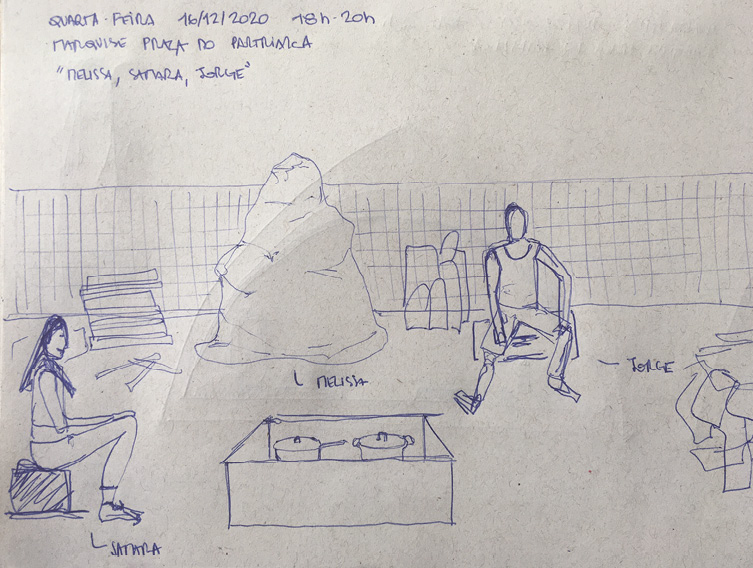
The diary registers:
Melissa mentioned that she had eaten some food from a packed lunch that didn’t sit well with her, and she’d been experiencing a tummy ache for days. She excused herself, grabbed a bucket and covered herself with a white cape. Before she covered herself, I asked her if she wanted me to move away so she could feel more comfortable using the toilet, but she said no, “that she’s used to it, and that nothing would come out, it was just pain, so I could relax”.
Whether they are aware of it or not, through this interactional-spatial dynamics these women end up producing object-situational spaces – fleetingly emerging in the various public places where they engage in daily face-to-face interactions.
A similar dynamic applies to the interactional management of the physical setting also comprising urban furniture. The following photograph (Fig. 2), which my student Paula took at dawn on a Saturday in mid-November 2020, is especially revealing of ways in which the combination of objects and urban furniture ends up producing infrastructure-situational spaces:
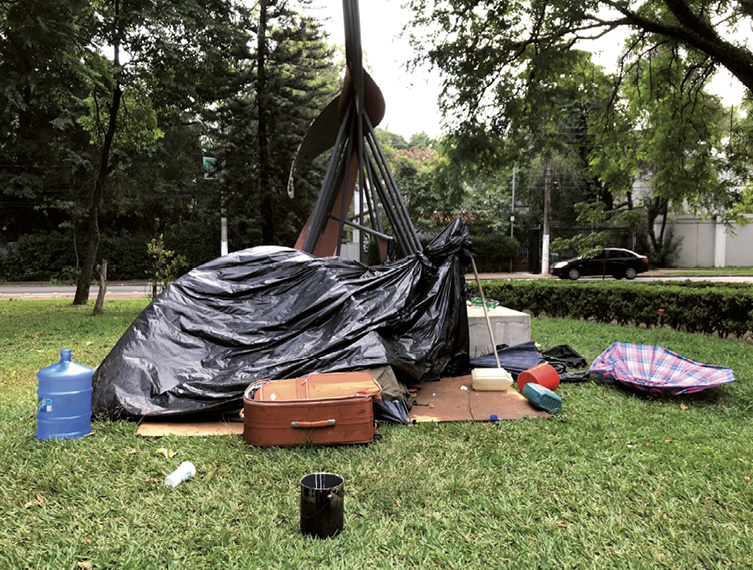
This square is located in one of São Paulo’s highest-rent districts, almost five kilometres from Sé Square. The forementioned low walls, benches, railings, lamp posts, electric cables, and public sculptures such as the “Homenagem a García Lorca” by artist Flávio de Carvalho (1899-1973), dated 1968, all play a role in supporting homeless couples physically shape their street dwellings.
Last but not least, let me address the situational impact of the last two spatialization patterns. The women’s affective bonds with animals and (family) peers influence their surrounding social setting in public places. The spatial outcome is what I term family-situational spaces. The forementioned data clearly show that these women are surrounded, on a face-to-face basis, by children, animals and/or romantic partners.
This holds true even for geographically distant public places, such as the one my student Ana photographed on a Thursday morning in January 2021 during her fieldwork among homeless women and their children in a tent set (Fig. 3):
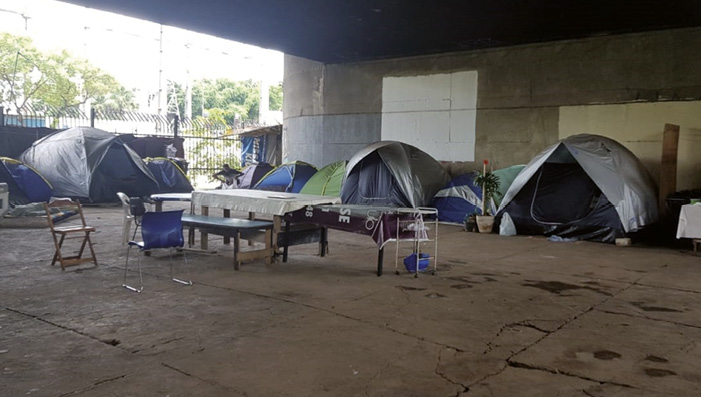
The women and children referred to their dwelling as “Vilinha” (Little Village), a label imbued with an unmistakable affective touch. The use of diminutives for emotional or affectionate purposes is a long-standing tradition in Brazilian Portuguese. In São Paulo’s history, since the nineteenth century, the term “vila” has been used to designate any specific, architecturally conceived group of houses within a neighborhood –and by extension the neighborhood itself (as well as, more recently, political-administrative districts). In this ethnographic context, however, the toponym suggests that, for these people, the place may have been in some sense “homely”– precisely in the affectively experienced sense of “familiarity and homeliness” (Blunt and Dowling 2006, 26).
The dataset unfortunately does not contain any emic explanation about the local meaning of Vilinha. Hence, let me avoid overinterpreting it as evidence of homemaking. Indeed, a common thread across my interview data is the women’s explicit denial of any verbal association between their dwellings and a house in the sense of home; that is, the “casa”. On the contrary, they affectively associate the term casa with spatial cosiness and temporal rest far away from public space, whether with or without a family.
That said, I may return to the crucial point here. Vilinha, as a term of family endearment, was applied to a public place whose physical materiality scarcely invites any sense of affection.
Regardless of their quantitative sparsity, I hope that, once submitted to the preceding two-step methodology, the ethnographic data above demonstrate the empirical relevance of this paper’s argument. Intersectional inequalities also shape the physical-material and social setting of public space situationally. While this may seem all too ephemeral, an impressionistic glance at São Paulo’s public places during the pandemic suffices to demonstrate the striking temporal persistence of this ephemerality.
Against the backdrop of this empirical outcome, we may summarize four lessons from the homeless women in Covid-19 São Paulo as to this paper’s central issue, which concerns precisely the daily impact of intersectional inequalities on public space, conceived both physical-materially and socially. Implicit in each lesson is a contribution of this paper to the dossier’s major topic; that is, the links between intersectionality and social inequality in the urban public spaces of present-day Latin America.
First, we learn that the temporal repetitions implicit in patterns or regularities play a crucial methodological role when it comes to sociologically depicting the situational impact of intersectionally marked asymmetries on urban public space. Although empirically experienced situations of face-to-face interaction are temporally fleeting by definition, I was only able to examine them because my ethnographic dataset provides three or more recurrences regarding their becoming spatial in São Paulo’s public streets, squares, courts and halls. Hence, my methodological emphasis on patterns of spatialized interaction. Otherwise, the temporal uniqueness of the here-and-now in social interaction remains empirically elusive and conceptually ungraspable. This comes as no surprise when we recall that expressly sociological descriptions of social life rely on the analytical depiction of “regularities” (Fernandes 1970, 29) – whether as counterpoints or not.
Thus, the first contribution of this paper to the dossier is a specific, interactional-spatial methodology to the situational relationship between intersectional asymmetries and urban public space in Latin America.
Second, we learn that the situational impact of intersectional inequalities in public spaces is temporally enduring once embedded social-structurally. Within its ephemerality, it vividly reproduces asymmetries socially forged in the family as an institutional space and the casa as a domestic space. The frequent verbal references to family bonds within the dataset draw on the structurally ingrained, patriarchal and hierarchical moral code that underpins the “family” as a symbolic reference among the poor in urban Brazil (Sarti 2003, 20). Indeed, the values at play are situationally inseparable from the morally rigid social structure that underlies the so-called malocas. A synonym of the Indigenous term “hut”, maloca is used by homeless people in contemporary urban Brazil to denote the public-spatially regular, face-to-face gatherings of homeless people in public places across the city for either dwelling or gathering purposes (for a synthesis see Frehse 2021c, 48-56).
Hence, this paper makes a second contribution to the dossier. It demonstrates that addressing the relationship between intersectional inequalities and public space in urban Latin America requires attention to values socially forged in other spaces, whether institutional or symbolic. In particular, family and and domestic spaces serve as symbolically crucial, albeit implicit, interactional references. Their spatial diversity can be encapsulated in the image of the so-called patriarchal house (casa) in Latin America.
Third, the implicit symbolic presence of both the family and the casa within the women’s interactions in São Paulo’s public places teaches us that a specific spatial product is being created daily in the pandemic city: a family public space. Its legal, physical and informational accessibility for women is situationally grounded in family-based, intersectional inequalities.
Thus, we arrive at this paper’s third contribution to the dossier’s issue. The family public space is a spatial product that should not to be confused with the two previously mentioned trends in urban-studies regarding the conceptualization of public space through the lens of homelessness. It is neither a private space in public nor a home. The family public space is a social-structurally specific space.
The fourth and final potential contribution of this paper concerns the impact of Latin American intersectional inequalities in particular to the interactional production of urban public space. By teaching us about the importance of creating family dwellings in the streets, the women in focus highlight the historically longstanding role of the family as an institution in Brazil – and more broadly in Latin America. While delving deeper into this issue would exceed the scope of the present paper, its mere possibility suggests that the situational impact of intersectional inequalities in urban public space is a complex family issue. It begins outside the street –in the family’s casa– and extends into the street by producing it here-and-now as a family public space.
Hence, we learn that, contrary to the most deeply held hopes of urban and homelessness scholars, what these women seem to resist the most in public places is not homelessness. Rather, it is the risk of being family-less in the street.
The theoretical, methodological and empirical research underlying this study was funded respectively by SMUS (Project Nr. 57526630) –which, in turn, is funded by the German Federal Ministry for Economic Cooperation and Development (BMZ) via the German Academic Exchange Service (DAAD)– and by the British Academy’s Visiting Fellowships 2023 Programme (Project VF2\100498). Partial funding for this paper was provided by the Coordenação de Aperfeiçoamento de Pessoal de Nível Superior - Brasil (CAPES) - Finance Code 001.
I thank the SMUS student-research team encompassed by Giulia Patitucci, Giovanna Bernardino, Ednan Santos, Paula Quintão, Ana Gil as well as Tales Cunha, Caio Reis and Anna Silva, who helped me collect the major ethnographic dataset, which underlies this study. Moreover, my gratitude extends to the homeless people who joined the project. Last but not least, I thank the Iberoamericana reviewers and my colleagues Laura Kemmer, Frank Müller, Serge Paugam, Bruna Gisi, Flavia Rios, Lena Lavinas, Angela Alonso and Leopoldo Waizbort, from my university’s Department of Sociology, all of whom provided critical readings that contributed to the final version of this paper.
Banerjee, Paroj. 2023. “Making-Home from Below: Domesticating Footpath and Resisting ‘Homelessness’ in Mumbai.” Antipode 55, no. 1: 5-26. https://doi: 10.1111/anti.12889.
Baquero, Oswaldo S., and Érica Peçanha, eds. Comunidades e Famílias Multiespécies: Aportes à Saúde Única em Periferias. IEA/SUP/Amavisse. https://doi.org/10.11606/9786588152218.
Bettie, Julie. 2014. Women without Class. University of California Press.
Brekhus, Wayne H. 2022. “Markedness and Unmarkedness in Identified and Social Interaction.” In The Oxford Handbook of Symbolic Interactionism, edited by Wayne H. Brekhus, Thomas DeGloma, and William R. Force. Oxford University Press.
Butler, Judith. 2002. “Is Kinship Always Already Heterosexual?” Differences: A Journal of Feminist Cultural Studies 13, no. 1: 14-44.
Cabral, Mariana P. G., Francisco A. C. de Lima, Raquel C. de Lima, and Maria L. Magalhães Bosi. 2024. “A cor da morte na pandemia de Covid-19: epidemologia social crítica, interseccionalidade e necropolítica.” Physis 34: e34053. http://dx.doi.org/10.1590/S0103-7331202434053pt.
Dantas, Marianny N. P., Mercês de F. dos S. Silva, and Isabelle R. Barbosa. 2022. “Reflexões sobre a mortalidade da população negra por Covid-19 e a desigualdade racial no Brasil.” Saúde e Sociedade 31, no. 3: e200667pt. https://doi.org/10.1590/S0104-12902022200667pt.
Damasceno, Victoria, and Rogério Pagnan. 2021. “Explosão de violência doméstica durante pandemia faz PM de SP implantar Patrulha Maria da Penha.” Folha de S. Paulo, April 27. https://folha.com/8jqs94du.
Esposito, Jennifer, and Venus Evans-Winters. 2021. Introduction to Intersectional Qualitative Research. Sage.
Fernandes, Florestan. 1970. Elementos de Sociologia Teórica. Companhia Editora Nacional/Edusp.
Fórum Brasileiro de Segurança Pública (FBSP). 2024. 18º Anuário Brasileiro de Segurança Pública. FBSP. https://forumseguranca.org.br/wp-content/uploads/2024/07/anuario-2024.pdf.
Frehse, Fraya. 2016a. “Desigualdades no uso corporal dos espaços públicos urbanos na América Latina.” desiguALdades.net Working Paper Series 95. https://www.desigualdades.net/Working_Papers/index.html.
— 2016b. “Da desigualdade social nos espaços públicos centrais brasileiros.” Sociologia & Antropologia 6, no. 1: 129-158. https://doi.org/10.1590/2238-38752016v616.
— 2018. “On the Everyday History of Pedestrians’ Bodies in São Paulo’s Downtown amid Metropolization (1950-2000).” In Urban Latin America: Words, Images, Flows and the Built Environment, edited by Bianca Freire-Medeiros and Julia O’Donnell. Routledge.
— 2020. “A Rua de Máscara (São Paulo, 5 de novembro de 2020).” Documentary Film. https://youtu.be/DDhrEFczyko.
— 2021a. “Time and the Production of Space in Sociology.” Sociologia & Antropologia 11, no. 2: 389-414. https://doi.org/10.1590/2238-38752021v1122.
— 2021b. “Erving Goffman’s Sociology of Physical Space for Architects and Urban Designers.” In The New Urban Condition, edited by Leandro Medrano, Luiz Recamán, and Tom Avermaete. Taylor & Francis/Routledge.
— 2021c. “The Historicity of the Refiguration of Spaces under the Scrutiny of the Pre-Covid São Paulo Homeless Pedestrians.” In Spatial Transformations, edited by Angela Million, Christian Haid, Ignacio Castillo Ulloa, and Nina Baur. Routledge.
— 2021d. “Arquitetura de Rua em São Paulo em Tempos de Covid-19/Street Architecture in Covid-19 São Paulo/Straßenarchitektur in São Paulo zu Corona-Zeiten.” Documentary Film. Technische Universität München. https://youtu.be/a-o3aaE22mM.
— 2022a. “‘To Have a Home’: Intersectional Inequalities and Urban Public Space in post-Covid Latin America viewed through Women-headed Homeless Families in São Paulo.” Research project, The British Academy Visiting Fellowship Programme 2023 (Award Reference VF2\100498). https://www.thebritishacademy.ac.uk/projects/professor-fraya-frehse/.
— 2022b. “Concepts of Space (Region, Territory, Frame).” In Goffman-Handbuch: Leben-Werk-Wirkung, edited by Robert Hettlage and Karl Lenz. J.B. Metzler.
— 2025. “How Löw’s Constitution of Space Methodologically Enhances Lefebvre’s Production of Space.” In Figuring Out Spaces: Über die Sozialität von Räumen und die Räumlichkeit des Sozialen, edited by Jochen Kibel, Nina Meier, Silke Steets, and Gunter Weidenhaus. Transcript.
Frehse, Fraya, Caio M. Reis, and Giula Patitucci. 2024. “Contribuições interacionais ‘de pessoas em situação de rua para a sustentabilidade urbana’”. Revista Brasileira de Ciências Sociais 39 e39014.2024: 1-21. http://www.doi.org/10.1590/39014/2024.
Ganji, Farnaz, and Clare Rishbeth. 2020. “Conviviality by Design: The Socio-spatial Qualities of Spaces of Intercultural Urban Encounters”. Urban Design International 25: 215-34.
Goffman, Erving. 1959. The Presentation of Self in Everyday Life. Anchor.
— 1963. Behavior in Public Places. The Free Press.
Handel, Ariel. 2019. “What’s in a Home? Toward a Critical Theory of Housing/Dwelling.” Environment and Planning C: Politics and Space 0, no. 0: 1-18. http://dx.doi.org/10.1177/2399654418819104.
Harding, Alan, and Talja Blokland. 2014. Urban Theory. Sage.
Instituto Pólis. 2020. “Raça e Covid no Município de São Paulo – julho 2020.” https://polis.org.br/estudos/raca-e-covid-no-msp/ (accessed November 9, 2025).
Jaramillo Cruz, Javier. 2022. “Discapacidad y derecho a la ciudad en la producción social del espacio público.” Revista INVI 37, no. 104: 152-68. https://doi.org/10.5354/0718-8358.2022.65643.
Kemmer, Laura, Wladimir Sgibnev, Tonio Weicker, and Maxwell Woods. 2022. “Spaces of Exposure: Re-thinking ‘Publicness’ through Public Transport.” Cultural Geographies 29, no. 2: 285-299. https://journals.sagepub.com/doi/full/10.1177/14744740211068097.
LabCidade. 2025. “Coronavírus. Categoria: Territorialização da Pandemia.” Laboratório Espaço Público e Direito à Cidade. https://www.labcidade.fau.usp.br/category/territorializacao-da-pandemia/.
Lancione, Michele. 2025. “The Colonies of Home.” In The Routledge Handbook of Home, edited by Elaine Stratford. Routledge.
Lefebvre, Henri. 2000. La production de l’espace. Anthropos.
Lenhard, Jacques, Laureline Coulomb, and Alejandro Miranda-Nieto. 2022. “Home Making without a Home: Dwelling Practices and Routines among People Experiencing Homelessness.” Housing Studies 37, no. 2: 183-188. http://doi.org/10.1080/02673037.2022.2022862.
Leite, Rogério P. 2025. Contra-Usos da Cidade. Editora da Unicamp.
Low, Setha. 2021. Why Public Space Matters. Oxford University Press.
Malinowski, Bronislaw. 1926. Crime and Custom in Savage Society. Harcourt, Brace & company, inc.
McCarthy, Lindsey. 2020. “Homeless Women, Material Objects and Home (Un)making.” Housing Studies 35, no. 7: 1309-1331. https://doi.org/10.1080/02673037.2019.1659235.
Ministério da Saúde. 2025. “Covid-19 no Brasil [Filter ‘Ano: 2020, 2021, 2022’; ‘Óbitos Acumulados’]”. https://infoms.saude.gov.br/extensions/covid-19_html/covid-19_html.html. Accessed November 9, 2025.
Natalino, Marco. 2022. “Estimativa da População em Situação de Rua no Brasil (2020-2022).” Instituto de Pesquisa Econômica Aplicada (IPEA). https://repositorio.ipea.gov.br/handle/11058/11604.
Paul, Joshua. 2023. “‘My Room is like a Sanctuary’: Exploring Homelessness and Home(un)Making in the Austere City.” Area 55: 150-159. https://www.doi.org/10.1111/area.12830.
Perelman, Mariano. 2017. “Disputas en torno al uso del espacio público em Buenos Aires.” Cadernos CRH 31, no. 82: 8798. https://doi.org/10.1590/S0103-49792018000100006.
Pleace, Nicholas, Eoin O’Sullivan, and Guy Johnson. 2022. “Making Home or Making Do: A Critical Look at Homemaking without a Home.” Housing Studies 37, no. 2: 315-331. http://www.doi.org/10.1080/02673037.2021.1929859.
Ragin, Charles C., and Peer C. Fiss. 2017. Intersectional Inequality: Race, Class, Test Cores, and Poverty. The University of Chicago Press.
Reckwitz, Andreas. 2012. “Affective Spaces: A Praxeological Outlook.” Rethinking History 16, no. 20: 241-258.
Rede Nossa São Paulo. 2021. “A Covid-19 e as desigualdades – setembro de 2021.” https://nossasaopaulo.org.br/wp-content/uploads/2021/09/Mapa-da-Desigualdade-Especial-Covid-2021.pdf (accessed November 9, 2025).
Reimberg, Juliana. 2023. “A Implementação da Política de Acolhimento Institucional para Mulheres em Situação de Rua na Cidade de São Paulo: uma análise a partir da atuação das Organizações da Sociedade Civil.” MA Thesis, University of São Paulo. https://www.teses.usp.br/teses/disponiveis/8/8131/tde-25042024-115512/pt-br.php.
Sarti, Cynthia. 2003. A Família como Espelho. São Paulo: Cortez.
SMADS/Qualitest (Secretaria Municipal de Assistência e Desenvolvimento Social/Qualitest). 2021. Censo da População em Situação de Rua do Município de São Paulo – 2021: Produto V – Relatório completo. São Paulo: SMADS.
Tryuenque, Marcia C. 2023. “Multispecies Families in Latin America: Protecting Animals by Protecting Human Rights.” ReVista: Harvard Review of Latin America, February 5. https://revista.drclas.harvard.edu/familias-multiespecie-en-latinoamerica/.
World Inequality Database. 2023. “Top 10% National Income Share [2023].” Accessed November 9, 2025. https://wid.world/share/#0/countriesmap/sptinc_p90p100_z/all/last/eu/k/p/yearly/s/false/24.781000000000002/80/curve/false/region.
Yuval-Davis, Nira. 2015. “Situated Intersectionality and Social Inequality”. Raisons Politiques 2, no. 58: 91-100.
Manuscript received: 28.03.2025
Revised manuscript: 27.11.2025
Manuscript accepted: 16.03.2026
1 I am aware of the socially prejudiced nature and use of homelessness as a synonym of a mere “absence of home” (Blunt and Dowling 2006, 126; Handel 2019; Banerjee 2023; Lancione 2025).
2 For information on São Paulo see, among others, Instituto Pólis (2020), Nossa São Paulo (2021); for Brazil see, among others, Dantas et al. (2022) and Cabral et al. (2024).
3 All translations from languages other than English are my own.
4 A first individual study took place in November 2020 (Frehse 2020) in the framework of my role as coordinator of a team research-and-practice project sponsored by the Global Center of Spatial Methods for Urban Sustainability (SMUS – https://gcsmus.org). The second study, in September-October 2021, ended in a film commissioned by the Museum of Architecture of the Technische Universität München (Frehse 2021d). The two team studies, in turn, spanned from November 2020 to April 2022 as part of the SMUS project, and involved the collaboration of eight graduate students from sociology, anthropology, history, architecture, urban planning, social psychology and nursing based at four São Paulo universities.
5 See among others FD Frehse (2020-2021) regarding Thu 5.11.2020, 10:00-14:00; FD Gil (2020-2021) regarding Friday 11.12.2020, 14:00-18:00; FD Patitucci (2020-2021) regarding respectively Wed 18.11.2020, 18:00-19:00, Tue 24.11.2020, 18:00-20:00, Fri 8.01.2021, 8-10:00, Tue 19.01.2021, 8:00-10:00; FD Quintão (2020-2021) regarding Wed 13.01.2020, 19:30-1:30.
6 FD Bernardino (2020-2021) regarding Thu 10.12.2020.
7 FD Patitucci (2020-2021) regarding Thursday 19.11.2020, 18:00-20:00.
8 FD Gil (2020-2021) regarding Fri 11.12.2020, 14:00-18:00.
9 FD Patitucci (2020-2021) regarding Fri 08.01.2021, 8:00-10:00.
10 FD Patitucci (2020-2021) regarding Tue 19.01.2021, 8:00-10:00.
11 FD Patitucci (2020-2021) regarding Wed 18.11.2020, 18:00-19:00.
12 FD Patitucci (2020-2021) regarding Tue 24.11.2020, 18:00-20:00.
13 FD Bernardino (2020-2021) regarding Tue 05.01.2021, 14:00-17:30.
14 FD Patitucci (2020-2021) regarding Fri 08.01.2021, 8:00-10:00.
15 FD Patitucci (2020-2021) regarding Tue 24.11.2020, 18:00-20:00.
16 FD Santos (2020-2021) regarding Wed 28.01.2021, 10:00-11:00.
17 FD Santos (2020-2021) regarding respectively Fri 26.11.2020 and Thu 10.12.2020, 7:00-12:00.
18 FD Patitucci (2020-2021) regarding Wed 16.12.2020, 18:00-20:00.
19 FD Patitucci (2020-2021) regarding Wed 18.11.2020, 18:00-19:00.
20 FD Patitucci (2020-2021) regarding Wed 16.12.2020, 18:00-20:00.
21 FD Quintão (2020-2021) regarding Sat 14.11.2020, 18:20-19:50.
22 FD Gil (2020-2021) regarding Thu 21.01.2021, 9:00-13:00.