
DOI: 10.18441/ibam.26.2026.92.37-60
Gynna Millan
Universidad del Valle, Colombia
gmillan.uk@gmail.com
ORCID ID: https://orcid.org/0000-0003-1252-631X
Isabella Jaramillo
Universidad del Valle, Colombia
isabella.jaramillo@correounivalle.edu.co
ORCID ID: https://orcid.org/0009-0008-6585-4986
Ángela Franco Calderón
Universidad del Valle, Colombia
angela.franco@correounivalle.edu.co
ORCID ID: https://orcid.org/0000-0002-8134-2269
Catalina Ortiz
University College London, UK
catalina.ortiz@ucl.ac.uk
ORCID ID: https://orcid.org/0000-0001-5000-7428
Andrés Sepúlveda
Investigador independiente, Colombia
andresepul43@gmail.com
ORCID ID: https://orcid.org/0009-0000-2859-4419
Self-built neighborhoods in Latin American cities are often approached through standardized upgrading policies and programs that prioritize physical-spatial interventions like land titling and infrastructure improvement (Denaldi and Cardoso 2021; Di Virgilio, Guevara, and Arqueros 2014; Rigon 2022). While such interventions remain important, we argue that these approaches fundamentally misread the nature of public space in self-built neighborhoods. The GREAT (Gridding Equitable Urban Futures in Areas of Transition) research project, undertaken between 2020 and 2023, revealed that public spaces in these contexts are not just physical assets to be improved, but rather sites where multiple forms of discrimination intersect to influence everyday life. This insight challenges the dominant technical-rational paradigm of upgrading programs and suggests the need for new analytical frameworks able to capture the complex interplay between social identities and spatial practices (Millstein 2017; Rigon 2022; Yeboah 2021). The case of District 18 in Cali, Colombia, illustrates how intersectional inequalities materialize in urban public spaces within Latin America’s self-built neighborhoods. Unlike other Latin American cities that experience similar contrasts between economic prosperity and social inequality, Cali presents a distinctive convergence of factors that make it particularly valuable for understanding intersectional dynamics in public space. The city’s history of internal displacement, its significant Afro-descendant population, and its most recent social uprising1 have created a laboratory where multiple forms of discrimination become evident in public spaces. With an estimated population of 2.3 million people, Cali embodies the paradoxes of Latin American urbanization: while it stands as one of Colombia’s most important financial centers, a quarter of its population lives below the monetary poverty line and the Gini Coefficient was 0.512 in 2022 (Secretaría de Desarrollo Económico 2023). This inequality manifests spatially through segregated urban growth patterns inherited from the colonial era (Hernández 2017, xviii). This situation is particularly visible in the self-built neighborhoods that house around 250,000 people, many of them internally displaced persons (IDPs) and poor Afro-descendant, Indigenous and Mestizo migrants (Franco-Calderón 2022).
In these neighborhoods, residents face multiple factors of disadvantage –being poor, displaced, belonging to ethnic minorities, and bearing the social stigma of living in barrios populares– which generates unique challenges that single-approach upgrading methods fail to address. Beyond physical precarity, residents navigate complex social dynamics including disputes over territorial control, competition for scarce public spaces, and the continuous arrival of IDPs seeking refuge. These challenges came to the fore during the 2021 social uprising that kept Cali under siege for two months, revealing the urgent need to address intersecting inequalities in the peripheries of the city.
Within this context, we advance a novel theoretical and methodological framework that reconceptualizes neighborhood upgrading through an intersectional lens. Unlike previous approaches that treat ethnic, cultural, and socioeconomic diversity as background conditions to be managed, we position these intersecting identities as shapers of how public space is accessed, used, and contested. This approach reveals how power relations in self-built neighborhoods are not just reflected in public spaces but are actively produced and reproduced through everyday spatial practices (Kirabo 2022; Lutta et al. 2021).
The methodological innovation lies in developing an intersectional spatial analysis through five integrated strategies that moves beyond traditional upgrading methodologies in several ways. First, by building cross-sector alliances, we challenge the conventional top-down upgrading programs’ implementation. Second, our focus on localizing urban agendas recognizes how global frameworks must be reinterpreted through local intersectional realities. Third, our methods for gathering intersectional data combine quantitative and qualitative approaches to capture how different forms of discrimination manifest spatially. Fourth, our engagement with policy processes demonstrates how intersectional insights can transform institutional practices. Finally, our creation of ‘bridging’ spaces represents an innovative approach to knowledge co-production that recognizes the multiple forms of expertise needed to understand and address intersectional inequalities in public space.
The examination of District 18 and the intersectional methodological approach allow us to contribute to this dossier’s exploration in different ways. The analysis reveals how historic legacies of violence, conflict and spatial segregation continue to shape access and use of public spaces, particularly in contemporary self-built neighborhoods. The methodological framework demonstrates how different social markers of disadvantage –ranging from ethnic identity and gender to displacement status– interact with and are reproduced by the materiality of public space in ways that conventional upgrading approaches often overlook. By documenting how marginalized groups navigate and contest public spaces in District 18, we illuminate the role these spaces play as sites where multiple forms of discrimination become visible and, potentially, addressable through innovative planning and urban design practices such as neighborhood upgrading programs.
The concept of intersectionality, first articulated by Crenshaw (1989; 1991), examines how different social categories intersect to create unique experiences of oppression and privilege (Bowleg 2012; Collins 2015; McCall 2005). While originally focused on the marginalization of African American women, the framework has evolved into a powerful analytical tool for understanding how multiple identities interact with structural inequalities (Collins 2015). Recent research emphasizes intersectionality’s potential as an instrument for understanding the interplay of multiple identities and the structural inequalities that shape individuals’ experiences (Davis 2014; Grzanka and Miles 2016). Scholars have increasingly recognized the importance of situating intersectionality within broader social structures, moving beyond a focus on individual identities to examine how systemic factors contribute to social inequities (Agénor 2020). Despite the growing interest in adopting intersectionality in different fields, there remains a persistent challenge in its application to research and practice. Critical voices argue that intersectionality is often diluted when it is treated only as a tool to navigate complexity, rather than to confront power and systemic inequalities (Bauer et al. 2021; Buchanan and Wiklund 2020). These critical perspectives call for researchers and practitioners to ensure that the intention to work with intersectionality remains focused on enlightening pathways for social justice and activism, rather than becoming just an analytical exercise (Collins 2015).
Public spaces in self-built neighborhoods are sites where intersecting forms of discrimination become particularly visible. Lefebvre (1977, 341) argues that space is ‘political and ideological’. As such, public spaces cannot be considered as neutral containers but rather contested territories where power relations materialize (Kamalipour 2017; Lutta 2021). The intersectional lens reveals how different groups experience varying degrees of oppression or privilege in these spaces. For instance, women may face temporal restrictions on their use of public spaces due to safety concerns, while ethnic minorities might experience discrimination in shared areas. LGBTIQ+ residents often confront multiple layers of exclusion that limit their access to communal spaces (Browne 2007), while elderly residents may find themselves displaced from recreational areas by youth activities. These experiences challenge top-down assumptions of upgrading programs claiming that residents of self-built neighborhoods have homogeneous needs and aspirations (Rigon 2022). Traditional approaches often focus on physical improvements without considering how different groups might be affected differently by the same intervention (Núñez Collado and Wang 2020). Power dynamics are also complex where public space itself is scarce and contested. Miraftab (2009) argues that public spaces in these contexts serve multiple functions: as sites of social reproduction, economic survival, and political resistance. The intersection of these functions with residents’ diverse identities represents multiplicity in space (MacLeavy, Fannin, and Larner 2021; Massey 2005; Liodaki et al. 2024), where different forms of oppression and resistance coexist and interact. For example, as we observed in District 18, a community open space might serve as a meeting point for women to undertake recycling activities during the day, a recreational space for youth in the afternoon, and a gathering place for community meetings and political participation in the evening. Each of these uses carries its power dynamics and potential for exclusion or inclusion based on intersecting identities.
Moreover, the temporal dimension of public space adds another layer of complexity to intersectional analysis. Different times of day might privilege certain groups while excluding others, thereby creating power geometries in space-time (Massey 2005). These temporal patterns often reflect and reinforce existing social hierarchies, with marginalized groups restricted to less desirable times or forced to negotiate their presence in shared spaces. Understanding these temporal dynamics is essential for designing public spaces that accommodate diverse needs and uses throughout the day.
In recent years, there has been a growing interest in incorporating the intersectional approach in the formulation and implementation of public policies (García and Zajicek 2021; Hankivsky and Jordan-Zachery 2019; Manuel 2006; Viveros Vigoya 2016). While promising, this interest faces significant challenges. García and Zajicek (2021) note that traditional policy approaches often rely on single-category analyses that fail to capture how different forms of disadvantage interact. This limitation is particularly evident in neighborhood upgrading programs that treat communities as undifferentiated wholes, overlooking internal power dynamics and competing needs (Rigon 2022).
However, emerging research demonstrates the potential of intersectional approaches to enhance urban interventions. By revealing how different social categories intersect to create unique experiences of urban space, intersectionality can inform more nuanced and effective upgrading strategies (Kakar, Peden, and Jagnoor 2021). This approach is particularly relevant for public spaces, where multiple forms of exclusion and privilege intersect. The institutional barriers to implementing intersectional approaches are deeply rooted in technocratic rationality (Walker and Ossul-Vermehren 2021) or in the tendency to prioritize technical solutions over social complexity. This manifests in standardized planning procedures that struggle to account for multiple, overlapping forms of disadvantage. While maintaining a perception of inclusion, participatory planning processes might privilege certain voices while silencing others (Miraftab 2009), particularly when they fail to consider how gender, ethnicity, and class influence participation patterns. In addition, there is institutional resistance to incorporating intersectionality within existing policy frameworks (Hancock 2007). García and Zajicek (2021) note that public institutions are structured around traditional, siloed approaches to policy development. Such structures often resist the changes necessary to implement intersectionality, which require collaboration across different areas and a shift away from single-issue policies.
Furthermore, the data-gathering practices of planning institutions reinforce single-category approaches. Traditional census and survey methods collect data on different social categories separately, making it difficult to analyze how these categories intersect in people’s lived experiences. Sen and Iyer (2019) argue that this data limitation creates a knowledge gap that hampers the development of truly intersectional policies. Therefore, new methodological approaches are needed to capture the complexity of intersecting inequalities while remaining practical for policy implementation.
In the context of neighborhood upgrading, intersectionality offers a framework for understanding how residents experience interventions differently based on their intersecting identities (Franco-Calderón and Ramírez 2023). While upgrading programs traditionally focus on physical improvements and land tenure (Rincón García, Torres Tovar, and Vargas-Moreno 2007), our analysis of spatial contestation, overlapping forms of discrimination, and temporal geographies of exclusion, reveals the need to consider how these interventions might affect or benefit different social groups. The application of intersectionality to upgrading programs requires what Rigon and Castán-Broto (2022) call a “transformative approach” that goes beyond technical interventions to address underlying power structures, particularly regarding how social categories of difference interact with spatial and temporal dimensions to produce and reproduce social hierarchies in public spaces.
As Satterthwaite (2012) argues, upgrading programs must consider the temporal dimension of settlement formation and how different waves of residents might have varying needs and vulnerabilities. Recent arrivals, particularly displaced persons, might face different challenges than long-term residents, while their intersecting identities further complicate their ability to benefit from upgrading strategies. This temporal dimension adds another layer to intersectional analysis, requiring attention to how historical processes of settlement formation interact with current patterns of disadvantage.
District 18 in Cali presents a unique case for examining how intersecting inequalities shape public space access and use in self-built neighborhoods. The area’s development trajectory reflects broader patterns of urban inequality: beginning with extra-legal land occupation in the 1970s in flatter areas followed by accelerated informal growth into landslide-prone hills during the 1990s, coinciding with increased internal displacement due to the internal armed conflict. Today, the district has around 32 neighborhoods that house over 60,000 residents (Fig. 1) many of whom grapple with precarious living conditions and face multiple, overlapping forms of disadvantage (Universidad del Valle and Secretaría de Vivienda Social y Hábitat 2020).
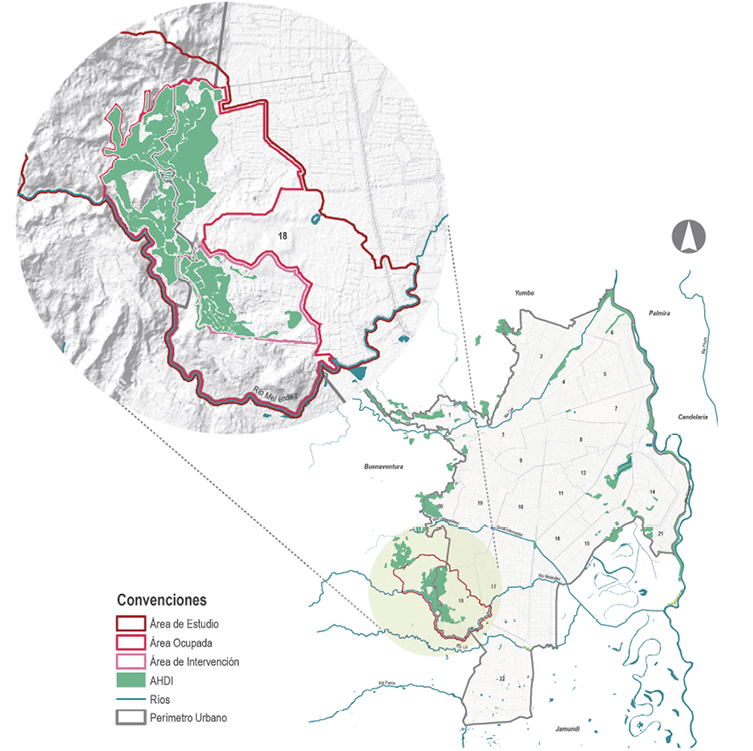
What made District 18 particularly significant for our intersectional analysis was the spatial and social composition found in 2020 when the project started. The settlement patterns reveal how different waves of migrants have created layered communities, each with distinct needs and vulnerabilities. Population growth data demonstrates how the intensification of Colombia’s armed conflict between the late 1990s and 2010 dramatically shaped the district’s demographic composition (Fig. 2a). In turn, the informal growth to landslide-prone areas in the upper part coincides with the concentration of IDPs (Fig. 2b):
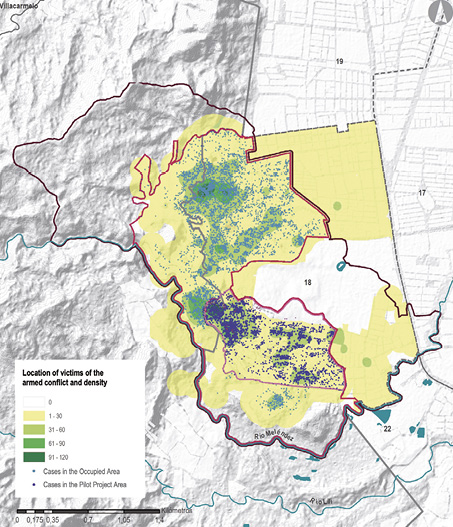
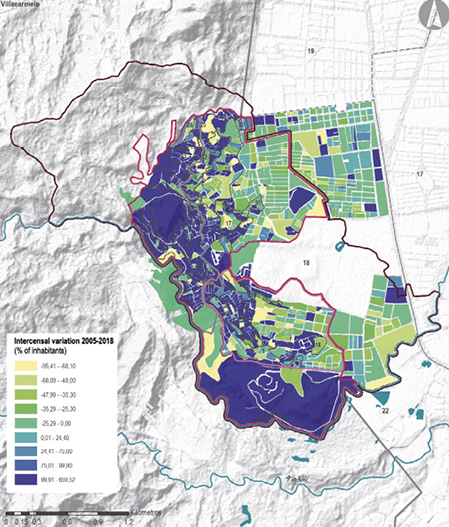
This spatial stratification found in District 18 reflected multiple, intersecting inequalities. Early settlers in the flatter areas generally have more consolidated housing and infrastructure, while more recent migrants, often IDPs, occupy precarious hillside locations. This spatial hierarchy intersects with ethnic and social divisions: Afro-descendant and Indigenous communities are concentrated in the most physically vulnerable areas and women-headed households often face additional barriers to secure a home.
Despite demographic concentration in these settlements across Cali –approximately 250,000 people live in similar conditions– it was not until 2020 that the local government included neighborhood upgrading in its Development Plan. This delay in policy response makes District 18 an important case study for understanding how intersectional approaches can reveal and address long-standing urban inequalities. In 2020, a tripartite alliance was formed between the Secretariat of Social Housing and Habitat of Cali, the Universidad del Valle, and community representatives from four self-built neighborhoods selected as a pilot based on distinctive characteristics identified in previous research.2 This partnership enabled moving beyond conventional upgrading approaches to consider how multiple forms of disadvantage intersect in residents’ daily lives. As presented in the sections below, the depth and granularity of both qualitative and quantitative data gathered through this process provided evidence for how intersecting inequalities manifest spatially and socially in self-built neighborhoods, particularly in the use and access of public spaces.
Our methodological approach deliberately took distance from conventional upgrading processes that typically prioritize physical-spatial interventions. To do so, we developed an intersectional spatial analysis through five integrated strategies specifically designed to reveal how different social categories intersect to shape experiences in public spaces. This approach emerged from the alliance between academia, local government, and the community, enabling a combination of theoretical rigor and practical application while challenging traditional ways of gathering and analyzing data about self-built neighborhoods. As highlighted in the dossier, our approach is positioned within the broader debate on the intersection of inequalities and public space in Latin American cities. Through an empirical case, we demonstrate how theoretical discussions on intersectionality can be operationalized in neighborhood upgrading practices, contributing to a deeper understanding of how spatial, social, and temporal dimensions interact to reproduce or challenge urban inequalities.
The research unfolded through three interconnected phases, each building upon the insights of the previous one. We began with an intensive qualitative exploration (February to August 2020), conducting semi-structured interviews with community leaders who helped us understand how different groups perceived and used public spaces. These interviews revealed complex patterns of inclusion and exclusion that we further explored through focus groups with specific populations, including women from community kitchens, recycling groups, ethnic minorities, elderly residents, people with reduced mobility, and members of the LGBTIQ+ community. Discussions led to the collaborative development of an intersectional matrix that identified key categories of analysis, which the community validated through participatory workshops.
Building on these qualitative insights, we implemented a quantitative documentation phase (October and November 2021). Using the digital tool KoBoToolbox, we conducted a comprehensive geocoded census-type survey in 2,759 households. Ten percent of survey questions were designed capture intersecting disadvantages, moving beyond traditional demographic categories to understand how different forms of marginalization overlap and interact. This quantitative data proved crucial for the process of legal recognition of the neighborhoods while providing robust evidence of how inequalities manifest spatially.
Throughout 2021, we complemented these methods with visual documentation through participatory video workshops. This visual approach captured the lived experiences of different community members, revealing how intersecting identities shape daily interactions in the urban space. The resulting videos proved particularly effective in communicating complex intersectional dynamics to city officials and the broader public, underpinning more inclusive upgrading approaches.
The use of combined methods revealed how public spaces in District 18 function as sites of both oppression and resistance, where different groups negotiate access and belonging through complex temporal and spatial patterns. For instance, our mapping exercises identified how the main community park transformed throughout the day, serving different user groups but also becoming a space of conflict and exclusion. The combination of methods allowed us to understand not just who used these spaces, but how intersecting identities shaped patterns of access, exclusion, and resistance in ways that conventional upgrading assessments might miss.
The 2021 social uprising in Cali marked a critical juncture in addressing historical socio-spatial inequalities. This moment of crisis revealed how decades of public neglect had created spaces where multiple forms of discrimination intersected –from internal displacement due to violence to racial segregation and limited access to urban infrastructure. The emergence of the alliance of local government, academia, and the community from District 18 represented more than institutional collaboration, exemplifying how intersectional approaches can address and reshape power relations in urban governance. The GREAT project provided a framework for testing how intersectional approaches could transform traditional upgrading processes.
Research findings revealed that this alliance’s effectiveness stemmed from its ability to bridge historically antagonistic relationships, particularly the deep-seated distrust between communities and governmental structures. The university’s position as a mediator proved crucial in translating different forms of knowledge and power. As one community leader noted, ‘we’ve seen projects come and go, but having the university involved gave us confidence that our voices would be heard differently this time’ (Personal communication, November 22, 2022).
Through participatory workshops, we observed how different identity groups experienced varying levels of access to public spaces or common areas in the neighborhoods. For instance, workshops focused on women’s experiences unveiled that their participation in public space was constrained by temporal factors (limited to certain hours) and spatial ones (restricted to specific areas considered ‘safe’).
This alliance’s impact extended beyond immediate project outcomes. The university’s engagement with both municipal administration and local communities positioned intersectionality as a lens for implementing the Comprehensive Neighborhood Upgrading Public Policy in Cali. However, this process also revealed persistent tensions. As one public official reflected, ‘it is very difficult and rarely occurs that academic research coincides with political agendas and interests’ (Personal communication, November 22, 2022).
These challenges highlighted the university’s role as an intermediary institution to create a new space where different forms of knowledge and power can be negotiated to develop more equitable upgrading processes (Rigon 2022). This role, that at the same time generates knowledge through research, was particularly important in creating trust and facilitating dialogue between technical planning requirements and community-based knowledge systems. The alliance’s success in District 18 demonstrates that the intersectional approach has the potential to transform traditional power hierarchies in urban governance. By recognizing and engaging with multiple forms of knowledge and experience, this model offers a basis for more inclusive upgrading processes that address both physical infrastructure needs and underlying social inequalities.
The implementation of intersectional approaches in neighborhood upgrading requires careful attention to how inequalities manifest across different scales of urban governance. The case of District 18 demonstrates how local experiences of intersecting disadvantages can inform and reshape broader policy frameworks. Rather than treating policy alignment as a top-down process, we found that intersectional analysis reveals how marginalized communities experience and negotiate different scales of urban policy simultaneously.
The process began by examining how District 18 residents’ everyday experiences of exclusion connected to broader patterns of urban inequality. Using intersectional mapping we knew how people with reduced mobility faced forms of exclusion that extended beyond the neighborhood scale. As one resident who uses a wheelchair explained,
It’s not just about the steep streets in our neighborhood. Even if I manage to reach the main road, bus drivers often pass by without stopping, or they say they’re in a hurry to help me board. This means that I can’t reliably get to work in other parts of the city (Personal communication, June 6, 2022).
This statement demonstrates how local infrastructural challenges intersect with systemic discrimination in public transportation to create barriers to economic, social and cultural participation. A community leader further noted,
Many of our neighbors with restricted mobility limitations have skills and want to contribute to the city’s economy, but they’re confined to their neighborhood because the city is not designed to cater for their needs (Personal communication, March 15, 2011).
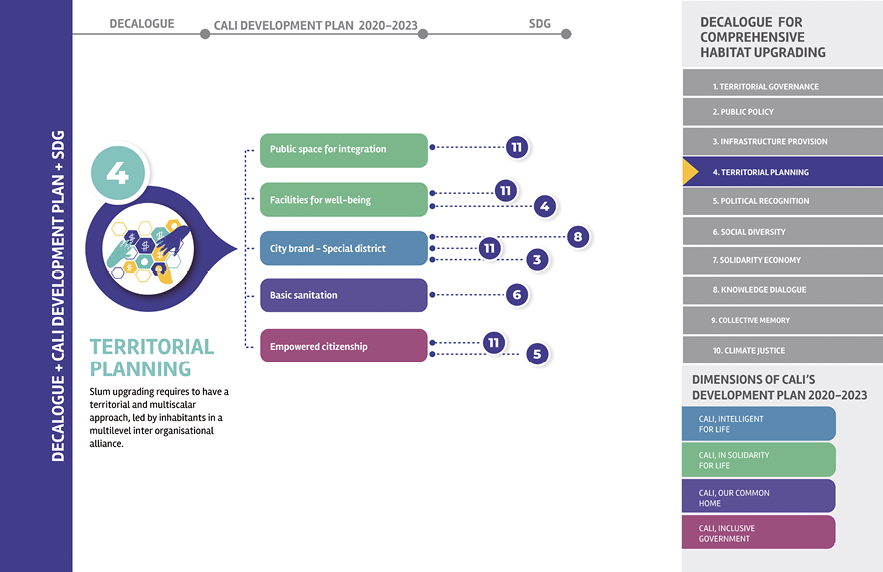
This testimony informed our approach to policy alignment across three scales. At the local level, we worked with Cali’s Development Plan 2020-2023 ‘United for Life’, identifying how its eighteen strategic lines intersected with residents’ lived experiences. Rather than treating neighborhood upgrading as the responsibility of a single entity, intersectional analysis revealed connections across multiple municipal programs –ranging from peace building and income generation to risk reduction. This approach challenged traditional policy silos by demonstrating how different forms of disadvantage require coordinated interventions. At the regional scale, we used the Decalogue for Participatory Slum Upgrading for LAC countries developed by Synergies for Solidarity in 2020 as a framework to translate local intersectional findings into broader policy recommendations. Two elements proved particularly powerful: the guideline on Collective Memory helped legitimize IDPs’ experiences of displacement and settlement formation, while the focus on Solidarity Economies validated existing community-based practices, particularly those led by women and ethnic-racial minorities.3
Finally, connecting local intersectional data to the Sustainable Development Goals (SDGs) helped demonstrate how addressing overlapping inequalities in self-built neighborhoods contributes to global urban justice. This multi-scalar approach, exemplified below (Fig. 3), revealed what authors such as Castán Broto and Neves Alves (2018) identify as ‘interconnected spaces of inequality’, which show how interventions at the neighborhood level can address broader patterns of urban exclusion.
However, this scalar integration presented challenges. City officials often struggled to translate intersectional insights into standardized policy frameworks, while community members questioned whether global goals reflected their immediate needs. As one resident noted, ‘We understand these bigger objectives, but our daily struggles need immediate solutions’ (Personal communication, March 13, 2023). These tensions highlighted the importance of maintaining focus on lived experiences while building broader policy connections.
The development of an intersectional matrix with District 18 communities revealed how conventional categories of social analysis prove insufficient for understanding the complex dynamics of self-built neighborhoods. Research findings demonstrated that individual identity categories typically used in intersectional studies –such as gender, ethnicity, and class– needed to be complemented by collective categories that reflect the particular social fabric of popular neighborhoods in Latin American cities. This methodological innovation emerged from recognizing the collective dimension of urban marginalization (Castán Broto and Neves Alves 2018).
Through workshops and focus groups, we identified seven intersecting categories of oppression and privilege. Individual categories included gender, ethnicity, functional diversity, being a victim of armed conflict, and resident status in precarious settlements. However, the addition of collective categories such as socio-spatial segregation and community participation, proved to be key for understanding how power operates in these spaces. This expanded framework revealed complex dynamics that conventional upgrading approaches often miss.
The category of socio-spatial segregation emerged as particularly significant, manifesting what Bourdieu (1995) terms ‘symbolic violence’4, and considering that these areas are commonly stigmatized by citizens living in formal neighborhoods who describe them as ‘invasiones’ and see their inhabitants as a burden on the State, particularly the IDPs (Centro Nacional de Memoria Histórica 2015, 451). As one community leader explained, ‘Even after decades of living here, we’re still seen as illegitimate city residents.’ This stigmatization intersects with other forms of discrimination that affect residents’ own positioning and their interactions with formal city institutions.
Our intersectional mapping exercises also revealed how public spaces become sites where multiple forms of oppression and privilege materialize. For instance, the community park emerged as a space of contested temporalities and uses. A trans woman’s testimony captured this complexity:
Once, we wanted to play a soccer game on the Meléndez soccer field and they were refusing us [...] A mother told the person in charge that those faggots were not allowed to enter. Then we, without being rude, claimed our rights. It’s a public field! (Personal communication, June 7, 2022).
This incident demonstrates how gender identity intersects with spatial rights and public space access.
Moreover, the temporal dimension of public space exclusion emerged as a crucial finding. Elderly residents reported feeling displaced from parks during youth sporting activities. As one elderly resident noted, ‘The park belongs to everyone, but in reality, it belongs to different people at different times’ (Personal communication, March 15, 2022). Meanwhile, parents identified certain areas as off-limits to children due to drug consumption. These patterns reveal how different forms of exclusion operate on daily and seasonal rhythms, creating what we term ‘temporal geographies of exclusion’ (Fig. 4).
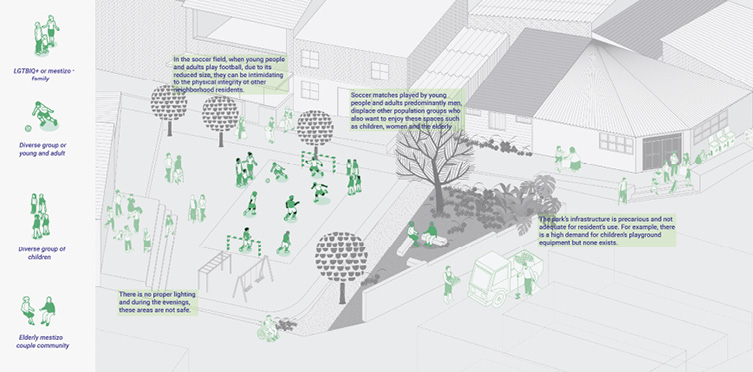
Regarding community participation, it emerged as a complex category that could represent both oppression and privilege. Some residents viewed community leaders as privileged power-holders: ‘one of the leaders has the keys to the community park and it’s he who decides who gets to enjoy it’ (Personal communication, June 6, 2022). However, leaders themselves described feeling oppressed by community expectations: ‘Everyone expects us to solve their problems, from water access to land titles, but we’re volunteers struggling with the same daily challenges and these processes require intense negotiations’ (Personal communication, March 13, 2023). These findings demonstrate how intersectional mapping can reveal the complex power dynamics that shape public space access and use in self-built neighborhoods while including diverse voices and aspirations with the idea of preventing the reproduction of conflicts, revictimization and the entrenching of existent territorial control structures. More importantly, they suggest that upgrading programs must consider not just physical infrastructure but the temporal, social, and power relations that determine who can access and benefit from public spaces.
The implementation of the intersectional approach in District 18 transformed not only how we as researchers and the city officials understood the territory but also how upgrading policies were conceived, designed, and implemented. Our methodological approach, aligned with the proposition that knowledge created through an intersectional lens is relevant for policy making (Walker and Ossul-Vermehren 2021), meant that insights directly influenced intervention strategies while challenging conventional upgrading approaches.
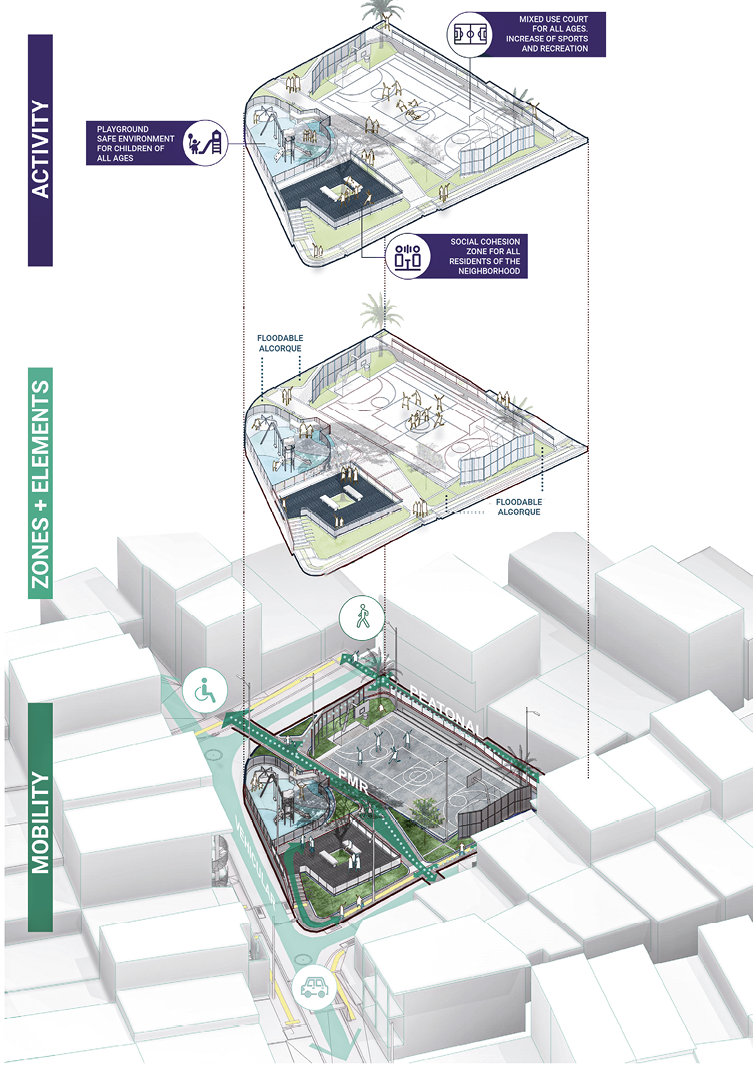
A key innovation emerged in how we addressed public space design. Rather than treating public spaces as neutral containers for community activities, the analysis revealed the need for what we define as ‘temporally adaptive spaces.’ For instance, the new design of one of the community parks incorporated flexible elements that could accommodate different user groups throughout the day, such as shaded seating areas for elderly residents that didn’t interfere with youth sporting activities, or well-lit pathways that enhanced women and LGBTQ+ community members’ safety during evening hours (Fig. 5). As one of the architects involved in the design noted, ‘we’re not just designing spaces, we’re designing possibilities for the coexistence of different social diversities’ (Personal communication, July 10, 2022).
Public space design also considered temporal patterns of use, ensuring that physical improvements enhance rather than restrict the diverse ways different groups access and use community spaces throughout the day. Moreover, cultural diversity has become central to community space planning, recognizing that public spaces must accommodate and celebrate different cultural practices and forms of spatial appropriation.
The intersectional approach also revealed the concentration of ethnic minorities and the urgency for policy attention. The survey showed that in cases such as Brisas de las Palmas, one of the pilot neighborhoods, 28% of residents self-identified as Afro-descendants and 12.5% as Indigenous, some reporting experiences of discrimination that affected their access to urban services and opportunities. This data evidenced the need to develop culturally sensitive upgrading strategies, including the incorporation of ethnic community practices in public space design. The survey also revealed the high concentration of people who recognize themselves as victims of the armed conflict living in these neighborhoods; 41.7% of Brisas de las Palmas residents self-identified as victims, yet only 15% were officially registered in the Registro Único de Victimas (RUV). This finding has profound implications for Colombia’s victim reparation policies, which have historically focused on new housing projects rather than upgrading settlements where IDPs have established community networks (Corte Constitucional 2016).
Finally, we develop intersectional maps using Geographic Information Systems (GIS) which included ‘victims’ as a category for intersectional analysis. This step was fundamental to support the Constitutional Court’s argument that IDPs were living in precarious settlements and to draw government’s attention to the need of including legal recognition and upgrading actions as reparation measures5 to ensure access to decent housing for IDPs (Ortiz and Franco-Calderón 2022). As a result, the emphasis on intersecting vulnerabilities in District 18 led to the development of more comprehensive neighborhood upgrading strategies that essentially reconceptualize how upgrading interventions should respond to multiple, overlapping forms of disadvantage. Significantly, neighborhood upgrading in Colombia is gaining traction as a potential form of reparation for conflict victims, acknowledging the role that these neighborhoods play in providing stability and community networks for displaced populations.6
The challenge of implementing intersectional approaches extends beyond individual projects to questions of institutional sustainability and knowledge transfer. The case of District 18 demonstrates how academic institutions can play a crucial role in proposing and implementing new frameworks for progressive urban practice. The creation of the Laboratorio de Barrios Populares (PopuLab) at Universidad del Valle embodies a new model for engagement with the social production of the habitat as the most recurrent form of urbanization in the Global South.
PopuLab emerged from recognition that intersectional approaches require long-term institutional commitment rather than project-based interventions. Its launch event in 2022, which brought together over 120 participants from communities, public entities, professional associations, NGOs, and academia, demonstrated the appetite for new innovative approaches and methodologies to work with communities and residents of self-built neighborhoods. As one community leader reflected, ‘I feel recognized as a woman, mother, Afro-Colombian, and social leader with many dreams to be achieved within my community’ (Personal communication, November 22, 2022).
The laboratory’s integration into the School of Architecture’s curriculum through a design studio and an elective course in 2023 marked a significant departure from traditional architectural education in Latin America. Unlike Schools of Sociology or Social Work, architecture programs in the region have historically maintained distance from self-built neighborhoods, often describing them as marginal areas, tugurios, villas miseria, or chabolas; areas considered beyond the aesthetic parameters of architecture and urbanism inspired by Global North models. This curricular innovation challenges these prejudices, training a new generation of architects to understand the complex intersectionality of urban marginalization.
The impact of this institutional transformation extends beyond the university. The community empowerment achieved through the intersectional approach in District 18 has demonstrated remarkable resilience through political transitions. When a new administration took office in January 2024, the momentum for inclusive upgrading continued. Through the Development Plan 2024-2028 ‘Cali, peaceful capital of Colombia’, the new mayor committed to legally recognize 45 settlements city-wide. This dramatic increase from the four pilot neighborhoods carried out between 2020 and 2023, suggests how intersectional approaches can reshape political priorities. Similarly, the ongoing construction of three public space projects designed by the School of Architecture of Universidad del Valle through intersectional methodologies provides concrete evidence of how theoretical insights can transform urban practice. This institutionalization of intersectionality suggests new possibilities for sustainable urban spaces. By creating permanent spaces for dialogue between academic knowledge, community experience, and policy practice, it is possible to build institutional capacity for intersectional intervention, which refers to the ability to address multiple, overlapping forms of disadvantage through sustained, collaborative action (Sen and Iyer 2019).
Our analysis of District 18 contributes to both theoretical understanding and practical implementation of intersectional approaches in neighborhood upgrading, particularly regarding the contested nature of public spaces in self-built neighborhoods. Through the five key strategies presented –building alliances, connecting scales, mapping intersectional experiences, engaging policy processes, and institutionalizing transformative practices– this case demonstrates how intersectionality can move from a theoretical framework to an operational approach for achieving more comprehensive neighborhood upgrading processes.
The experience in Cali advances intersectional theory in urban studies in several ways. First, it expands traditional intersectional categories by incorporating collective dimensions specific to self-built neighborhoods in Latin America. While intersectional analysis often focuses on individual identity categories like gender, race, and class, research findings reveal the importance of including collective categories such as socio-spatial segregation and community participation. This expansion responds to the need to adapt intersectional frameworks to specific cultural and spatial contexts (Collins 2015). In self-built neighborhoods, where collective action often determines access to resources and services, these additional categories become relevant for understanding how power hierarchies operate in space.
Second, the case study demonstrates how temporal geographies of exclusion intersect in ways not previously emphasized in upgrading literature. The finding that different groups experience varying degrees of exclusion from public spaces depending on the time of the day challenges conventional upgrading approaches that treat space as temporally neutral. This temporal-spatial intersection, particularly evident in how elderly residents, women, and LGBTIQ+ community members negotiate access to public spaces, makes evident the proposition that access to urban resources is determined not just by location but by the intersection of social identity and temporal rhythms (Miraftab 2009).
Third, the case contributes to debates about scale in intersectional analysis. By tracing how local experiences of exclusion connect to municipal, national, and global policy frameworks, our research responds to multi-scalar approaches to intersectional policy analysis (Kakar, Peden, and Jagnoor 2021). The success of linking neighborhood-level interventions to broader policy frameworks while maintaining focus on lived experiences offers a model for more grounded intersectional practices (Walker and Ossul-Vermehren 2021).
The methodological innovations developed in District 18 also advance urban research practice. The combination of participatory mapping, intersectional matrix development, and temporal analysis of public space use offers new tools for understanding how multiple forms of disadvantage manifest spatially but most often in ways that are not explicit to the untrained eye. These methods help exclusions and oppressions that conventional upgrading assessments often miss. With this research, we also make explicit how intersectional approaches can transform neighborhood upgrading practices. The recognition of IDPs within upgrading programs illustrates how these types of analyses bring to the fore previously overlooked populations and their unique needs. This finding has relevance for post-conflict contexts where upgrading programs might serve as tools and mechanisms for reparation and social integration.
The experience in District 18, however, also reveals challenges in implementing intersectional approaches. The institutional resistance to cross-sectoral collaboration, the difficulty of maintaining community engagement across multiple time scales, and the complexity of translating intersectional insights into standardized policy frameworks are ongoing challenges that call for the building of more institutional capacity for intersectional practice (García and Zajicek 2021). This case also raises important questions about the scalability and transferability of intersectional approaches in neighborhood upgrading. While the creation of PopuLab demonstrates one path toward institutionalizing intersectional practice, questions remain about how such approaches might be adapted to different contexts and institutional frameworks. Furthermore, the emphasis on public space as an entry point for intersectional upgrading, while productive in District 18, may need modification in contexts where other urban elements prove more contentious.
Despite these challenges, the Cali experience suggests that intersectional approaches offer powerful tools for understanding and addressing the urban inequalities that emerged in public spaces in self-built neighborhoods. By revealing how different forms of disadvantage intersect in space and time, these approaches enable more nuanced and effective upgrading strategies. More importantly, they suggest ways to transform upgrading from a technical exercise into a more community-led planning practice that challenges underlying power structures while improving physical conditions.
This paper has demonstrated how intersectional approaches can transform our understanding and practice of neighborhood upgrading, particularly regarding the production and reproduction of social hierarchies in public spaces. Through the case of District 18 in Cali, we have shown how different social categories of difference –both individual and collective– intersect themselves to create unique patterns of oppression and privilege in urban space.
While our focus on public spaces provided important insights, future research and practice should examine how intersectionality manifests in other aspects of urban life, such as housing and basic services access, mobility means and patterns, and local economic opportunities. Additionally, questions remain about how intersectional approaches might be scaled up beyond pilot projects to influence city-wide policies and practices.
The role of public spaces in reproducing or challenging social hierarchies emerges as a central topic. Our findings suggest that public spaces in self-built neighborhoods are not merely physical assets to be improved, but rather sites where intersecting forms of discrimination become visible and can be addressed if using the right methodologies and tools. This understanding has important implications for how we approach neighborhood upgrading programs, suggesting the need to move beyond physical improvements to consider how design and management decisions can either reinforce or challenge existing power relations. For planning practice, our work suggests the importance of developing new tools and methods that can capture and respond to intersecting markers of disadvantage. The success of approaches like intersectional mapping and temporal analysis of public space use indicates promising directions for future methodological development.
Finally, this research contributes to broader debates about social justice in Latin American cities by demonstrating how attention to intersecting inequalities can inform more equitable urban development practices. As cities worldwide grapple with questions of inclusion and justice, intersectional approaches offer valuable tools to tackle patterns of urban inequality. We believe that the journey towards intersectional neighborhood upgrading policies and programs is just beginning, but it is one that demands our continued attention, creativity, and commitment.
Agénor, Madina, 2020. “Future Directions for Incorporating Intersectionality into Quantitative Population Health Research.” American Journal of Public Health 6, no. 110: 803-806.
Bauer, Greta R., Sioban M. Churchill, Mayuri Mahendran, Chantel Walwyn, Daniel Lizotte, and Alma Angelica Villa-Rueda. 2021. “Intersectionality in Quantitative Research: A Systematic Review of its Emergence and Applications of Theory and Methods.” SSM - population health 14: 100798.
Buchanan, Nicole T., and Lauren O. Wiklund. 2020. “Intersectionality Research in Psychological Science: Resisting the Tendency to Disconnect, Dilute, and Depoliticize.” Research on Child and Adolescent Psychopathology 49: 25-31.
Bourdieu, Pierre. 1995. Outline of a Theory of Practice. Cambridge University Press.
Bowleg, Lisa. 2012. “The Problem with the Phrase Women and Minorities: Intersectionality–An Important Theoretical Framework for Public Health.” American Journal of Public Health 7, no. 102: 1267-1273.
Browne, Kath. 2007. “(Re)Making the Other, Heterosexualising Everyday Space.” Environment and Planning A: Economy and Space 39, no. 4: 996-1014.
Castán Broto, Vanesa, and Sílvia Neves Alves. 2018. “Intersectionality Challenges for the Co-Production of Urban Services: Notes for a Theoretical and Methodological Agenda.” Environment and Urbanization 30, no. 2: 367-386.
Centro Nacional de Memoria Histórica. 2015. Colombia, una nación desplazada. https://www.centrodememoriahistorica.gov.co/descargas/informes2015/nacion-desplazada/una-nacion-desplazada.pdf.
Collins, Patricia Hill. 2015. “Intersectionality’s Definitional Dilemmas.” Annual Review of Sociology 41, no. 1: 1-20.
Corte Constitucional. 2016. “Auto 373/2016: Pautas y criterios para el levantamiento del estado de cosas inconstitucional en materia de desplazamiento forzado.” https://www.corteconstitucional.gov.co/relatoria/autos/2016/A373-16.htm
Concejo de Santiago de Cali. 2024. “Acuerdo No. 0578 de 2024. Plan de Desarrollo del Distrito Especial, Deportivo, Cultural, Turístico, Empresarial y de Servicios de Santiago de Cali 2024-2027.” Cali, Capital Pacífica de Colombia.
Crenshaw, Kimberlé. 1989. “Demarginalizing the Intersection of Race and Sex: A Black Feminist Critique of Antidiscrimination Doctrine, Feminist Theory and Antiracist Politics.” University of Chicago Legal Forum 1: 139-167.
— 1991. “Mapping the Margins: Intersectionality, Identity Politics, and Violence against Women of Color.” Stanford Law Review 43, no. 6: 1241-1299.
Davis, Kathy. 2014. “Intersectionality as Critical Methodology.” In Writing Academic Texts Differently: Intersectional Feminist Methodologies and the Playful Art of Writing, edited by Nina Lykke. Routledge.
Denaldi, Rosana, and Adauto Lucio Cardoso. 2021. “Slum Upgrading beyond Incubation: Exploring the Dilemmas of Nation-Wide Large Scale Policy Interventions in Brazil’s Growth Acceleration Programme (PAC).” International Journal of Urban Sustainable Development 13, no. 3: 530-545. https://doi.org/10.1080/19463138.2021.1958336.
Di Virgilio, María Mercedes, Tomás Alejandro Guevara, and María Soledad Arqueros. 2014. “Un análisis comparado sobre la implementación de políticas de regularización de asentamientos informales en Argentina, Brasil y México.” Revista INVI 29, no. 80: 17-51.
Franco-Calderón, Angela María. 2022. “Hábitat y Futuros Sociales. Autoproducción de la vivienda y el territorio.” In Urbis Vitalis. Urbanismo, medio ambiente y sociedad, edited by Ángela María Franco-Calderón. Programa Editorial Universidad del Valle.
Franco-Calderón, Angela María, and Danny María Ramírez. 2023. Informal Settlement Upgrading with an Intersectional Approach. Programa Editorial Universidad del Rosario. https://doi.org/10.12804/urosario978958500179.
García, Teresa C., and Anna Zajicek. 2021. “Incorporating Intersectionality in Public Policy: A Systematic Literature Review.” Humanity & Society 46, no. 2: 271-290.
Grzanka, Patrick R., and Joseph R. Miles. 2016. “The Problem with the Phrase ‘Intersecting Identities’: LGBT Affirmative Therapy, Intersectionality, and Neoliberalism.” Sexuality Research and Social Policy 4, no. 13: 371-389.
Hancock, Ange-Marie. 2007. “When Multiplication Doesn’t Equal Quick Addition: Examining Intersectionality as a Research Paradigm.” Perspectives on Politics 5, no. 1: 63-79.
Hankivsky, Oleana, and Julia S. Jordan-Zachery. 2019. “Introduction: Bringing Intersectionality to Public Policy.” In The Palgrave Handbook of Intersectionality in Public Policy, edited by Olena Hankivsky and Julia S. Jordan-Zachery. Springer Nature.
Hernández, Felipe. 2017. “Introduction: Locating Marginality in Latin American Cities.” In Marginal Urbanisms. Informal and Formal Development in Cities of Latin America, edited by Felipe Hernández. Cambridge Scholars Publishing.
Kakar, Inayat S., Margaret Peden, and Jagnoor Jagnoor. 2021. “Intersectionality-Based Policy Analysis: Equity in mobility in India.” Transport Policy 101: 14-22.
Kamalipour, Hesam. 2017. “Mapping Urban Interfaces: A Typology of Public/Private Interfaces in Informal Settlements.” Spaces and Flows: An International Journal of Urban and Extraurban Studies 8, no. 2:1-12. https://doi.org/10.18848/2154-8676/CGP/v08i02/1-12.
Kirabo, Brenda. 2022. “Spatial Orders in Informal Settlements”. The Journal of Public Space 7, no. 1: 77-92. https://doi.org/10.32891/jps.v7i1.1530.
Liodaki, Danai, Lela Rekhviashvili, Thilo Lang, and Elia Apostolopoulou. 2024. “Theorizing Multiple Geographies: Interrelations of Space and Multiplicity in Geographical Research.” Geography Compass 18, no. 8: e12766. https://doi.org/10.1111/gec3.12766.
Lefebvre, Henri. 1977. “Reflections on the Politics of Space.” In Radical Geography, edited by Richard Peet. Methuen and Co.
Lutta, Jacob, Yves Schoonjans, and Aldo Lupala. 2021. “The Complexity of Social and Cultural Dynamics in the Emergence of Collective Spaces in Unplanned Urbanisation: Learning from Mlalakuwa-Dar es Salaam.” Current Urban Studies 9, no. 3: 445-463. https://doi.org/10.4236/cus.2021.93028.
MacLeavy, Julie, Maria Fannin, and Wendy Larner. 2021. “Feminism and Futurity: Geographies of Resistance, Resilience and Reworking.” Progress in Human Geography 45, no. 6: 1558-1579. https://doi.org/10.1177/03091325211003327.
Manuel, Tiffany. 2006. “Envisioning the Possibilities for a Good Life: Exploring the Public Policy Implications of Intersectionality Theory.” Journal of Women, Politics & Policy 28, no. 3-4: 173-203. https://doi.org/10.1300/J501v28n03_08.
Massey, Doreen B. 2005. For Space. London: Sage http://www.sagepub.co.uk/booksProdDesc.nav?prodId=Book227109.
McCall, Leslie. 2005. “The Complexity of Intersectionality.” Journal of Women in Culture and Society 30, no. 3: 1771-1800.
Millstein, Marianne. 2017. “Rights, Identities and Belonging: Reflections on the Everyday Politics of Urban Citizenship in Delft, Cape Town.” Norsk Geografisk Tidsskrift - Norwegian Journal of Geography 71, no. 4: 253-267. https://doi:10.1080/00291951.2017.1369457
Miraftab, Faranak. 2009. “Insurgent Planning: Situating Radical Planning in the Global South.” Planning Theory 8, no. 1: 32-50.
Núñez Collado, José Rafael, and Han-Hsiang Wang. 2020. “Slum Upgrading and Climate Change Adaptation and Mitigation: Lessons from Latin America.” Cities 104: 102791. https://doi.org/10.1016/j.cities.2020.102791.
Ortiz, Catalina, and Ángela María Franco-Calderón. 2022. Comprehensive Neighbourhood Upgrading as a Strategy for the Transition towards Urban Territorial Peace. The Gridding Equitable Urban Futures in Areas of Transition, Policy Brief 1. https://doi.org/10.25100/policy-briefs.PB.01-eng.
Rigon, Andrea. 2022. “Diversity, Justice and Slum Upgrading: An Intersectional Approach to Urban Development.” Habitat International 130: 102691.
Sen, Gita, and Aditi Iyer. 2019. “Beyond Economic Barriers: Intersectionality and Health Policy in Low- and Middle-Income Countries.” In The Palgrave Handbook of Intersectionality in Public Policy, edited by Olena Hankivsky and Julia S. Jordan-Zachery. Springer International Publishing.
Satterthwaite, David. 2012. “Upgrading Informal Settlements”. In International Encyclopedia of Housing and Home, vol. 7, edited by Susan J. Smith, Marja Elsinga, Lorna Fox O’Mahony, Ong Seow Eng, Susan Wachter, and Kavita Datta. Elsevier.
Secretaría de Desarrollo Económico. 2023. Dinámica de la pobreza monetaria y desigualdad en Cali. Centro de Inteligencia Económica y Competitividad. https://www.cali.gov.co/desarrolloeconomico/loader.php?lServicio=Tools2&lTipo=descargas&lFuncion=descargar&idFile=81079.
Synergies for Solidarity. 2020. Decalogue for Participatory Slum Upgrading. Roadmap for Latin America and the Caribbean. https://www.synergiesforsolidarity.org/en/dec%C3%A1logo-mib-2020.
Rincón García, John Jairo, Carlos Alberto Torres Tovar, and Eloisa Vargas-Moreno. 2007. Pobreza urbana y mejoramiento integral de barrios en Bogotá. Universidad Nacional de Colombia.
Universidad del Valle and Secretaría de Vivienda Social y Hábitat de Santiago de Cali. 2020. Estudio técnico urbanístico de diagnóstico. Mejoramiento integral del hábitat en los asentamientos precarios de la Comuna 18 y alrededores. https://citce.correounivalle.edu.co/grupos-de-investigaci%C3%B3n/observatorio-de-arquitectura-y-urbanismo-contempor%C3%A1neos/proyectos-oau/mih-cali.
— 2021. Programa de mejoramiento integral del hábitat y apoyo en legalización urbanística de AHDI en la Comuna 18 y alrededores. https://citce.correounivalle.edu.co/grupos-de-investigaci%C3%B3n/observatorio-de-arquitectura-y-urbanismo-contempor%C3%A1neos/proyectos-oau/mih-cali.
Viveros Vigoya, Mara. 2016. “La interseccionalidad: una aproximación situada a la dominación.” Debate Feminista 52: 1-17. https://doi.org/10.1016/j.df.2016.09.005.
Walker, Julian, and Ignacia Ossul-Vermehren. 2021. “(Re-)Constructing Disability through Research.” In Inclusive Urban Development in the Global South, edited by Andrea Rigon and Vanesa Castán-Broto. Routledge.
Manuscript received: 28.03.2025
Revised manuscript: 27.11.2025
Manuscript accepted: 16.03.2026
1 The social uprising began with a national strike resulting from protests over a tax reform, but Cali was the city where the protest unleashed the greatest episodes of violence and a total blockade of all access roads to the city between April and June 2021, coinciding with the time this research was being undertaking.
2 Social features such as community cohesion, solidarity bonds, existence of grass-root organizations and spatial characteristics like level of consolidation of the buildings and date of the settlement’s emergence.
3 Most of them related to community kitchens, recycling and salsa dance academies.
4 In the case of self-built neighborhoods, we understand symbolic violence as a way of exerting control and minimizing other’s values through veiled messages to maintain hierarchical relationships with people and communities who have normalized a condition of inferiority.
5 As noted by the Court (2016), government housing programs for victims have focused on new housing projects that uproot victims who have found shelter and neighborhood ties in settlements where they may have been living for years and even decades.
6 The National Development Plan 2022-2026 (Law 2294 of 2023) created the Neighborhoods of Peace Program (Article 296), focused on promoting the intervention of precarious settlements as a way of contributing in peacebuilding in urban and rural areas of the country.