
DOI: 10.18441/ibam.26.2026.92.95-112
Daniela Vicherat Mattar
Universiteit Leiden, Netherlands
d.a.vicherat.mattar@luc.leidenuniv.nl
ORCID ID: https://orcid.org/0009-0006-3534-4104
“Mi cuerpo, que es mi territorio, mi nación, por así decirlo, ha merecido ser agredido, ha debido ser castigado para que aprenda a callarme y a mostrar respeto”.1
(María Paz Grandjean 2020)
That is how María Paz described her experience of being shot in the face by the police on the evening of 18 October 2019 in Santiago. María is an actress. That day the play she was performing at the Cultural Center Gabriela Mistral (GAM) in downtown Santiago was cancelled due to an unexpected eruption of social discontent and protests in the city. It all started with high school students protesting against a rise in the price of metro tickets by 30 Chilean pesos (CLP). This demonstration broadened into the largest cycle of mobilizations and protest of the democratic period, since 1990. Known in Chile as the Estallido Social (literally translated, a Social Eruption), the mobilization opposed the wide array of unresolved inequalities in the country during the 30 years since the end of the military dictatorship. A repeated slogan from those protest days summarized the situation well: “No son 30 pesos, son 30 años”.2 During the most intense weeks of the revolt, and the immediate months that followed, the center of Santiago, and many other cities across Chile, became open air canvases where street art expressions (some by street artists, but mostly by lay citizens) revealed multiple dimensions of entrenched and stagnant forms inequality persistent after the dictatorship. These forms of street art activism, or “artivism”, used the walls and surfaces of public spaces as a forum to express demands addressed to the intersectional character of these inequalities, how they affect the bodies that experience them, and also the positionality and situatedness of the bodies in the territories that they inhabit.
In this paper I read street artivism as a window to explore two ideas. The first is the multiple and intersectional character of the inequalities that underpinned the Chilean Estallido Social of 2019 (hereafter, Estallido, uprising or revolt). The second is to deepen our understanding of intersectionality through the notion of cuerpo/territorio (literally, body/territory), an idea developed by communitarian Indigenous feminists from Bolivia, Ecuador and Guatemala (Ramírez Salgado 2024). I explore the interplay between body/territory and intersectionality by means of a visual and textual analysis of two expressions of street art during the Chilean Estallido. I argue that the uprising made explicit the intersectional character of inequality and how that intersectional inequality affects bodies and territories at the same time. These connections do not merely involve the intersection of identity markers (e.g., based on gender, race, and class) as normally understood in the scholarship on inequality that take an intersectional approach. In addition to these connections, I argue body/territory furthers our understanding of how intersectionality involves also the intersection between the experiences of the bodies affected by these identity markers (in their marginalization or privilege) and the territories where these experiences unfold. Thus, the notion of body/territory not only advances our understanding of the intersectional character of inequality, moreover it enables us to see how these experiences of inequality define the possibilities and limitations of these bodies in the territories they occupy, like public spaces during this uprising. Thus, the notion of body/territory enables a reading of street artivism in public spaces not only as an aesthetic expression of protest and discontent, but also as a mechanism to advance our imagination on the necessary intersection between bodies and territories that affords public spaces their democratic potential.
The paper is organized in three sections. The first section discusses the concepts of intersectionality and body/territory in the Latin American and Chilean contexts. The focus is on what body/territory adds conceptually to intersectionality in our understanding of experiences of multiple inequalities affecting large parts of the population. The second section looks at some of the inequalities that led to the Chilean Estallido, in particular those grounded in violent experiences of gender, class, and nationality. I discuss these inequalities through two vignettes taken from street art during the uprising. The first image, a stencil placed on a building on Providencia Avenue, is a cauldron on a fireplace with the slogan “Resistir para un Buen Vivir. La Dignidad se Cocina a Fuego Lento”.3 The second image, a stencil pasted on the walls of the GAM, depicts a crying eye accompanied by the motto “Vivir en $hile cuesta un ojo de la cara”.4 Both stencils use slogans and images that were reproduced widely across the city and the country during the uprising. I discuss these images by referring to three dimensions: their graphic components; their textual references; and the specific location of these stencils in the surroundings of Plaza Italia, a large public space in Santiago and central node of the revolt. The third and concluding section considers how these vignettes combine the representation of multiple inequalities with the struggles of protesting bodies in the public spaces of Santiago. The vignettes thereby illustrate both the intersectional character of the inequalities denounced during the Estallido and the unavoidable connection between bodies and territories, not only in the experience of violent forms of inequality, but also in the protesters’ resistance and the occupation of public spaces and walls in the search for a dignified life.
The notion of intersectionality was introduced by Kimberlé Crenshaw in 1989 to refer to the combination of race, class, and gender discrimination in her legal defense of Black women workers at General Motors. Since then, the concept has become a point of reference in critical scholarship, diversity work advocacy, policy-making, and multiple forms of activism (Viveros Vigoya 2016). Despite its multiple uses and interpretations, at the core of intersectionality is the understanding that individual identities have multiple aspects and that these dimensions (typically gender, sex, race, class, nationality) combine to afford differential social positionings and associated unequal abilities to exercise citizenship rights. Thus, intersecting systems of privilege and oppression combine to strengthen each other, epistemically and materially, thereby deepening the disenfranchisement of vulnerable individuals and groups (Hill Collins 2021). As per Hill Collins and Bilge (2016), actors that mobilize agendas of intersectionality have in common: (i) an urge to grapple with the complexities of social inequalities; (ii) an understanding that these inequalities reproduce asymmetrical power relations that maintain dynamics of privilege and discrimination; and (iii) an acknowledgment of the urgent need to establish relationships across social divisions in the search for social justice.
The idea of intersectionality has gained immense traction as a political and activist tool, as well as an analytical concept. It offers a way to understand the complexities of entrenched social inequalities and attendant hierarchies of power: the interweaving of markers of difference that distinguish certain peoples from the norm(al) in a given society. These markers of difference are defined by dominant ideas about who is a citizen: typically, a heterosexual white propertied man. Hence, intersectionality has had major importance in advancing feminist, anti-racist and other social justice agendas to expand and democratize the idea of citizenship.
In Latin America, Elisa Dorlin (2009) has described the intersectional character of discrimination and marginalization based on differential gendered and sexual experiences of the body. The reference to these concrete experiences is not merely descriptive, but also has an analytical edge that points to the contribution that the notion cuerpo/territorio (body/territory) can add to intersectionality. While intersectionality highlights there are interrelating elements, as defined by identity markers, that configure experiences of inequality, the notion of body/territory puts forward the spatialization of these interconnections in bodies and territories. The experiences of inequality conveyed in the idea of intersectionality are not abstract (defined “from the top” and “from outside”): they are always embodied and situated. In the words of González, García, Lezica and Lozano (2022, 64):
[F]or an intersectional approach not to imply a vision “from the top” and “from outside” of social relations, as if a scenario could be created by crossing inequalities outside the subjects who live them, we propose to regard intersections from their experiences. That means to configure a viewpoint which recognizes and unravels oppressive relations, but also makes visible in the same fabric the dispute strategies and resignifications carried out individually and collectively.
From its inception in the communitarian and indigenous feminist movements of Bolivia, Ecuador and Guatemala, the concept of cuerpo/territorio (body/territory) has gained traction across Latin American feminisms (Ramírez Salgado 2024). The idea of connecting body with territory in a dyad resonates, especially to highlight the material implications of inequality both in the bodies and the territories where they are experienced. Body/territory reflects the multiple types of violence inflicted upon bodies and territories that are excluded from the normalized dominant logics of patriarchy, colonial extractivism, and neoliberal capitalism. The idea echoes intersectionality with its understanding that violence and marginalization result from interlocking forms and experiences of exclusion. However, body/territory particularly emphasizes that intersecting forms of inequality (based on gender, sex, class, nationality, for example), and their correlated experiences of exclusion or privilege, affect bodies as well as territories, together (Zaragocin and Caretta 2020). The notion of body/territory understands the body as the primary territory, the locus where individual identity is grounded in a dialectical relationship with the places and communities –the material and symbolic territories– that it inhabits. Thus, intersectionality is not only dependent on social stratifications and identity markers, as argued by Hill Collins and Bilge (2016), but also on the material configurations that enable them through bodies and territories. The notion of body/territory deepens our understanding of intersectionality by recognizing the material and symbolic connection between bodies and territories in the continuous struggles against inequality and for a dignified life.
The body/territory framework has evolved through various Latin American feminist movements, including communitarian, Indigenous, and decolonial feminisms. For example, it has been applied as a methodology to conduct research in urban spaces through collaborations between feminist collectives, activists, and researchers (Ramírez Salgado 2024; Serafini 2024). In Guatemala, the Indigenous leader Lorena Cabnal (2017) refers to “la red de la vida” (the network of life) as an interplay of different bodies and territories, an interplay that is constitutive to Indigenous cosmologies. Also in Guatemala, researcher-activists Barrios-Klee and Mazariegos (2022) use the notion of body/territory to create safe spaces against widespread femicides. In Honduras, assassinated Lenca activist Berta Cáceres (2015) argued that recovering and defending the territorialities of rivers and ancestral Indigenous lands was essential to sustain human, individually, and collectively. In Bolivia, body-mapping, an alternative form of cartography that highlights the personal and collective significance of the territory in the body, has been used to trace the impact of transnational infrastructures on the bodies of young Indigenous women in the Amazon region (Guzmán 2023). In studying collective action and protests in Argentina and Chile, Paula Serafini (2024) has mobilized the notion of body/territory to create a “political cartography” of these movements.
My own earlier work has used body/territory as analytical lens to read the street art interventions produced in the context of the Estallido, particularly in relation to claims over feminist ecological agendas (Vicherat Mattar 2024). In what follows, I delve deeper into body/territory as a method to analyze the intersectional dimension of popular demands during the Estallido (particularly represented in vignette 1) and the violence inflicted upon the bodies of these protesting voices (particularly represented in vignette 2). My contribution to the dossier is hence twofold: analytically it helps spatializing the notion of intersectionality through the idea of body/territory or how inequality is always embodied and situated. Methodologically, I mobilize conceptual debates on intersectionality and body/territory to discuss the role of street artivism in public spaces during the Estallido. The following section explores two images and their, potential to read the Chilean Estallido in terms of intersecting forms of inequality as they converge in bodies and territories.
María Grandjean’s testimony, in the epigraph of this essay, refers to the first evening of the Chilean Estallido, on Friday 18 October 2019. The words eloquently reflect the experience of what feminist scholars have termed body/territory: that is, the absence of “ontological difference between territory and the body. [Because] what is done to the body is done to the territory and vice versa” (Zaragocin and Caretta 2020, 1508). In María’s words: “My body, that is my territory, my nation has deserved to be attacked. It has been punished, so I learn to shut up and show respect”5 (Grandjean 2020, 30). Her testimony, titled “Description of an Attacked Body”,6 narrates in the first person how the Estallido was a collective event that she experienced in her own body as the result of interplaying forms of slow and acute violence. Slow violence resulted in this context from the conditions of inequality, precarity and marginalization that led to the Estallido. Concurrently, acute violence manifested in the revolt against the dismissive power and abusive privilege of the elites, in the violent repression of the revolt and confrontation with the police, and thus in the ongoing struggles over public spaces and their potential for public-making across Chile.7
The origins of the Estallido Social of October 2019 are dispersed. No single actor had the power to convene such a massive popular reaction, with the biggest demonstration in the history of Chile taking place on 25 October 2019, gathering over 1.2 million people on the streets of Santiago (Radio Bío Bío 2019). No one could imagine its force and collateral implications, with two failed attempts at writing a new constitution, one by an elected popular assembly (with a strong progressive feminist and indigenous agenda) and one by an expert council (a highly conservative proposal). Moreover, no one in 2019 could imagine that today, five years later, it is as if the revolt never occurred, amidst a collective amnesia that haunts the country (Silva Cuadra 2024). Indeed, ongoing actions attempt to criminalize and forget the revolt, inter alia by erasing the street art produced during those times.
In the late 2010s, as today, a discourse among parts of the political elite, and widely circulated in the press, maintains that no one could have predicted that an event like the Estallido could take place in Chile. Yet social indicators in the country consistently show that, despite having one of the highest human development index positions in Latin America, Chile also has one of the highest Gini coefficients and stark inequalities persist (Candia Cid et al. 2021). The Estallido was, in large part, an uprising against inequality in its multiple, intersecting manifestations: socio-economic, cultural, legal, territorial, ecological. Across Chile in general, and in Santiago in particular, people inhabit vastly different territories materially and symbolically, depending on their socio-economic and cultural positionings, as reflected in the urban fabric of the city. Plaza Italia is a pivotal public space that serves as one of the borders to demarcate these distinctions (Vicherat Mattar 2020). Territorialities of privilege extend to the northeast of the square, while territorialities of exclusion radiate in all other directions.
Residential segregation is one of Santiago’s key characteristics. The roots of the problem date from colonial times when manor houses and religious orders populated the northeast of the city. Today three north east districts concentrate the highest wealth in the country. Segregation not only results from housing and wealth inequalities. It also manifests in differential access to education, health, pensions and general accessibility to urban services and job markets (Fuentes et al. 2017). Mobility across the city is also a clear determinant of social positioning, with underprivileged groups experiencing long commutes to and from work (Moreno Alba et al. 2021). Thus, when in October 2019 the cost of the metro ticket increased by 30 CLP8, and the Minister of Economy advised people to wake up earlier to access lower off-peak fares, the city estalló (“revolted”), literally and figuratively. Students protesting against the rise of the metro ticket, along with the high costs of education, triggered the outbreak of multiple other voices expressing an intersection of marginalizations. Massive demonstrations occupied the streets, while city surfaces (streets, walls, statues, etc.) became open canvases where people expressed their discontent in multiple forms.
One of the focal points of the Estallido was Plaza Italia, a central public space in Santiago. Elsewhere I have described how this square moved from the margins of the colonial city to its topographic centre (Vicherat Mattar 2020). Plaza Italia’s central position is not only in the map of the city, but it also largely derives from its historical and symbolic role to demarcate social divisions in the city. My earlier work describes this as the border making potential of public space. Thus, Plaza Italia is widely known as a reference point for the urban segregation described above, with the wealthier three districts located at the north-east of the square. As the local vernacular has it, “de Plaza Italia para arriba” means “from Plaza Italia upwards”. Moreover, there is an ongoing latent struggle over the square’s name, with Plaza Baquedano, Plaza Italia and Plaza Dignidad being three names for the same location. The last name became widely used during the Estallido, although it did not stick and has been erased from the street art expressions of the period that used it.
One of the main features of the Chilean Estallido of 2019 was the protesters’ widespread appropriation and use of public spaces to make claims using a variety of expressive aesthetic forms. This type of activism, or street artivism (De Fina Gonzáles 2021) used walls, pavements and various other surfaces on public spaces and streets as sites of creation, contestation and contention. Their expressive power lies in their potential for public-making imaginaries, defying regimes of property and propriety during the weeks of the revolt. I have suggested that these forms of artivism can also be understood as “disobedient acts of citizenship”: namely, acts of contention in and through public spaces, with public-making potential to install a logic of care for affirming a dignified life (Vicherat Mattar 2024).
In what follows I use two vignettes from my own personal archive of photographs taken in the months that followed the Estallido, to describe the contentions over public space that took place in the square during the weeks of the revolt. These two vignettes are selected since they reflect both the revolts against intersecting experiences of inequality and the coalescence of bodies and territories during the Estallido in public spaces. I use the notion of body/territory as a method to analyze these vignettes and their potential to represent the interplay between intersecting inequalities in the city, highlighting three dimensions: their graphic components, their textual references, and their specific locations in the surroundings of Plaza Italia.
Produced by the Brigada de Propaganda Feminista (Feminist Propaganda Brigade), the silk-graphic poster Resistir para un Buen Vivir (“Resist in order to live well”) was widely spread during the weeks of the Estallido. Made in black/white and red/white versions, this poster uses the image of a boiling cauldron over the flames of a wood fire. On the side of the cauldron is the message La dignidad se cocina a fuego lento (“Dignity is cooked over a low fire”). The cauldron rests on burning sticks marked with what the Brigade denounces as interlocking mechanisms of exclusion in the country: the TV, the AFP (private pension system), the CAE (student loan credit unit), and the BIP! (public transport card). These institutions were among the most loudly criticized during the Estallido for their role in reproducing inequality in relation to information (TV), pensions (AFP), education (CAE) and mobility (BIP!). On top of the cauldron, two wooden spoons signify both the act of cooking (to sustain a dignified life) and the banging of cooking pots, as echoes of the protests across public spaces and private homes during the revolt (Fig. 1):
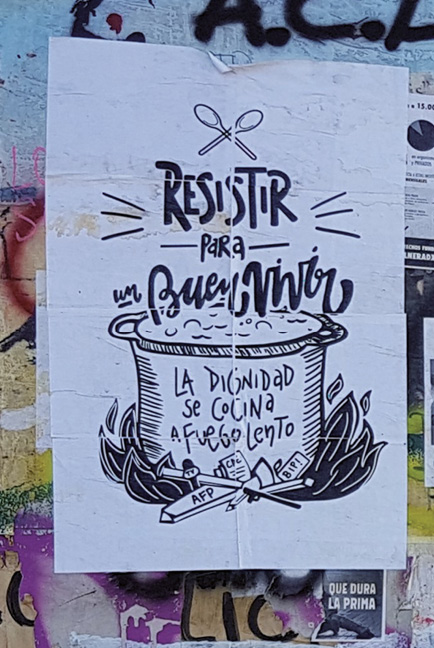
Formed in early 2015 the Feminist Brigade aims to make feminist and gender-based struggles visible in public spaces. The group collaborates with a network across Chile and Abya Yala (an indigenous term for Latin America, used by the Brigade in their statements), making explicit connections between feminists, Indigenous and anti-colonial struggles in Chile and the continent (Bridaga de Propaganda Feminista 2020; Gordon-Zolov and Zolov 2022). The Brigade produced this poster in the aftermath of 18 October 2019. Initially they meant the piece to be displayed on the International Day for the Elimination of Violence against Women (25 November). However, since the demonstrations brought several weeks of curfew and suspension of normal work activities, the Brigade redirected their creative forces to produce an image that would represent the energy of the Estallido and spread it across the city.
In the Brigade’s own account, “[t]he state imposed fear, isolation, control and repression on us. We responded with joy, subversion, and propaganda. Feminism has given us an essential tool, which is the politicization and contestation of all the spaces we inhabit” 9 (Brigada de Propaganda Feminista 2020, 43). This feminist politicization results from reclaiming space, private and public. The Brigade’s artivism during the Estallido defied the status quo and illustrated the connection of bodies (in and through practices that sustain bodies, like cooking) with the struggles taking place in public spaces. Indeed, their artivism conveys the body/territory nexus, which enables them to reclaim the city through advocacy for an alternative form of living, with dignity at its core.
In the poster, the private practice of cooking rests on the burning of intersecting inequalities (regarding education, mobility, and pensions), as embedded in public institutions that normalize an order that needs to be resisted and changed. The fire on which the cauldron boils is burning from the components that make life precarious in Chile: privatized pensions; privatized expensive networks of mobility; high education debts; and an elite-coopted media. The cauldron itself connects the private practice of cooking (frequently gendered, and often racialized in domestic work) with the revolt’s public demands. The large size of cauldron evokes popular experiences of the community kitchens. The poster mobilizes cooking as a practice that sustains bodies and territories: it presents domestic and care work as a practice that not only sustains bodies, but also sustains public-making claims for a dignified life in and through public spaces. As the Brigade (2020, 45) recognizes:
We know that this process of conquering our rights is slow and is being cooked for everyone. It reminds us that 18 October was the beginning of a road, and it is by no means closed. We need patience, confidence and organization to confront the onslaught of capital, the state and the parties of the order. The graphic elements of this poster are linked to a feminist memory. Like our ancestors, we cook in a pot that can always feed more mouths.10
The poster’s text emphasizes the collective work of resistance, connecting the protests in the streets of Santiago with other demands across the continent for a good and dignified life. The Brigade takes the indigenous notion of Buen Vivir (“living well”) as the aspiration leading the resistance. Buen Vivir is the Spanish translation of the Quechua and Aymara notions of sumak kauwsay and sumak qmaña, respectively. However, as Fernando Huanacuna Mamani notes, this translation is misleading because it conceals the broader network of life that underpins Indigenous cosmologies (CAOI 2010). In this sense, buen vivir refers to a larger form of “life in plenitude,” a life in balance and harmony with all that exists, human and non-human. This includes the territory that every living being, and body inhabits, as the concept of cuerpo/territorio underlines.
The Brigade’s graphic also touches on contestation over the messages that are deemed appropriate for, and that can also appropriate, public spaces. The Buen Vivir cauldron reflects both the multiplicity of demands that underpinned the social protests of the Estallido and the continuum between bodies and the territorialities that they contest in public spaces. By promoting feminist, Indigenous and broad social justice agendas, the poster reflects the interplay between intersectionality and inequality, as well as the necessity to situate this interplay in the bodies and territories that endure these sufferings.
The Brigade placed this poster in various locations across the city, especially high frequency around Plaza Italia. The image on this photo was placed on the south side of Avenida Providencia, to the north of Plaza Italia. Today traces of the graphic outburst of street art during the Estallido are hard to find. Under the guise of urban improvement and beautification of the city center after the protest and the pandemic, the authorities in the central districts of the city erased most of the graphics done during the revolt. The Brigade (2020, 47-48) already warned about this risk of “blanqueamiento”, or “whitening” of the walls in public spaces:
The exercise of ‘whitening’ is not new. Since colonization we know that white is the ‘correct’ colour, the one that does not bother, the desirable one. The racial policy painted on the walls of our cities. ‘Whitening’ is an exercise of forgetting, as an exercise to make [difference] invisible.11
Interestingly, the Brigade illustrates how the “whitening” of bodies in a society where indigenous demands are often criminalized and marginalized, correlates with the “whitening” of the walls after the revolt. Both reflect forms of slow violence that criminalizes, silences and aims to forget voices and demands that are permanently othered in Chile – and which underpinned the Estallido. These “whitening” strategies of silencing the walls of the city followed an open and acute process of violent confrontation between protesters and the police during the revolt, which also had an aesthetic repercussion, as the next vignette illustrates.
The motto in our second vignette encapsulates several aspects of inequality in the country. Multiple tags on the walls during the revolt reflected material dimensions of intersecting inequalities (precarious labour, private pensions, private education credits, eco-cides around industrial zones, human rights abuses, femicides, among others) as well as their symbolic violent correlations (fear, injustice, abuse, corruption) (Quiroga and Pasten 2020, 14). Likewise, the motto in this image illustrates both acute vulnerabilities and symbolic inequalities (Fig. 2):
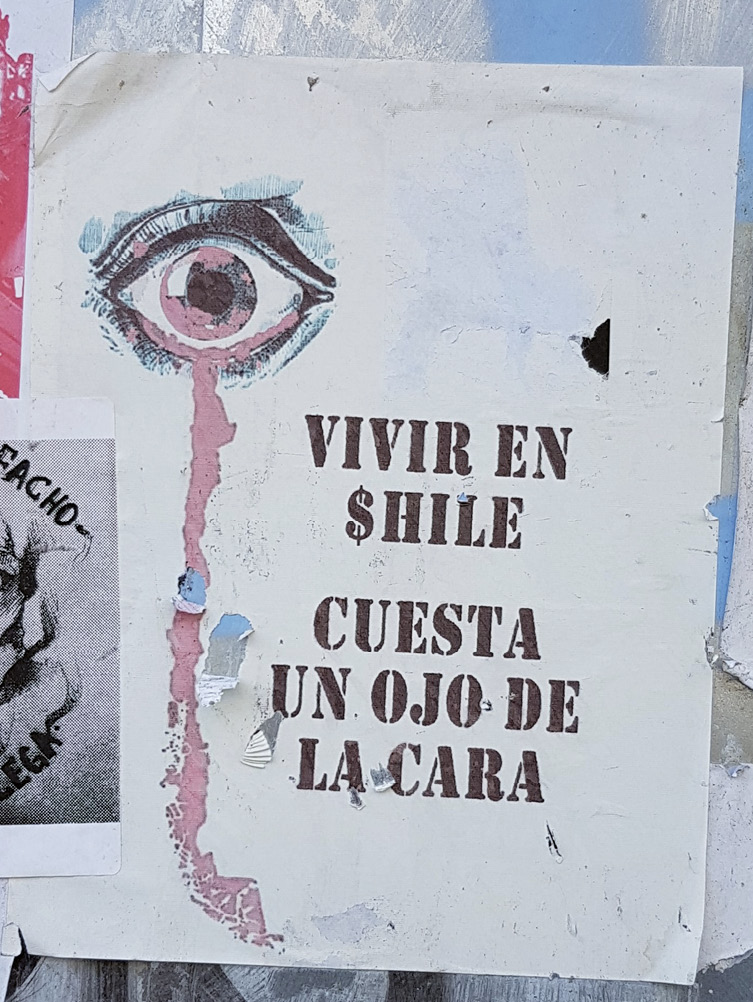
Here exchanging the C in the name of the country for the $ sign is particularly telling. The $ is not only a material reference to the high levels of socio-economic inequalities in the country, but also a phonetic reference to an informal border-making practice derived from the way that the name of the country is pronounced. Among Chileans the distinction Ch or Sh indicates social class and educational background, the latter pronunciation being associated with popular and working classes.
“The price of living in $hile is one of your eyes” also makes explicit reference to the violent repression of the demonstrations from day one of the Estallido. The image highlights a crying eye whose tear, in red, becomes the map of Chile. This merger of the blood-afflicted eye and tear with the national territory makes a visually explicit intersection of body and territory The body (through the eyes) and the territory (through the map) are presented as interrelated victims of structural violence, both systemic (from multiple inequalities of “living in $hile”) and contingent (from violent police repression during the revolt).
As I have discussed elsewhere in relation to a different image (Vicherat Mattar 2024), the crying eye can be interpreted both by what it sees in the territory and what it experiences in the body. The visual grammar of this poster reflects systematic abuses against protestors during the Estallido, including eye injuries and ocular mutilations, as well as torture and sexual violence in police detention centers, as described by the National Institute of Human Rights (2020) and Human Rights Watch (2020), with 445 registered cases of ocular damage during the weeks of the revolt. The HRW places these abuses in a broader context of structural violence upon disobedient bodies and territories: those protesting in public spaces during the Estallido; and those experiencing intersecting forms of discrimination and exclusion, mostly women, Indigenous peoples, migrants, and children.
The poster evokes bodies resisting in territories at different scales: from those protesting against extractive and agro-industrial systems of production that generate sacrificial zones across the country, to those occupying public spaces in peaceful demonstrations, to those engaging in violent confrontations with the police. The latter ones were self-defined as primera línea (“front line”) of confrontation with the police, included the presence of many women. Echoing Barbara Sutton’s (2007) idea of poner el cuerpo (“to put the body on the line”), women’s presence was a performative and political act, affirming their bodies as both vulnerable and empowered: vulnerable in-as-much as they are exposed to the violence of repression; empowered in-as-much as asserting that to fight structural violence is also to fight gender violence. In this vignette, material territorialities of the country and the locality converge with the symbolic territory of street art as a site of where the battle for imagination takes place, a battle for the public-making imaginaries that define what matters in the city, and for whom.
In her testimony, María Grandejan describes the violent disciplining of disobedient bodies during the protest as a silencing strategy: “What happened to me on 18 October reminded me vehemently of the command that I must not talk back, that ‘you must not be brazen’”12 (2020, 30). She connects this silencing by police brutal shooting protesters in the face to her previous intimate experience of domestic violence. In both cases, public and private experiences, she asks, “Why does someone allow themselves to violate the territorial boundary, the body of another –my body– by attacking it like this?” (2020, 30)13. In her testimony, the violence inflicted upon the body is a reflection of the violence inflicted upon the territory, where body and territory are intersecting battlefields where normalizing forces push to discipline disobedience, aiming to repress what is deemed to be inappropriate behaviour against the established order (in particular regarding gendered intimate relations, and civic behaviour in public spaces).
The heat of the revolt and police violence lasted for about a month. During that time, the authorities read the movement in a securitizing cue. They justified violent police repression by the supposed need to secure “public order”, without recognizing that the protesters questioned the normative underpinnings of that order (Mayol 2019). By November 15, a cross-party agreement was signed in the national congress to end the crisis: the Acuerdo por la Paz Social y la Nueva Constitución (Agreement for Social Peace and the New Constitution) (BCN 2019). This accord paved the way for two attempts to rewrite the Chilean constitution, as a first step to address the demands of the Estallido. Both attempts failed, and to this day the constitution remains being the one established during Pinochet’s dictatorship. Meanwhile the “whitening” of the walls progressed, as did the demobilization of protestors, the criminalization of the Estallido, its memory, and the progressive forgetting of the demands it put forward. Indeed, five years on few of the protester’s demands have been met, and cases of public corruption and institutional abuse proliferate across the country. Given this persistent inequality, the open question is whether another Estallido Social would happen again.
In their analysis of the graphic saturation of street art in downtown Santiago during four days in November 2019, Quiroga and Pasten (2020) identify four narrative clusters: No+ (abuses), dignity, repression, and resistance. They argue that these four clusters reflect two broad themes: one that emphasizes the connection between institutional abuses and state repression; and one that connect demands for a dignified life with popular resistance. The previous section of this essay has used the conceptual lens of body/territory to examine two vignettes that illustrate these two broad thematic lines in relation to the multiple inequalities denounced during the Chilean Estallido. The first vignette connects the demand for a dignified life with popular resistance – namely, when evoking a Buen Vivir cauldron boiling over the burning institutions of an unequal prevailing order (image 1). The second vignette connects a critique of abuses and inequalities in $hile with police repression, in particular the high number of ocular injuries (Image 2). In both vignettes, intersecting inequalities (especially based on class, gender, nationality) take form in the embodied experiences, and situated territories, where the Estallido unfolded.
To conclude, the ideas in this essay may be synthesized in four main points: a theoretical, a methodological, a empirical, and a political one. Together, these four claims expand our understanding of the democratic potential of public spaces in times of contestation and revolt.
Theoretically, this article’s analysis of street art vignettes has shown that combining the notions of body/territory and intersectionality enriches our understanding of persistent inequalities in Chile. While intersectionality points out the interconnection of different identity markers in the social reproduction of exclusion and marginalization, body/territory situates these intersections in concrete experiences of the bodies and territories involved. The multiple demands and claims presented in the two vignettes express the embodied experiences of intersecting inequalities, abuse and institutional violence and forms of collective healing that strive for a dignified life. Both vignettes show how –in struggles for public-making in public spaces– street artivism serves to connect private and public demands through bodies and territories.
Methodologically, this article has used the idea of body/territory as a descriptive and analytical tool to read the claims about intersecting inequalities that were expressed in street art during the Estallido. The vignettes illustrate a struggle for public-making taking place on the walls of Santiago. These, and many other aesthetic manifestations, reflect not only the multiplicity of demands being voiced by the protesters, but also the creative and affective potential of these forms of dissent and artivism. The vignettes illustrate how images were used in the protest to express how social inequality is necessarily embodied: in terms of class and gender as the testimony of María illustrates; or in terms of gender, class, and nationality, as the claims of the Feminist Brigade convey. At the same time as being embodied, the inequalities are also located in territories, both of Chile as a country and the streets of Santiago as a locality. Hence, the concept body/territory makes visible the intersection of bodies, territories, and inequalities in the private and the public realms, as well as in the individual and collective engagements of people claiming their right to be present in public spaces.
Empirically, this article has connected the intersection of inequalities that motivated the Estallido with the intersection of bodies and territories in the dispute for public spaces. I have suggested that the notion of body/territory strengthens our understanding of the intersectional character of inequality and how this combination of forces manifests concretely in the mass uprising during the Chilean Estallido. This empirical analysis could be taken to other sites of protest that occurred around the same time across the world, from Ecuador to Lebanon to Hong Kong. Body/territory helps to counteract the abstraction of intersectionality. It also helps to resist narratives that aim to demonise these revolts by criminalizing protest, shrinking the civic space of the right to demostrate, demobilizing collective action by beautifying public spaces and “whitening” their walls. The idea of body/territory reinforces the connection between bodily experiences of inequality, their intersectional character, and situatedness in the territories in which they take place and are expressed.
This leads to a final political argument: namely, that the notion of body/territory furthers our understanding of the democratic potential of public spaces. The aesthetic forms of collective protest during the Estallido, of which the above vignettes are just a sample, illustrate the connection between bodies and territories both in experiencing and denouncing inequality (vignette 2), and in imagining alternatives to it (vignette 1). The intersection of body and territory is thereby distinctly political in its capacity to put forward alternative imaginaries of public-making. For example, when the Feminist Brigade or María Grandjean describe their struggles for the recognition of gender rights and bodily autonomy, their claims over the (individual) body are connected to (collective) territorial relations. In this sense, the notion of body/territory refers to a continuum that is politically more than the sum of the parts (particular bodies or territories). As such, body/territory is an idea that can serve to expand our imagination on the democratic potential of public life in public spaces. For example, during the Chilean Estallido, alongside the massive demonstrations and confrontation with police, there were also large numbers of self-organized citizen assemblies across the country. Over two million citizens participated in these assemblies, producing insights for local governance through horizonal and participatory public-making practices. The expectation was that these exercises would help move beyond the crisis that led to the revolt. The assemblies, too, were a confluence of bodies and territories, addressing intersectional demands for social justice.
Today, five years after the Estallido, the memory of what happened in public spaces like Plaza Italia and the walls that surround it, remain an open dispute in Chile. The struggle has moved from the materiality of the streets and walls during the Estallido to a symbolic debate about how to remember what happened in October 2019. If mourning and grieving are experiences that afford the body an unavoidable public dimension (Butler 2004), then even particular struggles in public spaces have a universalizing potential. Here I mean not a liberal form of abstract universalism, but rather a universality derived from relationality and difference, something advanced in part by the concept of intersectionality. By furthermore grounding this relationality and difference in bodies and territories we can expand the political dimensions of intersectionality, the democratic potential of public spaces, the ongoing struggles for public memory, and overall, the possibilities for dignified forms of life.
Biblioteca del Congreso Nacional (BCN). 2019. “Acuerdo Por la Paz Social y la Nueva Constitución.” https://www.bcn.cl/procesoconstituyente/detalle_cronograma?id=f_cronograma-1 (accessed October 15, 2024).
Brigada de Propaganda Feminista. 2020. “Los trazos gráficos de la revuelta: la resistencia de las calles.” In Escritoras Feministas de la Revuelta, edited by Olga Grau, Luna Follegati, and Silvia Aguilera, 41-48. LOM.
Butler, Judith. 2004. Precarious Life: The Power of Mourning and Violence. Verso.
Cabnal, Lorena. 2017. “Especial: Territorio, Cuerpo, Tierra.” YouTube. https://www.youtube.com/watch?v=6uUI-xWdSAk (accessed October 24, 2024).
Cáceres, Berta. 2015. “Despertemos Humanidad.” Youtube. https://www.youtube.com/watch?v=AR1kwx8b0ms&t=3s (accessed September 24, 2024).
Candia Cid, Jessica, José Meriono Escobar, Claudia Bustos, and David Martínez. 2021. “Inequality and Social Polarization in Chilean Municipalities.” CEPAL Review 133: 155-171. https://doi.org/10.18356/16840348-2021-133-8.
Huanacuni Mamani, Fernando. 2010. Buen Vivir / Vivir Bien. Filosofía, políticas, estrategias y experiencias regionales andinas. Coordinadora Andina de Organizaciones Indígenas (CAOI).
De Fina González, Debora. 2021. “A Rapist in Your Path.” Feminist Studies 47, no. 3: 594-598. https://doi.org/10.2307/48678393.
Dorlin, Elsa. 2009. Sexo, género y sexualidades. Introducción a la teoría feminista. Nueva Visión.
Fuentes, Luis, Oscar Mac-Clure, Cristóbal Moya, and Camilo Olivos. 2017. “Santiago Chile: City of Cities? Social Inequalities in Local Labour Market Zones.” CEPAL Review121: 87-102. https://doi.org/10.18356/ac128476-en.
González Migliaro, Alicia, Dina García Mazariegos, Lorena Rodríguez Lezica, and Juliana Díaz Lozano. 2022. “Intersectionalities in the Body-Territory.” In Bodies, Territories, and Feminisms: Latin America Compilation of Political Practices, Theories, and Methodologies, edited by Diana Cruz, Manuel Bayón Jimenez, and Colectivo Miradas Críticas del Territorio desde el Feminismo. Ibidem-Verlag.
Gordon-Zolov, Terri, and Eric Zolov. 2022. The Walls of Santiago: Social Revolution and Political Aesthetics in Contemporary Chile. Berghahn.
Grandjean, María Paz. 2020. “Descripción de un cuerpo agredido.” In Escritoras Feministas de la Revuelta, edited by Olga Grau, Luna Follegati, and Silvia Aguilera. OM.
Guzmán, Nohely. 2024. “‘Esta Carretera Nos Atraviesa’: Roadbuilding and Mapping the Cuerpo-Territorio of Amazonian Indigenous Girls in Bolivia.” Gender, Place & Culture (April): 1-24. https://doi.org/10.1080/0966369X.2024.2338391.
Hill Collins, Patricia. 2021. “Intersectionality, Epistemic Oppression and Resistance: An Interview with Patricia Hill Collins.” Trabalhos em Linguística Aplicada 60, no. 1. https://doi.org/10.1590/010318139560811520210310.
Hill Collins, Patricia, and Sirma Bilge. 2016. Intersectionality. Polity Press.
Human Rights Watch. 2020. “Chile: Events of 2019.” In Human Rights Watch World Report 2020. https://www.hrw.org/world-report/2020/country-chapters/chile (accessed December 15, 2023).
Mayol, Alberto. 2019. Big Bang. Estallido Social 2019: Modelo Derrumbado-Sociedad Rota-Política Inútil. Catalonia.
Moreno Alba, Felipe, Óscar Figueroa, and Carole Guron. 2021. “Desigualdades urbanas: costos y tiempos de viaje en el área metropolitana de Santiago.” Revista INVI 36, no. 102. https://doi.org/10.4067/S0718-83582021000200054
Quiroga, Darío, and Julio Pasten. 2020. Alienígenas. El Estallido Social en los Muros. Ocho Libros.
Radio Bío Bío. 2019. “Plaza Italia reúne 1.2 millones de personas y se convierte en la mayor marcha en 30 años.” https://www.biobiochile.cl/noticias/nacional/region-metropolitana/2019/10/25/comienzan-a-concentrarse-manifestantes-en-plaza-italia-para-la-marcha-mas-grande-de-chile.shtml (accessed October 24, 2024).
Ramírez Salgado, Amira. 2024. “The Body as Territory: A Movement Perspective.” Studies in Theatre and Performance 44, no. 1: 201-217. https://doi.org/10.1080/14682761.2024.2342716.
Salazar, Gabriel. 2019. “El ‘reventón social’ en Chile: Una mirada histórica.” Nueva Sociedad. https://nuso.org/articulo/protestas-Chile-estudiantes-neoliberalismo/ (accessed October 24, 2024).
Silva Cuadra, Germán. 2024. “Chile país amnésico: la tercera ola.” El Mostrador, May 13. https://www.elmostrador.cl/noticias/opinion/2024/05/13/chile-pais-amnesico-la-tercera-ola/ (accessed November 29, 2024).
Stutton, Bárbara. 2007. “Poner el Cuerpo: Women’s Embodiment and Political Resistance in Argentina.” Latin American Politics and Society 49, no. 3: 129-162. https://www.jstor.org/stable/30130813
Vicherat Mattar, Daniela. 2020. “Public Space as a Border Space: Social Contention and Street Art in Santiago Post-18/O.” FRAME 33, no. 1: 31-47. https://www.frameliteraryjournal.com/33-1-urban-studies/1491/ (accessed October 24, 2024).
Vicherat Mattar, Daniela. 2024. “Public Spaces, Street Art, and the Challenges of Feminist Ecological Citizenship in Chile.” Gender & Development 32, no. 1-2: 71-91. https://doi.org/10.1080/13552074.2024.2348390.
Viveiros Vigoya, Marta. 2016. “La interseccionalidad: una aproximación situada a la dominación.” Debate Feminista 52: 1-17. https://doi.org/10.1016/j.df.2016.09.005.
Zaragocin, Sofía, and Martina Caretta. 2020. “Cuerpo-Territorio: A Decolonial Feminist Geographical Method for the Study of Embodiment.” Annals of the American Association of Geographers 111, no. 5): 1-16. https://doi.org/10.1080/24694452.2020.1812370.
Manuscript received: 28.03.2025
Revised manuscript: 27.11.2025
Manuscript accepted: 16.03.2026
1 “My body, that is my territory, my nation, so to speak, has deserved to be attacked, it has been punished so I learn to shut up and show respect”. In this and all future references to slogans, testimonies and quotes originally in Spanish, the translations have been done by me.
2 “It is not 30 pesos, it’s 30 years.”
3 “To resist for a good living. Dignity is cooked over low fire.”
4 “The price of living in $hile is one of your eyes.”
5 Spanish in the original, and epigraph of this essay: “Mi cuerpo, que es mi territorio, mi nación, por así decirlo, ha merecido ser agredido, ha debido ser castigado para que aprenda a callarme y a mostrar respeto.”
6 Spanish in the original: “Descripción de un cuerpo agredido.”
7 Both dimensions are further discussed in the visual analysis of the second vignette (image 2), Vivir en $hile cuesta un ojo de la cara.
8 In Santiago, the estimated monthly expenditure of public transport is on average $33.200 (€42 approx.). In a context where roughly half of the population live on a minimum wage (around $301.000, that is €376 approx.), the rise of $30 (€0,04 approx.) was a high increase in the life cost (Castiglioni 2019). For further discussion on the extent of the country inequalities and current indignation see the works of Mayol (2019) and Zalazar (2019).
9 Spanish in the original: “El estado nos impuso miedo, aislamiento, control y represión. Nosotras respondimos con alegría, subversión y propaganda. El feminismo nos ha entregado una herramienta fundamental, que es la politización y disputa de todos los espacios que habitamos.”
10 Spanish in the original: “Sabemos que este proceso de conquista de nuestros derechos es lento y se cocina para todxs. Nos recuerda que el 18 de octubre comienza un camino y que de ninguna manera está cerrado. Necesitamos paciencia, confianza y organización para enfrentar los embates del capital, el Estado y los partidos del orden. Los elementos gráficos de este afiche se vinculan a una memoria feminista. Como nuestras ancestras, cocinamos en una olla que siempre puede alcanzar para más bocas.”
11 Spanish in the original: “El ejercicio de “blanqueamineto” no es nuevo, desde la colonización que sabemos que el blanco es el color “correcto”, el que no molesta, el deseable. Su política racial hoy pintada en los muros de nuestra ciudad. El “blanqueamieto” como ejercicio de desmemoria, como ejercicio de invisibilización.”
12 Spanish in the original: “[l]o que me pasó el 18 de octubre me recordó con vehemencia el mandato de que no debo contestar, que “no hay que ser contestadora.”
13 Spanish in the original: “¿Por qué alguien se permite violar el límite territorial, el cuerpo del otro –el mio– agrediendolo así?”